
[論文レビュー] Gaia Data Release 3. Astrometric binary star processing
本論文は、ガリレオデータリリース3(Gaia DR3)に含まれる410万件の二重星候補の位置星処理を報告しており、加速度、軌道、可変性誘発移動(VIM)モデルを用いて未解像化された二重星を検出・特徴づける。33万8215件の加速度解、16万5500件の軌道解、869件のVIM解が同定され、従来の調査をはるかに超える位置星二重星カタログの拡張がなされ、二重星系の統計的分析が可能になった。
Context.The Gaia Early Data Release 3 contained the positions, parallaxes and proper motions of 1.5 billion sources, among which some did not fit well the "single star" model. Binarity is one of the causes of this. Aims. Four million of these stars were selected and various models were tested to detect binary stars and to derive their parameters. Methods. A preliminary treatment was used to discard the partially resolved double stars and to correct the transits for perspective acceleration. It was then investigated whether the measurements fit well with an acceleration model with or without jerk. The orbital model was tried when the fit of any acceleration model was beyond our acceptance criteria. A Variability-Induced Mover (VIM) model was also tried when the star was photometrically variable. A final selection has been made in order to keep only solutions that probably correspond to the real nature of the stars. Results. At the end, 338,215 acceleration solutions, about 165,500 orbital solutions and 869 VIM solutions were retained. In addition, formulae for calculating the uncertainties of the Campbell orbital elements from orbital solutions expressed in Thiele-Innes elements are given in an appendix.
研究の動機と目的
- 複数モデル適合を用いてGaia DR3における未解像化された位置星二重星を検出・特徴づけること。
- 光度および位置星的フィルタリング基準を用いて部分的に解像された二重星からの汚染を低減すること。
- 加速度、軌道、可変性誘発運動モデルの区別が可能な堅牢な選択パイプラインの開発。
- 二重星集団の統計的調査に耐えうる信頼性の高い位置星解の提供。
- スチュール・オルビタル要素から導かれるセイム・オルビタル要素の不確実性式の提供。
提案手法
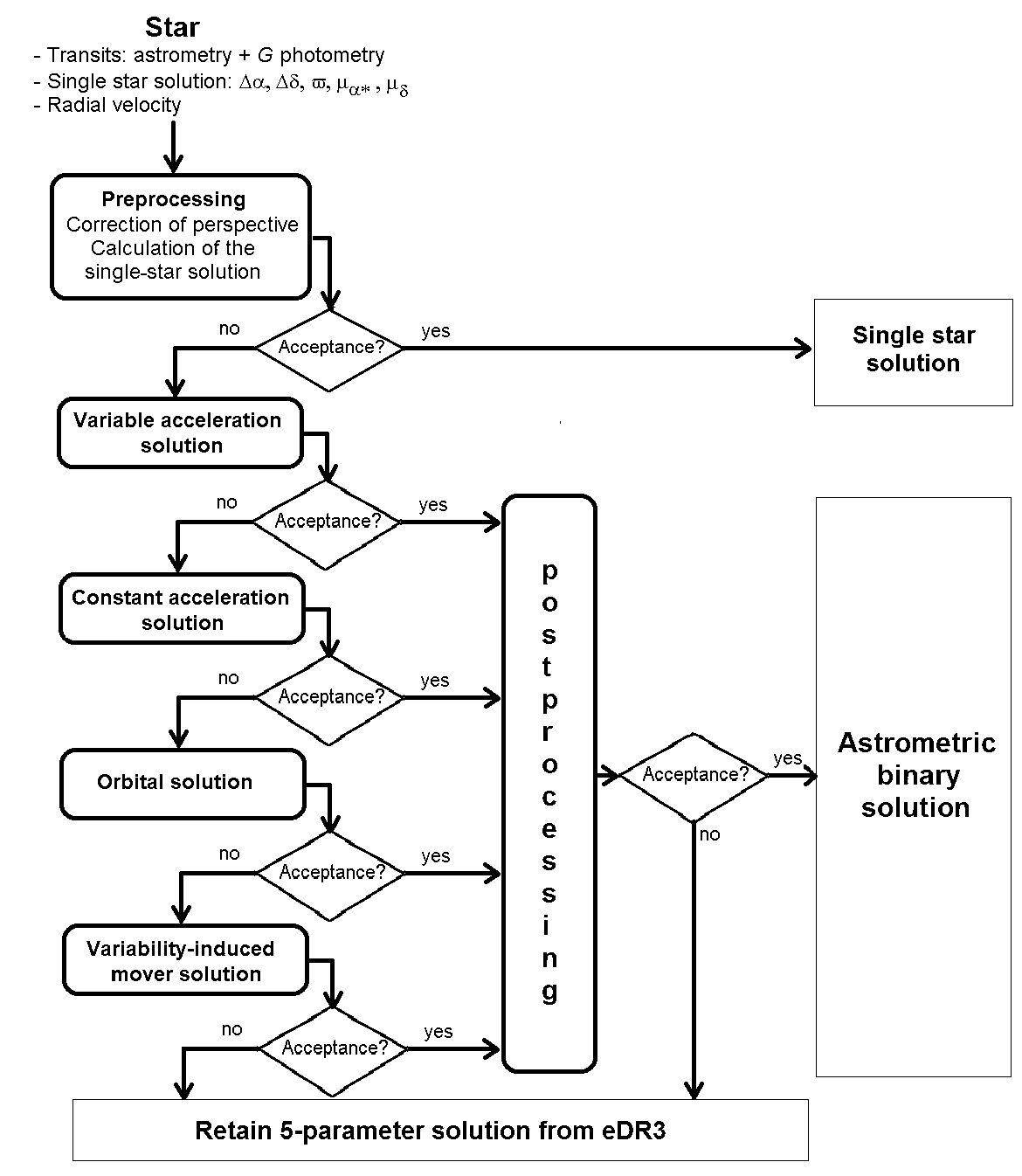
- 最初に、IPDベースの指標($ipd\_frac\_multi\_peak \leq 2$、$ipd\_gof\_harmonic\_amplitude < 0.1$)を用いて部分的に解像された二重星をフィルタリングした。
- 光度的フラックス過剰係数$C^{*}$を用いて$G$バンドの異常な明るさ行動を示す星を除外し、90%信頼度のために$|C^{*}| < 1.645\sigma_{C^{*}}$を適用した。
- 加速度モデルのテストを最初に実施し、加速度適合が受容基準を超えた場合にのみ軌道モデルを適用した。
- 可変性誘発移動(VIM)モデルは、1つの主要成分を持つ光度可変星にのみ適用した。
- 解の妥当性は、光重心と可変成分間の中央距離を用いて検証され、誤検出を低減するための高い$F_2$閾値が使用された。
- セイム・オルビタル要素の不確実性は、別途付録に提示された解析的公式を用いて、チル・インネス要素から導出された。
実験結果
リサーチクエスチョン
- RQ1高RUWE値かつ長い観測基準期間を持つGaia DR3の星のうち、単一星運動ではなく位置星的加速度で最もよく説明される割合はどの程度か?
- RQ2光度およびIPDベースの基準は、二重星モデリングの前段階で部分的に解像された二重星を効果的にフィルタリングできるか?
- RQ3加速度、軌道、VIMモデルの相対的な性能および信頼性は、未解像化された二重星の検出においてどの程度か?
- RQ4VIMモデルは、1つの光度可変成分を持つ系をどの程度正確に回復できるか?
- RQ5選択閾値およびモデル受容基準は、最終的な二重星カタログの完全性と純度にどのように影響を与えるか?
主な発見
- 最終カタログには、33万8215件の加速度解、16万5500件の軌道解、869件のVIM解が含まれており、これは従来の位置星二重星カタログをはるかに上回る大幅な拡張を示している。
- フィルタリングパイプラインにより、初期の3650万件の候補から、IPDおよび$C^{*}$ベースの選択基準を適用して411万5743件に削減された。
- VIM解は稀(869件)であり、固定成分モデルに限られ、処理の後段階で適用されたため、おそらく未検出に近い状態である。
- 高い$F_2$閾値と受容テストにおける$c$係数により、2つの可変成分を持つVIMF解が効果的に抑制され、汚染が低減された。
- 統計的チェックにより、汚染は最小限に抑えられていることが確認された:加速度解には固有運動における軌道運動の兆候がなく、VIM解には90°の傾きを持つ軌道解が生成されていない。
- 付録では、チル・インネス要素からセイム・オルビタル要素の不確実性を計算する解析的公式が提供されており、一貫性のある誤差伝搬が可能になった。
より良い研究を、今すぐ始めましょう
論文の読解から最終レビューまで、研究時間を劇的に削減しましょう。
クレジットカード登録不要
このレビューはAIが作成し、人間の編集者が確認しました。