
[論文レビュー] Gecko: Versatile Text Embeddings Distilled from Large Language Models
Geckoは、LLMsからの二段階データ蒸留(FRet)を通じて蒸留されたコンパクトなテキスト埋め込みモデルで、小さな次元と競争力のあるモデルサイズを維持しつつ、MTEBベンチマークで多用途な埋め込みを生み出します。
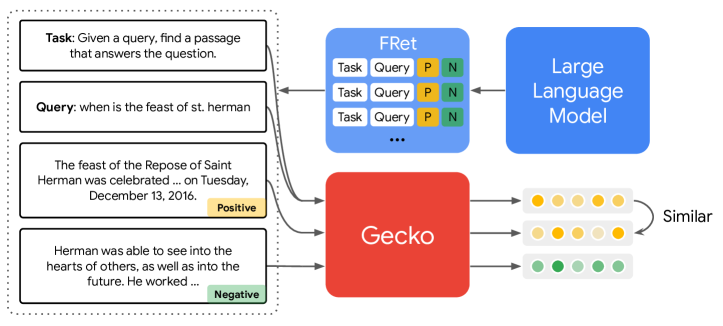
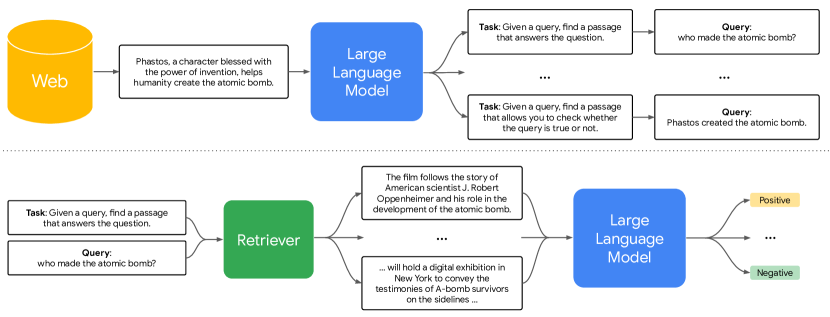
We present Gecko, a compact and versatile text embedding model. Gecko achieves strong retrieval performance by leveraging a key idea: distilling knowledge from large language models (LLMs) into a retriever. Our two-step distillation process begins with generating diverse, synthetic paired data using an LLM. Next, we further refine the data quality by retrieving a set of candidate passages for each query, and relabeling the positive and hard negative passages using the same LLM. The effectiveness of our approach is demonstrated by the compactness of the Gecko. On the Massive Text Embedding Benchmark (MTEB), Gecko with 256 embedding dimensions outperforms all existing entries with 768 embedding size. Gecko with 768 embedding dimensions achieves an average score of 66.31, competing with 7x larger models and 5x higher dimensional embeddings.
研究の動機と目的
- LLMの知識を活用する汎用的でコンパクトなテキスト埋め込みモデルの作成を動機づける。
- 埋め込みモデルのための多様で高品質な学習データを生成するための二段階のLLM蒸留を開発する。
- 合成的なLRetデータと人間が注釈付けしたデータを組み合わせて、タスクを横断して適用可能な多用途なエンコーダを訓練する。
提案手法
- few-shotで促されたLLMsを用いてウェブ文章のタスク-クエリペアを合成し、FRetデータセットを形成する。
- 生成された各クエリに対して、初期埋め込みモデルを用いて最も近いパッセージを取得し、LLMによる再ラベル付け(LLMベースのランキング)で陽性/陰性を再付与する。
- FRetと学術データセットを統合混合したデータを用いて、in-batchネガティブサンプルおよび同タワー内ネガティブを含む二塔対比学習ObjectiveでGeckoを訓練する。
- 意味的類似性と分類性能を向上させるため、慎重に構築した陽性/陰性を用いた対比学習Objectiveで分類データを組み込む。
- 複数の埋め込み次元(例:256および768)をサポートするため、末端のMRL(混合ランク学習)成分を含むマルチタスク混合損失を使用する。
- 分類、クラスタリング、ペア分類、再ランキング、検索、STS、要約といったタスクを横断してMTEBで評価し、平均パフォーマンスを報告する。
実験結果
リサーチクエスチョン
- RQ1LLM生成の合成データとLLMによる再ラベリングは、さまざまなタスクにおいてゼロショットおよび少数ショットのテキスト埋め込み性能を向上させられるか?
- RQ2LLM生成データ(FRet)と人手注釈データの組み合わせは、同程度のパラメータを持つベースラインをMTEBで上回る多用途な埋め込みを生み出すか?
- RQ3FRetの多様性とタスクの混成は、多言語・マルチモーダル風の検索タスクへの汎化にどう影響するか?
- RQ4LLMベースの陽性/陰性再ラベリングが検索と意味的類似性ベンチマークに与える影響は何か?
- RQ5コンパクトなGeckoモデル(例:1Bパラメータ、768次元)は、検索とSTSタスクにおいてより大規模な埋め込みシステムに対抗できるか?
主な発見
- Geckoは1.2Bパラメータ、768次元埋め込みでMTEBの平均66.31を達成し、より高次元の多くの大規模モデルを上回る。
- Gecko-1b-256は256次元埋め込みと同等のパラメータ予算で顕著なベースラインを上回る。
- ゼロショットGecko(FRetのみ)はすでに強力なMTEB性能を提供し、いくつかのベースラインに近づくか上回る。
- 陽性(p+)のLLMベース再ラベリングは、シードパッセージと異なり、いくつかのタスクで性能を向上させる。トップLLMランクの陽性を用いる方がシードパッセージより良い結果を生む。
- FRetの多様性と統一フォーマットは下流の性能を大きく向上させ、完全なFRet混合が全体的に最良の結果を達成する。
- Geckoの多言語版(gecko-multilingual-1b)は、英語生成のFRetデータを用いて多言語検索性能が高く、いくつかの多言語ベースラインを上回る。
この論文を読む
Nubintのビューアで原文を開き、読みながら気になる箇所をすぐに質問できます。
Nubintでこの論文を読むこのレビューはAIが論文の原文をもとに作成しました。引用する前に原文をご確認ください。