
[論文レビュー] Generalized contact matrices for epidemic modeling
本稿では、年齢、社会経済的地位(SES)、文脈など複数の次元にわたる人間の相互作用を階層化する一般化された接触行列を導入し、従来の年齢階層モデルを拡張する。本稿では、このようなモデルにおける基本再生産数 $R_0$ の閉形式表現を導出し、多変数階層化は単一変数モデルよりも $R_0 $ 値が等しいか、それ以上であることを証明している。これは、SES を無視した標準的な疫病モデルにおいて、リスクを低く見積もる可能性があることを示している。
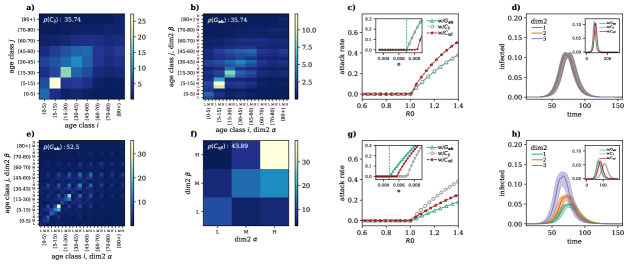
Contact matrices have become a key ingredient of modern epidemic models. They account for the stratification of contacts for the age of individuals and, in some cases, the context of their interactions. However, age and context are not the only factors shaping contact structures and affecting the spreading of infectious diseases. Socio-economic status (SES) variables such as wealth, ethnicity, and education play a major role as well. Here, we introduce generalized contact matrices capable of stratifying contacts across any number of dimensions including any SES variable. We derive an analytical expression for the basic reproductive number of an infectious disease unfolding on a population characterized by such generalized contact matrices. Our results, on both synthetic and real data, show that disregarding higher levels of stratification might lead to the under-estimation of the reproductive number and to a mis-estimation of the global epidemic dynamics. Furthermore, including generalized contact matrices allows for more expressive epidemic models able to capture heterogeneities in behaviours such as different levels of adoption of non-pharmaceutical interventions across different groups. Overall, our work contributes to the literature attempting to bring socio-economic, as well as other dimensions, to the forefront of epidemic modeling. Tackling this issue is crucial for developing more precise descriptions of epidemics, and thus to design better strategies to contain them.
研究の動機と目的
- 接触パターンにおける構造的要因としての社会経済的地位(SES)を無視する既存の疫病モデルの限界に対処すること。
- 任意の数の人口統計的および社会経済的次元を接触行列に組み込むことができる数学的フレームワークの開発。
- 一般化された接触行列を用いたモデルにおける基本再生産数 $R_0$ の閉形式解析的表現の導出。
- 多変数階層化が、単一属性モデル(例:年齢のみ)と比較して $R_0 $ および疫病動態に与える影響の定量的評価。
- 非医療的介入(NPI)のSESグループごとの不均一な導入状況を捉えるモデルの能力の実証。
提案手法
- 年齢やSESなどの複数の階層化次元を1つの多変数接触構造に統合する一般化された接触行列 $G_{\mathbf{a},\mathbf{b}}$ を提唱する。
- 一般化された接触行列によって定義される感染伝播率を備えた、感受性-潜伏期-感染性-回復(SEIR)型の区分モデルを構築する。
- 一般化された接触行列の固有値半径に基づいて、基本再生産数 $R_0$ の閉形式解析的表現を導出する。
- スペクトル理論を用いて、一般化された行列から算出される $R_0 $ が、単一次元行列から算出される $R_0 $ 以上であることを証明する。
- 制御された混合パターン(偏りのある混合対照的 vs. ランダム)と次元ごとの活動レベルの変動を想定した合成データを用いてモデルを検証する。
- ハンガリーのMASZK調査(2021年4月および11月)の実世界の接触データを用いて、標準モデルと一般化モデルとの間での感染率および疫病動態の比較を実施する。

実験結果
リサーチクエスチョン
- RQ1接触行列に社会経済的地位(SES)を階層化次元として組み込むと、$R_0 $ の推定値にどのような影響を与えるか?
- RQ2年齢+SES などの多変数階層化が、年齢のみのモデルと比較して、感染率やピーク有病率などの疫病動態にどの程度影響を与えるか?
- RQ3一般化された接触行列は、異なる人口サブグループ間での非医療的介入(NPI)の不均一な導入状況をよりよく捉えることができるか?
- RQ4一般化された接触行列の固有値半径とその結果得られる $R_0 $ の間の数学的関係は何か?
- RQ5接触パターンの相関(例:偏りのある混合、活動レベルの不均一性)が、多変数モデルにおける $R_0 $ に与える影響は何か?
主な発見
- SES次元を含む一般化された接触行列は、単一次元(例:年齢のみ)モデルよりも常に $R_0 $ 値が等しいか、それ以上となる。偏りのある混合が成立する場合にはその差が大きくなる。
- 3次元(年齢、SES、活動レベル)の合成シナリオにおいて、一般化された行列の固有値半径は2次元モデルよりも高くなり、感染制御の臨界閾値が高くなることを示唆している。
- 固定された $R_0 $ の条件下で、一般化された接触行列を用いたモデルは、標準モデルよりも感染率が低くなる予測を下す。これは、SES を無視した標準モデルが、疫病の規模を過大評価している可能性を示している。
- ハンガリーの接触データ(2021年4月および11月)への実世界応用により、一般化モデルが、標準の年齢のみモデルでは捉えきれないSESグループ間の発症率の格差をよりよく再現していることが確認された。
- 本モデルは、異なるSESレベルのサブグループが同じ政策介入下でも、異なる疫病経路を示すという、不均一なNPI導入パターンを効果的に再現できた。
- 合成的および実世界の両設定において、接触行列にSESを組み込むことで、構造的不平等が感染伝播に与える影響が顕著な場合に、より正確で包括的な疫病予測が可能になることが示された。
この論文を読む
Nubintのビューアで原文を開き、読みながら気になる箇所をすぐに質問できます。
Nubintでこの論文を読むこのレビューはAIが論文の原文をもとに作成しました。引用する前に原文をご確認ください。