
[論文レビュー] GMS-3DQA: Projection-based Grid Mini-patch Sampling for 3D Model Quality Assessment
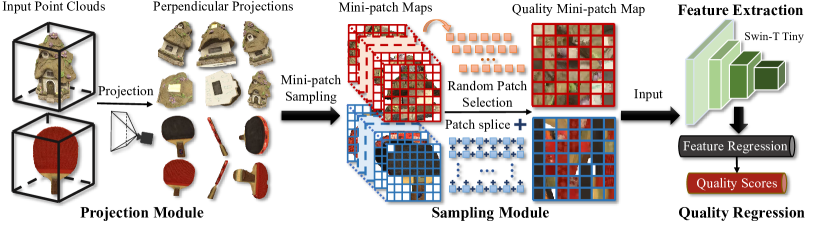
本稿では、計算コストを低減しつつ高い精度を維持するため、マルチプロジェクショングリッドミニパッチサンプリングを用いた、ノーリファレンス3D品質評価手法GMS-3DQAを提案する。6つの直交する投影画像をレンダリングし、それらからミニパッチを抽出して統合した1つの品質ミニパッチマップ(QMM)を生成することで、効率的なSwin-Transformerベースの特徴抽出を可能にし、従来手法よりも3.28倍高速で、パrameter数も少ない状態で最先端の性能を達成した。
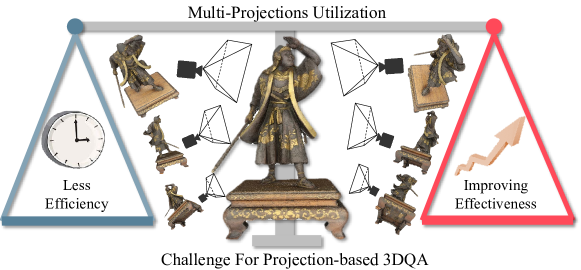
Nowadays, most 3D model quality assessment (3DQA) methods have been aimed at improving performance. However, little attention has been paid to the computational cost and inference time required for practical applications. Model-based 3DQA methods extract features directly from the 3D models, which are characterized by their high degree of complexity. As a result, many researchers are inclined towards utilizing projection-based 3DQA methods. Nevertheless, previous projection-based 3DQA methods directly extract features from multi-projections to ensure quality prediction accuracy, which calls for more resource consumption and inevitably leads to inefficiency. Thus in this paper, we address this challenge by proposing a no-reference (NR) projection-based extit{\underline{G}rid \underline{M}ini-patch \underline{S}ampling \underline{3D} Model \underline{Q}uality \underline{A}ssessment (GMS-3DQA)} method. The projection images are rendered from six perpendicular viewpoints of the 3D model to cover sufficient quality information. To reduce redundancy and inference resources, we propose a multi-projection grid mini-patch sampling strategy (MP-GMS), which samples grid mini-patches from the multi-projections and forms the sampled grid mini-patches into one quality mini-patch map (QMM). The Swin-Transformer tiny backbone is then used to extract quality-aware features from the QMMs. The experimental results show that the proposed GMS-3DQA outperforms existing state-of-the-art NR-3DQA methods on the point cloud quality assessment databases. The efficiency analysis reveals that the proposed GMS-3DQA requires far less computational resources and inference time than other 3DQA competitors. The code will be available at https://github.com/zzc-1998/GMS-3DQA.
研究の動機と目的
- 既存の投影ベース3D品質評価(3DQA)手法における高い計算コストと長時間の推論時間の問題に対処すること。
- 複数の投影からの特徴抽出における冗長性を低減しつつ、正確な評価に十分な品質情報の保持を図ること。
- 多様な3Dモデルタイプや歪みに対して高い性能を維持する効率的なノーリファレンス3DQAフレームワークの開発。
- ターゲットドメインにおけるラベル付きデータを最小限に抑えた状態でも、効果的なクロスドメイン一般化を可能にすること。
提案手法
- 3Dモデルから6つの直交する投影画像をレンダリングし、幾何的・視覚的品質情報の包括的カバレッジを確保する。
- マルチプロジェクショングリッドミニパッチサンプリング戦略(MP-GMS)を適用して、各投影画像から重複のないミニパッチを抽出する。
- 全6視点からの抽出ミニパッチを統合し、1つの品質ミニパッチマップ(QMM)を作成することで、マルチビュー品質パターンを統合する。
- QMMから階層的で品質に敏感な特徴を抽出するため、Swin-Transformerのティニー版バックボーンを用いる。
- 大規模な3DQAデータベース上でエンドツーエンドに学習し、知覚的に整合した品質表現を学習する。
- 全投影画像を処理するのと比較して、入力トークン数と計算演算量を削減することで、効率性を最適化する。
実験結果
リサーチクエスチョン
- RQ1投影ベース3DQA手法は、計算コストと推論時間を顕著に削減しつつ、高い精度を達成できるか?
- RQ2提案されたグリッドミニパッチサンプリング戦略は、複数の投影入力間の冗長性低減にどの程度効果的か?
- RQ3品質ミニパッチマップ(QMM)は、個々の投影画像を処理する手法と比較して、性能とロバスト性をどの程度向上させるか?
- RQ4提案手法は、ラベル付きデータが限られた状態でも、異なる3Dデータフォーマット(例:点群 vs. メッシュ)に対して十分に一般化できるか?
- RQ5提案手法は、ノーリファレンスおよびフルリファレンスの3DQAベースラインと比較して、精度と効率の両面で優れているか?
主な発見
- GMS-3DQAは、点群とメッシュの両方の品質評価データベースで最先端の性能を達成し、クロスドメイン評価においてSJTUではSRCCが0.75、WPCでは0.60を記録した。
- CPU上での推論速度は、最も速い競合手法と比較して3.28倍高速であり、パrameter数とFLOPsも顕著に少ない。
- SJTU-PCQAおよびWPCデータベースにおいて、それぞれ14および15のノーリファレンス指標と比較して、統計的有意差があるほど優れた性能を示した。
- TMQデータベースで学習したGMS-3DQAは、最良のイントラデータベースモデルと比較して、SJTUではSRCC 0.75、WPCでは0.60という競争力ある性能を示し、強力なドメイン一般化能力を示した。
- PCQAデータベースにおいて、GMS-3DQAはフルリファレンス手法と統計的に差がない結果を示し、高い知覚的正確性を確認した。
- QMMベースのアプローチにより、複数の視点からの品質パターンの統合が可能になり、冗長性が低減され、ロバスト性が向上した。
この論文を読む
Nubintのビューアで原文を開き、読みながら気になる箇所をすぐに質問できます。
Nubintでこの論文を読むこのレビューはAIが論文の原文をもとに作成しました。引用する前に原文をご確認ください。