
[論文レビュー] GraphCare: Enhancing Healthcare Predictions with Personalized Knowledge Graphs
GraphCareはLLMをプローブし生物医療KGsからサンプリングして患者固有の知識グラフを作成し、Bi-attention Augmented (BAT) GNNを用いてMIMIC-III/IVにおける死亡率、再入院、LOS、薬剤推奨の予測精度を向上させる。
Clinical predictive models often rely on patients' electronic health records (EHR), but integrating medical knowledge to enhance predictions and decision-making is challenging. This is because personalized predictions require personalized knowledge graphs (KGs), which are difficult to generate from patient EHR data. To address this, we propose extsc{GraphCare}, an open-world framework that uses external KGs to improve EHR-based predictions. Our method extracts knowledge from large language models (LLMs) and external biomedical KGs to build patient-specific KGs, which are then used to train our proposed Bi-attention AugmenTed (BAT) graph neural network (GNN) for healthcare predictions. On two public datasets, MIMIC-III and MIMIC-IV, extsc{GraphCare} surpasses baselines in four vital healthcare prediction tasks: mortality, readmission, length of stay (LOS), and drug recommendation. On MIMIC-III, it boosts AUROC by 17.6\% and 6.6\% for mortality and readmission, and F1-score by 7.9\% and 10.8\% for LOS and drug recommendation, respectively. Notably, extsc{GraphCare} demonstrates a substantial edge in scenarios with limited data availability. Our findings highlight the potential of using external KGs in healthcare prediction tasks and demonstrate the promise of extsc{GraphCare} in generating personalized KGs for promoting personalized medicine.
研究の動機と目的
- 外部知識を活用して個別化KGsを用いたEHRベース予測を強化する動機づけ。
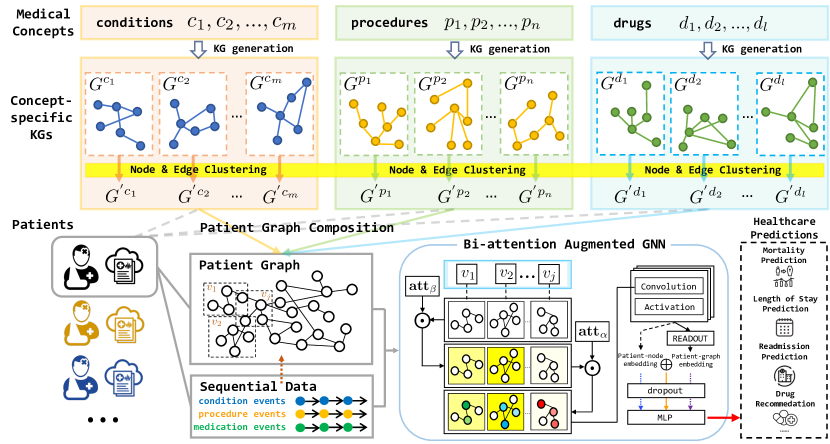
- LLMプロンプトとサブグラフサンプリングによって概念特異的KGsを生成し、患者特異的グラフを構築するFrameworkを提案する。
- Bi-attention Augmented (BAT) GNNを導入し、時系列の患者グラフを用いた臨床タスクを処理する。
提案手法
- 各医療概念の概念特異的KGをLLMプロンプティングと外部KGからのサブグラフサンプリングで生成する。
- 概念KG全体のノード/エッジをクラスタリングして集約概念グラフを形成する。
- 概念KGを患者特異的KGへ統合し、患者の訪問を相互接続されたvisit-subgraphsとして表現する。
- Bi-attention Augmented (BAT) Graph Neural Networkを適用し、ノードレベルおよび訪問レベルの注意機構を備えた時系列患者グラフから学習する。
- 患者表現(グラフ、ノード、結合埋め込み)を計算し、Mortality、Readmission、LOS、または薬剤推奨をMLPヘッドで予測する。
実験結果
リサーチクエスチョン
- RQ1外部知識グラフとLLM由来の関係は、標準ベースラインよりEHRベース予測性能を改善するか。
- RQ2個別化KGsは限られた患者データでもデータ効率の高い学習を可能にするか。
- RQ3BATにおける訪問レベルとノードレベルの注意を統合することは、長期的なEHRデータの予測精度にどう影響するか。
- RQ4KGの規模とソース(GPT生成 vs. UMLS)がGraphCareの性能に与える影響はどの程度か。
主な発見
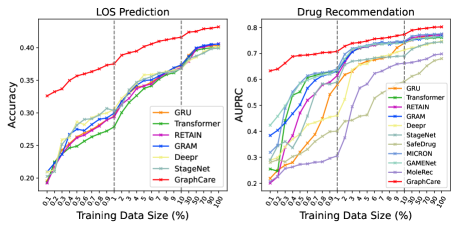
- BATを組み込んだGraphCareは、MIMIC-IIIおよびMIMIC-IVの死亡率、再入院、LOS、薬剤予測タスクにおいて一貫してベースラインを上回る。
- MIMIC-IIIでは、GraphCare with BATは死亡率のAUROCをベースラインより最大で70.3%向上(表2の正確な値を使用)など、他タスクでも同様の改善を示す。
- GraphCareはデータ効率が高く、より小さな訓練データ量で強い性能を発揮する。
- KGの規模が大きい場合やGPT由来とUMLS内容を組み合わせた場合(GPT-UMLS-KG)に性能が向上する。
- BATモジュールは、訪問レベルとノードレベルの両方の注意を取り入れることで、試験したGNNバリアントの中で最良の結果を生む。
この論文を読む
Nubintのビューアで原文を開き、読みながら気になる箇所をすぐに質問できます。
Nubintでこの論文を読むこのレビューはAIが論文の原文をもとに作成しました。引用する前に原文をご確認ください。