
[論文レビュー] Group DETR: Fast DETR Training with Group-Wise One-to-Many Assignment
Group DETRは、1対多の割り当てをグループ単位で行うことでDETRの学習を高速化する。各オブジェクトクエリグループ内で競争的な学習が可能となる一方で、標準的な推論を維持する。この手法はアーキテクチャの変更なしにDETRのさまざまなバリエーションにおいて学習収束性と性能を向上させ、12エポックで最大3.1 mAPの向上を達成し、COCOのtest-devで64.5 mAPを達成した。
Detection transformer (DETR) relies on one-to-one assignment, assigning one ground-truth object to one prediction, for end-to-end detection without NMS post-processing. It is known that one-to-many assignment, assigning one ground-truth object to multiple predictions, succeeds in detection methods such as Faster R-CNN and FCOS. While the naive one-to-many assignment does not work for DETR, and it remains challenging to apply one-to-many assignment for DETR training. In this paper, we introduce Group DETR, a simple yet efficient DETR training approach that introduces a group-wise way for one-to-many assignment. This approach involves using multiple groups of object queries, conducting one-to-one assignment within each group, and performing decoder self-attention separately. It resembles data augmentation with automatically-learned object query augmentation. It is also equivalent to simultaneously training parameter-sharing networks of the same architecture, introducing more supervision and thus improving DETR training. The inference process is the same as DETR trained normally and only needs one group of queries without any architecture modification. Group DETR is versatile and is applicable to various DETR variants. The experiments show that Group DETR significantly speeds up the training convergence and improves the performance of various DETR-based models. Code will be available at \url{https://github.com/Atten4Vis/GroupDETR}.
研究の動機と目的
- 最適化中により多くの監視を導入することで、DETR学習の遅い収束を解決すること。
- 従来のナーバスなアプローチが失敗するため、DETRにおける効果的な1対多割り当てを可能にすること。
- 推論パイプラインやアーキテクチャを変更せずに、学習の安定性と性能を向上させること。
- グループ単位の割り当てが、クエリ拡張を伴うパラメータ共有マルチヘッドネットワークと等価であることを探ること。
- さまざまなDETRバリエーション(Deformable DETR や DINO を含む)に広く適用可能であることを示すこと。
提案手法
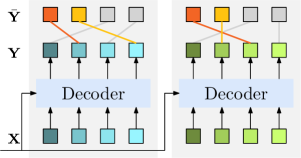
- Group DETRは、K個のオブジェクトクエリグループを用い、それぞれが独立して正例オブジェクトに1対1で割り当てられる。
- 各グループ内で自己注意機構を用いて予測が競争し、正しい割り当てには高いスコア、重複した割り当てには低いスコアが得られるように促進される。
- 自己注意は各グループごとに別々に行われ、グループ間の相互作用が分離され、学習が安定化する。
- この手法は、重みを共有する並列デコーダーを学習するのと同等であり、効果的に監視を増加させる。
- 推論時には、クエリの1つのグループのみが使用されるため、元のDETRアーキテクチャと推論速度が保たれる。
- このアプローチは既存のDETRバリエーションと互換性があり、デノイジングクエリやEMAなどの他の技術と組み合わせられる。
実験結果
リサーチクエスチョン
- RQ1ナーバスな実装が失敗する中で、1対多割り当てをDETR学習に効果的に適用できるか?
- RQ2グループ内での競争を伴うグループ単位の割り当てが、学習収束性とモデル性能を向上させるか?
- RQ3この手法は、アーキテクチャの変更なしにさまざまなDETRバリエーションに普遍的に適用可能か?
- RQ4グループ単位の割り当ては、DN-DETRにおけるデノイジングなどの既存の安定化技術と比べてどうか?
- RQ5改善された学習ダイナミクスは、デコーダーにとどまらずエンコーダーにも好影響を与えるか?
主な発見
- Group DETRは、SAM-DETRに適用した場合、12エポックでCOCO val2017で3.1 mAPの向上を達成した。
- 50エポックで、Group DETRはSAM-DETR++を1.3 mAP向上させ、さまざまな学習スケジュールにおいて一貫した向上を示した。
- ViT-Hugeを用いた場合、COCO test-devで64.5 mAPを達成し、より大きなモデルやより多くの事前学習データを用いたモデルを上回った。
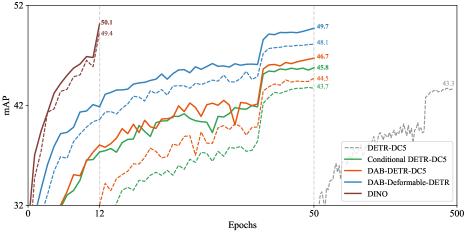
- Group DETRは、COCOでの学習曲線において損失の低下が速いことから、学習収束速度の向上が示された。
- この手法は既存の技術と相乗効果を発揮する:Group DETRとDINOやDN-DETRを組み合わせることで、さらに性能が向上した。
- 実験では、DN-DETRにおけるデノイジングクエリの数を増やすと100クエリを超えると性能向上が止まることが判明したが、Group DETRでは一貫した向上が得られた。
この論文を読む
Nubintのビューアで原文を開き、読みながら気になる箇所をすぐに質問できます。
Nubintでこの論文を読むこのレビューはAIが論文の原文をもとに作成しました。引用する前に原文をご確認ください。