
[論文レビュー] Hardware-efficient ansatz without barren plateaus in any depth
本稿では、任意の回路深さにおいてバーレンプレートを回避する2つの新しいパラメータ初期化条件を、ハードウェア効率的アーキテクチャ(HEA)回路に対して提案する。これにより、システムサイズや接続性にかかわらず一定の勾配大きさが保証される。局所ハミルトニアン下での時間発展演算子や、多体局在化(MBL)相への写像を活用することで、近位量子デバイス上でのHEAの効率的トレーニングが可能となり、勾配消失を回避する。
Variational quantum circuits have recently gained much interest due to their relevance in real-world applications, such as combinatorial optimizations, quantum simulations, and modeling a probability distribution. Despite their huge potential, the practical usefulness of those circuits beyond tens of qubits is largely questioned. One of the major problems is the so-called barren plateaus phenomenon. Quantum circuits with a random structure often have a flat cost-function landscape and thus cannot be trained efficiently. In this paper, we propose two novel parameter conditions in which the hardware-efficient ansatz (HEA) is free from barren plateaus for arbitrary circuit depths. In the first condition, the HEA approximates to a time-evolution operator generated by a local Hamiltonian. Utilizing a recent result by [Park and Killoran, Quantum 8, 1239 (2024)], we prove a constant lower bound of gradient magnitudes in any depth both for local and global observables. On the other hand, the HEA is within the many-body localized (MBL) phase in the second parameter condition. We argue that the HEA in this phase has a large gradient component for a local observable using a phenomenological model for the MBL system. By initializing the parameters of the HEA using these conditions, we show that our findings offer better overall performance in solving many-body Hamiltonians. Our results indicate that barren plateaus are not an issue when initial parameters are smartly chosen, and other factors, such as local minima or the expressivity of the circuit, are more crucial.
研究の動機と目的
- 近位量子ハードウェア上でのトレーニングを妨げるバーレンプレート問題を解決すること。
- 回路深さやキュービット接続性にかかわらず、大きな非ゼロ勾配を保証するパラメータ初期化領域を同定すること。
- バーレンプレートは回路設計ではなく、賢い初期化によって回避可能であることを示すこと。
- 提案手法を量子機械学習および多体ハミルトニアン問題に適用し、ランダム初期化と比較して優れた性能を示すこと。
提案手法
- 最初の手法では、HEAを局所ハミルトニアンによって生成される時間発展演算子に写像し、ParkとKilloran(2024)の最近の結果を用いて、局所的およびグローバルな観測量の両方に対して勾配大きさに下界が一定であることを証明する。
- 2番目の手法では、HEAを多体局在化(MBL)系として解釈し、現象論的MBL理論を用いて、局所観測量に対してMBL相で大きな勾配成分が生じることを議論する。
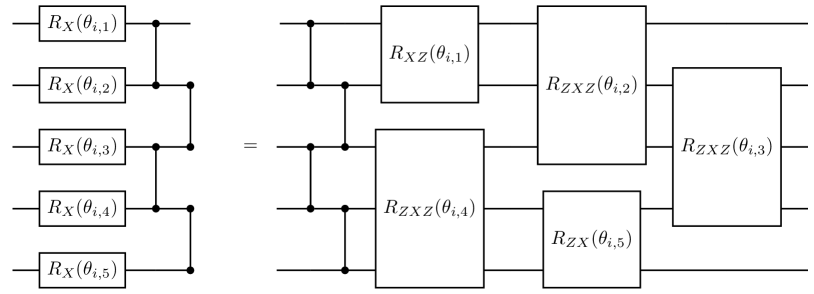
- 回路恒等式を用いて、HEAブロックから非パラメトリックなCZゲートを除去し、完全にパラメトリックな回路に導かれた勾配境界の適用を可能にする。
- HEAは固定初期状態|0⟩^⊗Nと、最後のdキュービットに作用するデータ符号化ユニタリE(ϕ)で実装され、コスト関数はバイナリクロスエントロピー損失によって定義される。
- パラメータ初期化は、小分散ガウス分布サンプリング(Small)、MBLにインspiredされた値、または一様ランダムサンプリング(Random)のいずれかを用い、最適化にはAdamを用いる。
- MNISTのPCAデータを用いた量子機械学習モデルにおける数値シミュレーションにより、異なる初期化手法の性能が検証される。
実験結果
リサーチクエスチョン
- RQ1ハードウェア効率的アーキテクチャ回路は、任意の深さにおいてバーレンプレートを回避してトレーニング可能か?
- RQ2特定のパラメータ初期化領域が、システムサイズや接続性に依存せず、HEAで一定の勾配大きさを保証するか?
- RQ3HEAを時間発展またはMBL系に写像することで、大きな勾配を保証できるか?
- RQ4賢い初期化は、変分量子アルゴリズムのトレーニング効率と精度において、ランダム初期化を上回るか?
- RQ5バーレンプレートはHEAトレーニングにおける主な障壁であるか、それとも局所最適解などの他の要因がより重要か?
主な発見
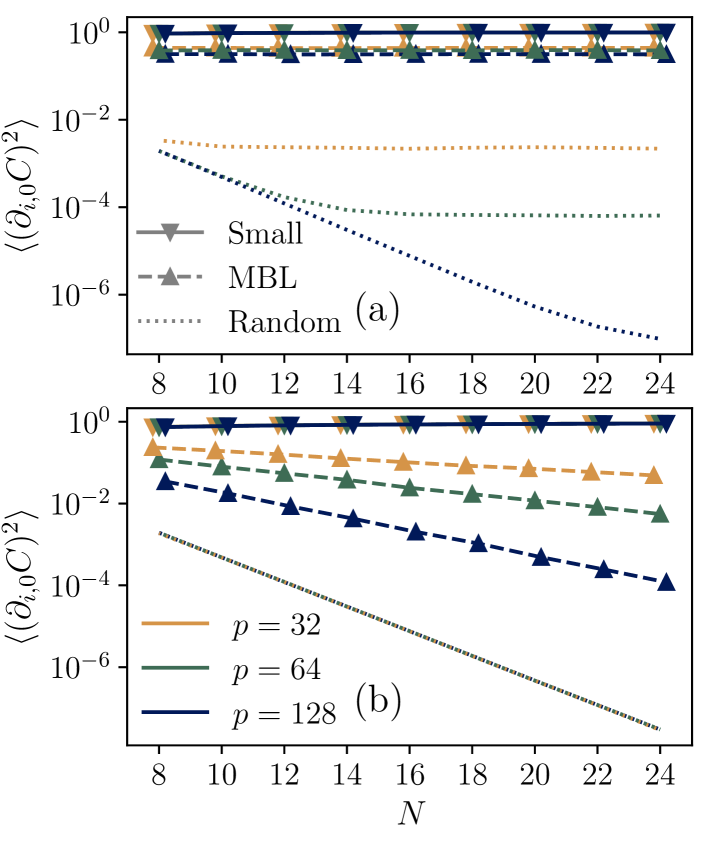
- 提案されたパラメータ初期化条件により、回路深さやキュービット接続性にかかわらず、局所的およびグローバルな観測量の両方で勾配大きさに一定の下界が保証される。
- 時間発展演算子条件に基づく初期化では、キュービット数が増加しても勾配大きさがゼロに近づかないことが保証される。
- MBL相では、現象論的MBL理論の予測通り、局所観測量に対して大きな勾配成分が観測される。
- 数値結果から、SmallおよびMBL初期化手法がランダム初期化を著しく上回り、量子機械学習タスクにおいてより速い損失減少と高いテスト精度を達成することが示された。
- Small初期化でトレーニングしたモデルが最も優れた性能を示し、それに次いでMBL初期化が続いた。一方、ランダム初期化では収束が遅く、精度が低かった。
- 結果から、適切なパラメータ初期化がなされれば、バーレンプレートはHEAに本質的な問題ではないことが示唆され、表現力と局所最適解の問題がVQA設計においてより重要な課題であると考えられる。
この論文を読む
Nubintのビューアで原文を開き、読みながら気になる箇所をすぐに質問できます。
Nubintでこの論文を読むこのレビューはAIが論文の原文をもとに作成しました。引用する前に原文をご確認ください。