
[論文レビュー] How AI Ideas Affect the Creativity, Diversity, and Evolution of Human Ideas: Evidence From a Large, Dynamic Experiment
この研究は、AI-generated ideas への露出が、開示の有無にかかわらず、ダイナミックな、群衆のようなブレインストーミング設定において、個人の創造性と集合的多様性にどのように影響するかを、800+ participants from 40+ countries の参加者から調査する。
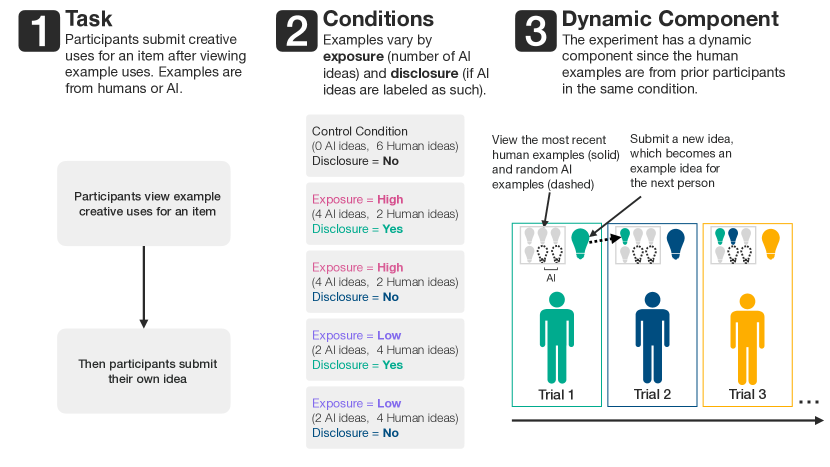
Exposure to large language model output is rapidly increasing. How will seeing AI-generated ideas affect human ideas? We conducted an experiment (800+ participants, 40+ countries) where participants viewed creative ideas that were from ChatGPT or prior experimental participants and then brainstormed their own idea. We varied the number of AI-generated examples (none, low, or high exposure) and if the examples were labeled as 'AI' (disclosure). Our dynamic experiment design -- ideas from prior participants in an experimental condition are used as stimuli for future participants in the same experimental condition -- speaks to the interdependent process of cultural creation: creative ideas are built upon prior ideas. Hence, we capture the compounding effects of having LLMs 'in the culture loop'. We find that high AI exposure (but not low AI exposure) did not affect the creativity of individual ideas but did increase the average amount and rate of change of collective idea diversity. AI made ideas different, not better. There were no main effects of disclosure. We also found that self-reported creative people were less influenced by knowing an idea was from AI and that participants may knowingly adopt AI ideas when the task is difficult. Our findings suggest that introducing AI ideas may increase collective diversity but not individual creativity.
研究の動機と目的
- AI-generated ideasへの曝露が、ダイナミックでカルチャーループ的な文脈における人間の創造性にどのように影響するかを検討する。
- AI disclosure (ラベリング ideas as AI) が創造性と多様性に対する影響を調節するかを判断する。
- AIアイデアが、続く参加者の世代にわたるアイデア多様性の進化にどのように影響するかを評価する。
提案手法
- AIと/または人間のアイデアを見てから自分のアイデアを出す、Alternate Uses Task (AUT) の派生版を使用する。
- 動的で前方伝播する設計で、AI露出レベル(なし、低、高)とAI開示(ラベル付き vs. ラベルなし)を操作する。
- アイデアを embeddings (SBERT) として表現し、AI exemplars へのコサイン類似度でアイデアの多様性とAIの採用を測定する。
- 個々の創造性を、GPT-3 ベースの独創性分類器で推定し、人間の判断と相関(r=0.81 全体)。
- 同じ条件内で、将来の参加者にアイデアをフィードフォワードさせることで、時間的ダイナミクスを追跡する。
実験結果
リサーチクエスチョン
- RQ1高いAI露出は個人の創造性を高めるのか、それとも群全体の多様性を高めるのか?
- RQ2AI生成アイデアのラベリング(開示)は、創造性やAIアイデアの採用に影響を与えるのか?
- RQ3AI露出は、時間の経過とともに集合的アイデア多様性の変化率に影響を与えるのか?
- RQ4自己認識的な創造的個人は、創造的とは認識しない人と比べて、AI開示アイデアに対して異なる反応を示すのか?
主な発見
- 高いAI露出は集合的アイデア多様性を高めるが、個人の創造性を改善するとは限らない。
- AI露出は時間の経過に伴うアイデア多様性の発展の速度を加速させる。
- 自己認識的に創造的な参加者は、AI開示の影響を受けにくく、AIアイデアの採用において敏感度が低い。
- 難易度が高いタスク、特に開示時には、AIアイデアを採用する可能性が高まる。
- 全体のサンプルを通じた、開示には創造性や多様性への主効果は見られない。

この論文を読む
Nubintのビューアで原文を開き、読みながら気になる箇所をすぐに質問できます。
Nubintでこの論文を読むこのレビューはAIが論文の原文をもとに作成しました。引用する前に原文をご確認ください。