
[論文レビュー] How Interpretable are Reasoning Explanations from Prompting Large Language Models?
本論文は、大規模言語モデルの prompting による推論チェーンの解釈性を、忠実度、頑健性、有用性の観点から評価し、説明と文脈および回答の整合性を高める SEA-CoT を導入します。
Prompt Engineering has garnered significant attention for enhancing the performance of large language models across a multitude of tasks. Techniques such as the Chain-of-Thought not only bolster task performance but also delineate a clear trajectory of reasoning steps, offering a tangible form of explanation for the audience. Prior works on interpretability assess the reasoning chains yielded by Chain-of-Thought solely along a singular axis, namely faithfulness. We present a comprehensive and multifaceted evaluation of interpretability, examining not only faithfulness but also robustness and utility across multiple commonsense reasoning benchmarks. Likewise, our investigation is not confined to a single prompting technique; it expansively covers a multitude of prevalent prompting techniques employed in large language models, thereby ensuring a wide-ranging and exhaustive evaluation. In addition, we introduce a simple interpretability alignment technique, termed Self-Entailment-Alignment Chain-of-thought, that yields more than 70\% improvements across multiple dimensions of interpretability. Code is available at https://github.com/SenticNet/CoT_interpretability
研究の動機と目的
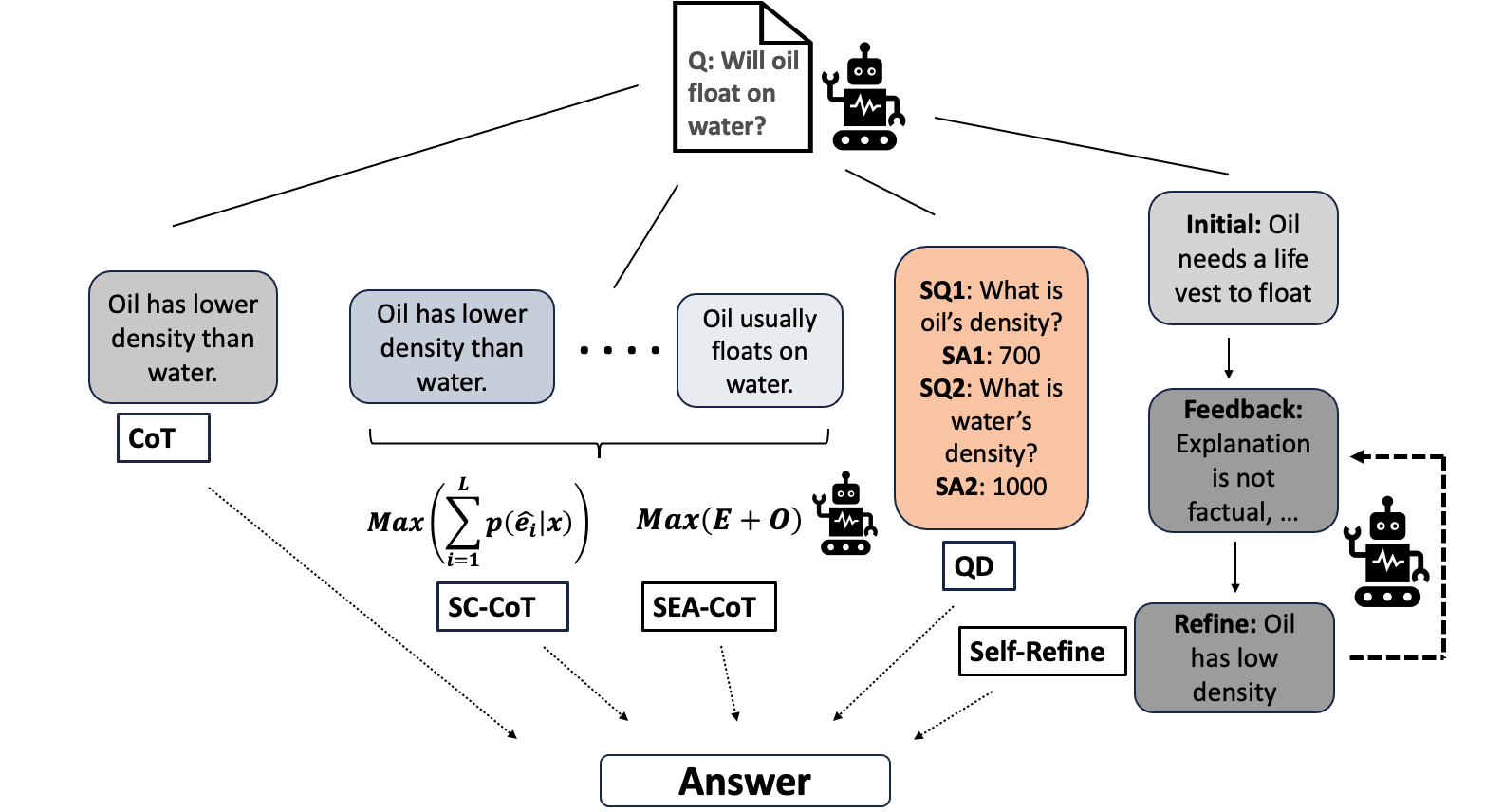
- CoT、SC-CoT、SEA-CoT、QD、SR など、さまざまな prompting 手法からの推論チェーンの解釈性を評価する。
- 常識推論ベンチマーク全体で、忠実度、頑健性、有用性という3つの解釈軸を評価する。
- 説明の整合性と解釈性を高める SEA-CoT の提案。
提案手法
- 推論チェーンの prompting 手法(CoT、SC-CoT、QD、SR)を整理する。
- SEA-CoT を提案する:含意 S_e と重複度 S_o に基づき、S_T = S_e + S_o で複数の説明を順位付けする。
- 少数ショットの NLI プロンプトを用いて、説明と文脈間の含意を推定する。
- 反事実と誤りによる忠実度、パラフレーズによる頑健性、シミュレーション可能性(LAS)による有用性を評価する。
- 70B Llama-2 モデル(GPTQ 量子化)を用い CSQA、OBQA、StrategyQA で摂動テストを実施する。
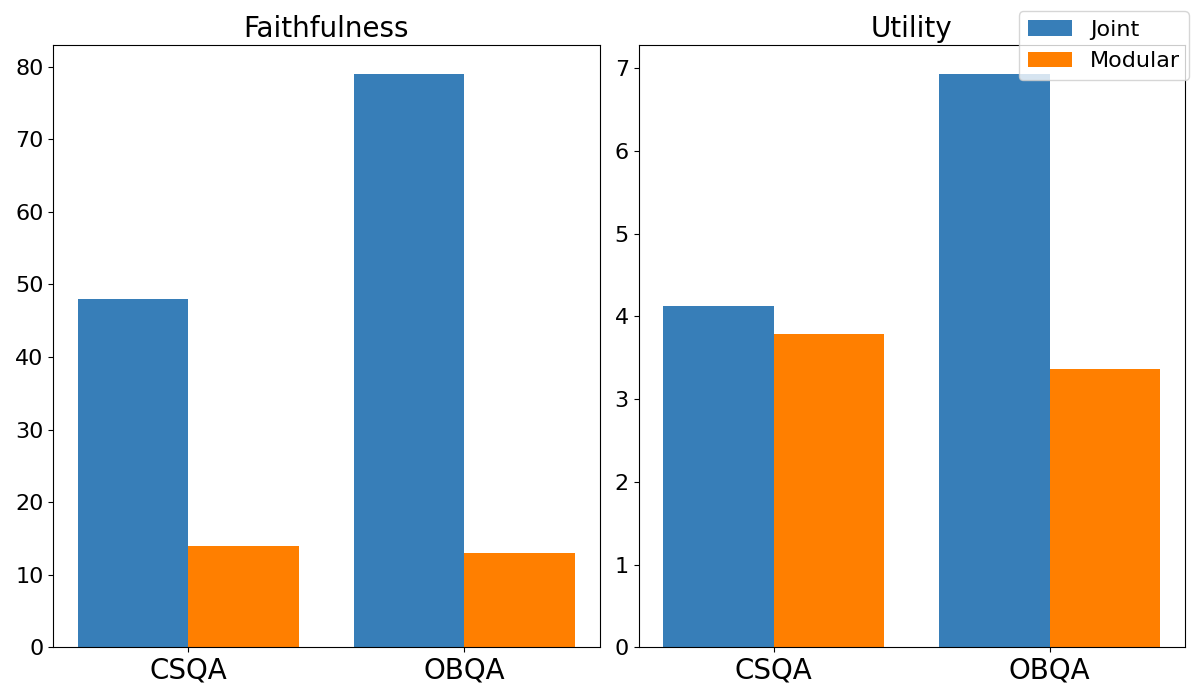
実験結果
リサーチクエスチョン
- RQ1prompting により導出された推論説明は、モデルの実際の意思決定プロセスにどれほど忠実か?
- RQ2これらの説明はパラフレーズや注入された誤りに対してどれほど頑健か?
- RQ3説明は下流の学習に対する有用性(シミュレータビリティ)を向上させるか?
- RQ4SEA-CoT は複数のデータセットと prompting の変種にわたって解釈性を改善するか?
- RQ5モデルサイズが解釈性特性に与える影響は何か?
主な発見
- SEA-CoT は Commonsense QA、OpenBookQA、StrategyQA において、頑健性・忠実度・有用性の総合解釈性スコアで最も高い値を示した。
- SEA-CoT は OBQA で顕著に大きな改善を達成(多くのベースラインと比較して相対改善 >75%)
- SC-CoT と比べて、SEA-CoT はタスク性能を犠牲にすることなく一貫して解釈性を向上させる。
- アブレーションは、含意と重複の両方(O&E)を用いる方が、いずれか一方のみを用いるよりも説明の選択で優れていることを示す。
- 大規模モデル(70B)は一般に解釈性スコアを向上させるが、SEA-CoT は小型モデル(例:7B)を他のプロンプトと比べて解釈性で競争力を持たせることができる。
- 表1は推論選択手法のアブレーション結果を示し、表2は解釈性指標へのモデルサイズ効果を示す。
この論文を読む
Nubintのビューアで原文を開き、読みながら気になる箇所をすぐに質問できます。
Nubintでこの論文を読むこのレビューはAIが論文の原文をもとに作成しました。引用する前に原文をご確認ください。