
[論文レビュー] How to build the best medical image segmentation algorithm using foundation models: a comprehensive empirical study with Segment Anything Model
この論文は、SAMの18個のファインチューニング戦略を17の医用画像データセットで経験的に比較し、医用画像分割のPEFTベースの効果的なアプローチとデータセット入手状況を特定します。
Automated segmentation is a fundamental medical image analysis task, which enjoys significant advances due to the advent of deep learning. While foundation models have been useful in natural language processing and some vision tasks for some time, the foundation model developed with image segmentation in mind - Segment Anything Model (SAM) - has been developed only recently and has shown similar promise. However, there are still no systematic analyses or "best-practice" guidelines for optimal fine-tuning of SAM for medical image segmentation. This work summarizes existing fine-tuning strategies with various backbone architectures, model components, and fine-tuning algorithms across 18 combinations, and evaluates them on 17 datasets covering all common radiology modalities. Our study reveals that (1) fine-tuning SAM leads to slightly better performance than previous segmentation methods, (2) fine-tuning strategies that use parameter-efficient learning in both the encoder and decoder are superior to other strategies, (3) network architecture has a small impact on final performance, (4) further training SAM with self-supervised learning can improve final model performance. We also demonstrate the ineffectiveness of some methods popular in the literature and further expand our experiments into few-shot and prompt-based settings. Lastly, we released our code and MRI-specific fine-tuned weights, which consistently obtained superior performance over the original SAM, at https://github.com/mazurowski-lab/finetune-SAM.
研究の動機と目的
- SAMのファインチューニング戦略のうち、医用画像分割性能を最も引き出すものを調査する。
- 多様な医用画像モダリティにわたって、SAMベースのアプローチを従来のUNetベース手法と比較する。
- データセット入手可能性のシナリオがファインチューニング戦略の選択に与える影響を評価する。
- 事前学習戦略(タスク拡張プロンプトと自己教師付き学習)と医用画像における少数ショット/対話的セグメンテーション設定を探る。
提案手法
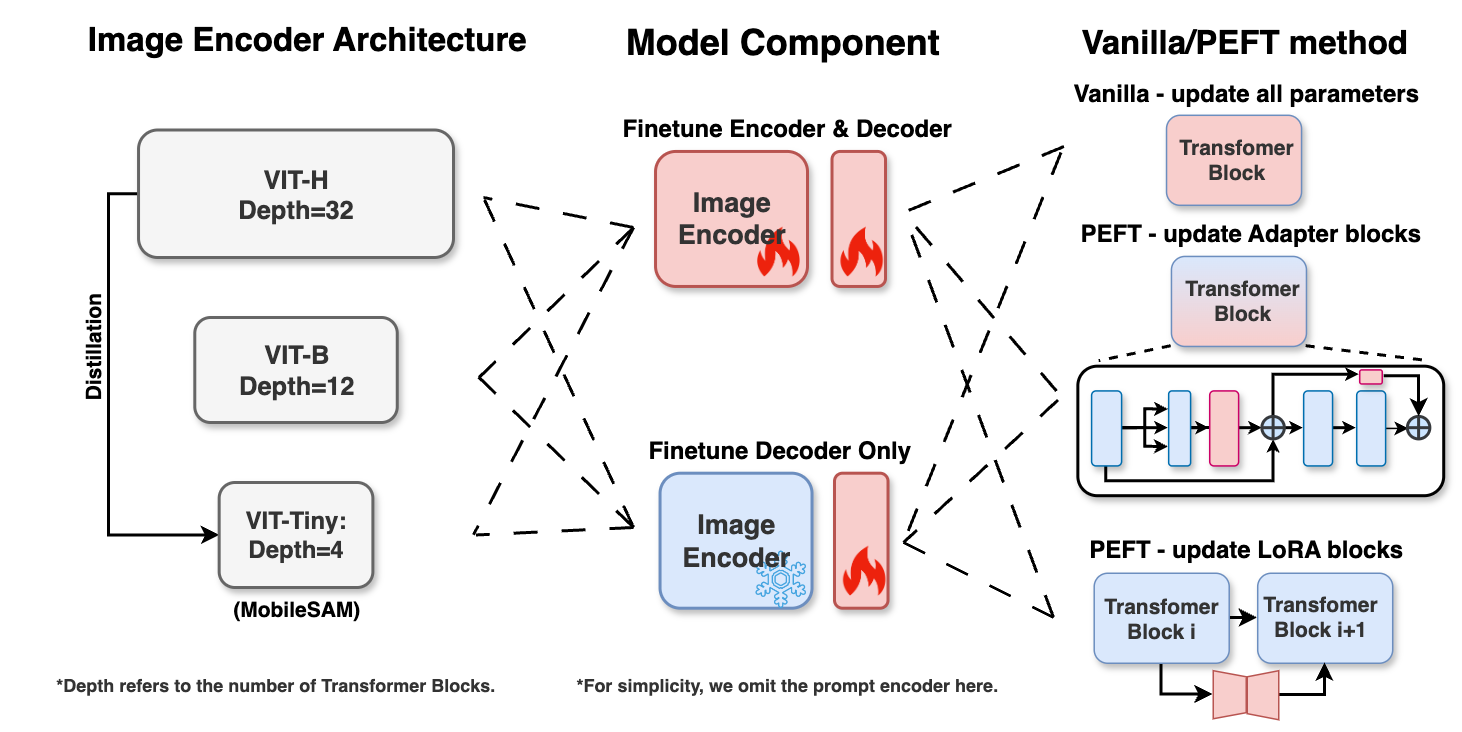
- 医用データセット上でSAMをファインチューニングして、18のアーキテクチャ–コンポーネント–手法の組み合わせを評価する。
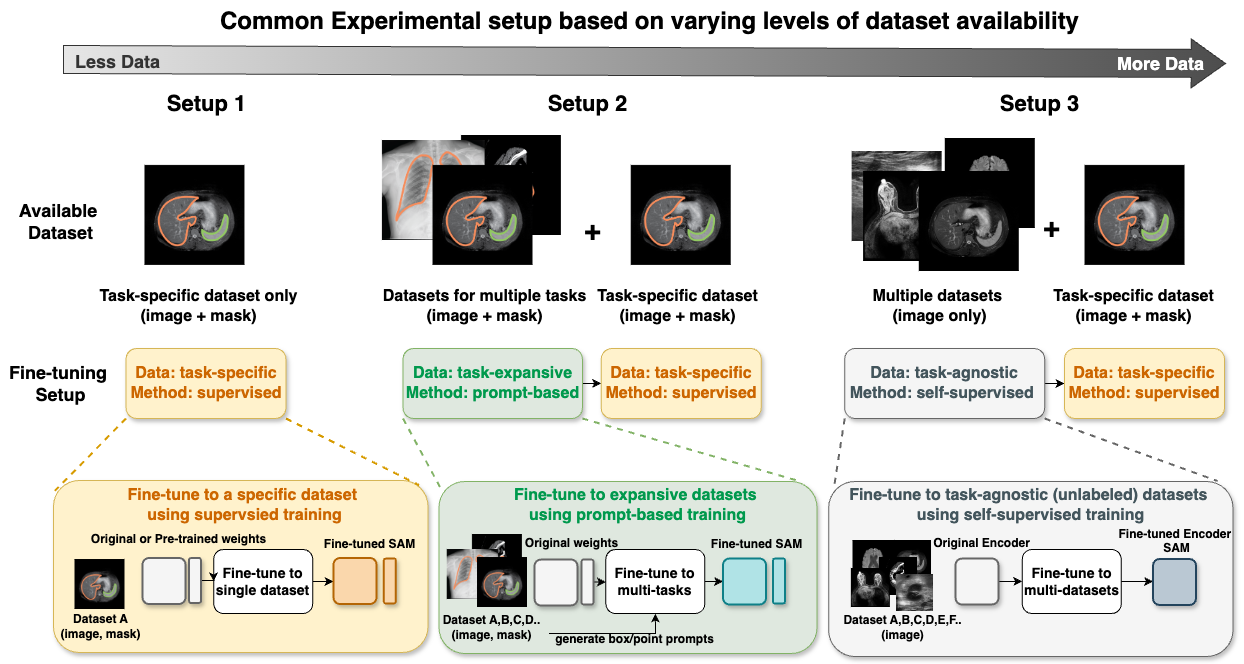
- 3つのデータ入手シナリオを検討する:単一のラベル付きデータセット、複数のラベル付きデータセット、ラベル付き+ラベルなしデータセットの複数。
- ViT-H、ViT-B、ViT-Tのバックボーンを、デコーダ/エンコーダ/バニラ、およびPEFTバリアント(AdapterとLoRA)とともに使用。
- データ入手状況に応じて、タスク特化の教師あり学習、タスク拡張プロンプトベース学習、タスク非依存の自己監視学習(MAE)を順次適用。
- 17データセットでSAMのファインチューニングをUNet、nnUNet、SwinUNetのベースラインと比較。Dice Similarity Coefficient (DSC)を報告。
- 再現性のためにMRI専用の事前学習済み重みとコードを提供。
実験結果
リサーチクエスチョン
- RQ1異なるデータ入手状況下で、医用画像分割における最良のSAMファインチューニング戦略とは何か?
- RQ2PEFT手法(Adapter/LoRA)は医用画像におけるSAMのバニラファインチューニングより優れているか?
- RQ3追加の事前学習(タスク拡張プロンプトまたは自己教師付きMAE)は医用データセットでのSAMの性能を向上させるか?
- RQ4多様な放射線画像モダリティと臓器に対して、SAMは従来のUNetベース手法とどう比較されるか?
主な発見
- エンコーダとデコーダの両方をファインチューニングし、PEFT(AdapterまたはLoRA)を使用することは、デコーダのみを更新するより一般にDSCを向上させる。
- エンコーダの選択の影響はPEFTを使用すると小さくなる;データ量と学習の安定性のため、より小さなバックボーン(ViT-BまたはViT-T)は医用タスクでViT-Hを上回ることがある。
- 自己監視型事前学習(MAE)とタスク拡張プロンプトベース学習は、いくつかの設定で最終的な性能をさらに改善できる。
- 複雑なターゲットではSAMベースの手法が一部のUNet系に勝ることがあるが、単純なターゲットでは特定のデータセットでUNet系(nnUNet)が優れる。
- 大規模なSAM(ViT-H、エンコーダ/デコーダ、バニラ)を直接ファインチューニングすると、いくつかのデータセットでモデル崩壊を招く可能性があり、医用設定におけるPEFTの利点を強調している。
- 本研究はMRIを対象とした事前学習と、再現性のための公開コードベースとファインチューニング済み重みを提供している。
この論文を読む
Nubintのビューアで原文を開き、読みながら気になる箇所をすぐに質問できます。
Nubintでこの論文を読むこのレビューはAIが論文の原文をもとに作成しました。引用する前に原文をご確認ください。