
[論文レビュー] HQA-Attack: Toward High Quality Black-Box Hard-Label Adversarial Attack on Text
HQA-Attackは、限られたクエリ予算の下で高い意味的類似度と低い摂動率を達成する、シンプルでありながら効果的なブラックボックス硬ラベルテキスト敵対的攻撃フレームワークを提案する。まず元の単語を復元して摂動を低減し、その後、意味的類似度と敵対的成功度に基づくターゲット付き同義語置換を用いて残りの変更を最適化することで、複数のベンチマークで先行手法を著しく上回る。
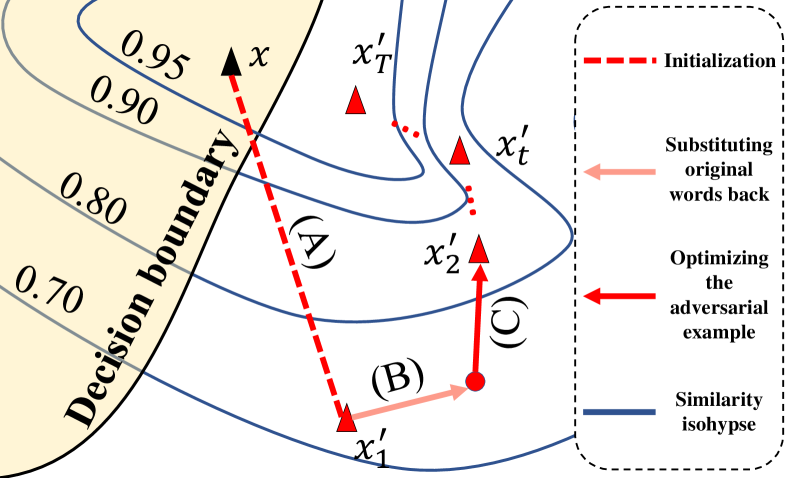
Black-box hard-label adversarial attack on text is a practical and challenging task, as the text data space is inherently discrete and non-differentiable, and only the predicted label is accessible. Research on this problem is still in the embryonic stage and only a few methods are available. Nevertheless, existing methods rely on the complex heuristic algorithm or unreliable gradient estimation strategy, which probably fall into the local optimum and inevitably consume numerous queries, thus are difficult to craft satisfactory adversarial examples with high semantic similarity and low perturbation rate in a limited query budget. To alleviate above issues, we propose a simple yet effective framework to generate high quality textual adversarial examples under the black-box hard-label attack scenarios, named HQA-Attack. Specifically, after initializing an adversarial example randomly, HQA-attack first constantly substitutes original words back as many as possible, thus shrinking the perturbation rate. Then it leverages the synonym set of the remaining changed words to further optimize the adversarial example with the direction which can improve the semantic similarity and satisfy the adversarial condition simultaneously. In addition, during the optimizing procedure, it searches a transition synonym word for each changed word, thus avoiding traversing the whole synonym set and reducing the query number to some extent. Extensive experimental results on five text classification datasets, three natural language inference datasets and two real-world APIs have shown that the proposed HQA-Attack method outperforms other strong baselines significantly.
研究の動機と目的
- 予測ラベルしか入手できないブラックボックス硬ラベルテキスト攻撃設定において、高品質な敵対的例を生成する課題に対処すること。
- 敵対的例生成における意味的類似度の維持と低い摂動率を保ちながら、クエリ消費量を低減すること。
- 局所最適解や不正確な勾配推定に悩まされるヒューリスティック法および勾配ベース手法の限界を克服すること。
- 信頼度スコアを公開しない実世界のAPIに適した実用的で効率的な攻撃フレームワークを開発すること。
- 高品質な敵対的例を通じて、NLPモデルの防御の強化と評価を可能にすること。
提案手法
- ランダムな単語置換により敵対的例を初期化し、誤分類されたラベルを持つ候補を生成する。
- 誤分類を維持したまま摂動率を低減するために、敵対的例内の元の単語を段階的に復元する。
- 残りの変更済み単語に対して、意味的類似度を向上させるとともに敵対的成功を保持する最小限のクエリコストで、遷移的同義語を探索する。
- 各変更済み単語に対して同義語集合を用いるが、類似度と敵対的利得に基づいて最も有望な遷移単語のみを選択することで、全走査を回避する。
- 信頼度スコアや勾配推定に依存せず、予測ラベル(硬ラベル)と同義語集合のみを活用する。
- 敵対的例の最適化を2段階で行う:まず単語の復元による摂動低減、次に意味的認識に基づく同義語置換による最適化。
実験結果
リサーチクエスチョン
- RQ1ブラックボックス硬ラベル敵対的攻撃は、最小限のクエリ使用量で高い意味的類似度と低い摂動率を達成できるか?
- RQ2勾配や信頼度スコアにアクセスできない状況下で、意味的類似度と敵対的成功度に基づいて同義語最適化を効果的にガイドできるか?
- RQ3同義語探索の前に単語を復元することで、摂動を低減しつつ攻撃成功率を維持できるか?
- RQ4ヒューリスティック法および勾配ベースのベースラインと比較して、クエリ効率と敵対的品質の点で本手法はどのように優れているか?
- RQ5限られたクエリ予算の下でも、意味的に自然で効果的な高品質な敵対的例を生成できるか?
主な発見
- HQA-Attackは、5つのテキスト分類データセット、3つの自然言語推論データセット、2つの実世界APIにおいて、HLGA、TextHoaxer、LeapAttackを含む強力なベースラインを著しく上回る。
- 限られたクエリ予算の下でも、既存の手法よりも高い意味的類似度と低い摂動率を達成する。
- 元の単語を最初に復元することで、変更済み単語の数を削減し、より自然で滑らかな敵対的例を生成する。
- 遷移的同義語探索により、全同義語集合の走査と比較してクエリコストを低減し、効率性を向上させる。
- MRおよびAGデータセットでは、『Negative』から『Positive』、『World』から『Business』への予測変更に、最小限で意味的に整合性のある変更で成功した。
- テキスト分類および自然言語推論を含む多様なNLPタスクにわたり、本手法は優れた汎用性を示し、その強靭さと実用性を確認した。
この論文を読む
Nubintのビューアで原文を開き、読みながら気になる箇所をすぐに質問できます。
Nubintでこの論文を読むこのレビューはAIが論文の原文をもとに作成しました。引用する前に原文をご確認ください。