
[論文レビュー] HSIDMamba: Exploring Bidirectional State-Space Models for Hyperspectral Denoising
HSIDMamba (HSDM) を導入。ハイパースペクトルデノイジングの双方向状態空間モデルで、線形(ほぼ)計算複雑さを実現し、最近のトランスフォーマよりも推論が速い。
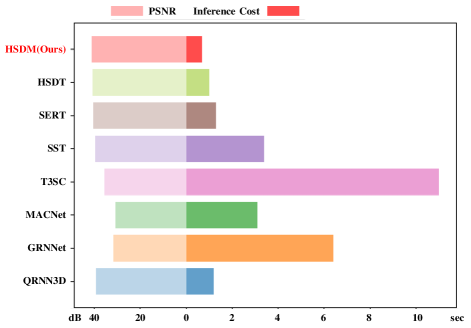
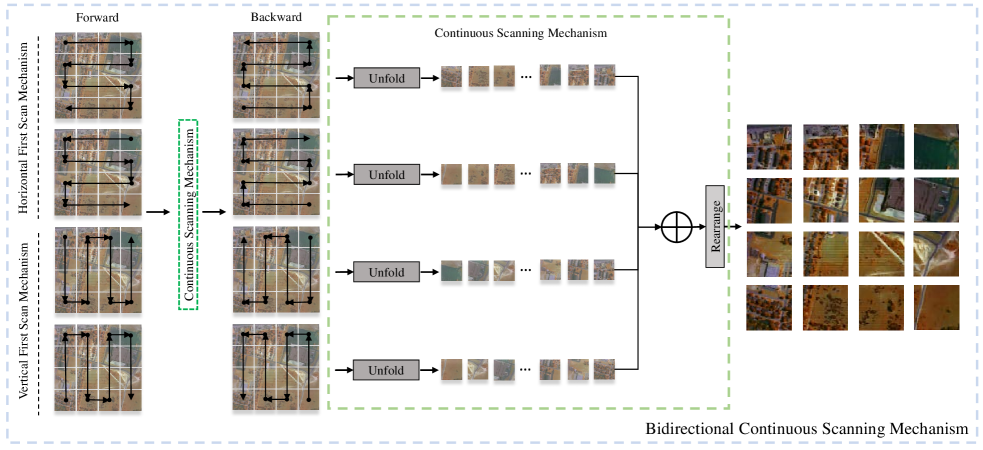
Effectively modeling global context information in hyperspectral image (HSI) denoising is crucial, but prevailing methods using convolution or transformers still face localized or computational efficiency limitations. Inspired by the emerging Selective State Space Model (Mamba) with nearly linear computational complexity and efficient long-term modeling, we present a novel HSI denoising network named HSIDMamba (HSDM). HSDM is tailored to exploit the capture of potential spatial-spectral dependencies effectively and efficiently for HSI denoising. In particular, HSDM comprises multiple Hyperspectral Continuous Scan Blocks (HCSB) to strengthen spatial-spectral interactions. HCSB links forward and backward scans and enhances information from eight directions through the State Space Model (SSM), strengthening the context representation learning of HSDM and improving denoising performance more effectively. In addition, to enhance the utilization of spectral information and mitigate the degradation problem caused by long-range scanning, spectral attention mechanism. Extensive evaluations against HSI denoising benchmarks validate the superior performance of HSDM, achieving state-of-the-art performance and surpassing the efficiency of the transformer method SERT by 31%.
研究の動機と目的
- ハイパースペクトルデノイジングにおける長距離の空間-スペクトルモデリングの効率的な必要性を動機づける。
- HSIDMamba (HSDM)、HSIデノイングに特化した双方向・連続状態空間アーキテクチャを提案する。
- 双方向連続スキャン、残差のスケーリング、スペクトルアテンションを取り入れ、長距離依存性を捉える。
- トランスフォーマーベースの手法に対して最先端のデノイジング性能と優れた効率を実証する。
提案手法
- 長い1Dスペクトル列を処理するために、双方向連続スキャンを用いた選択的状態空間モデル(Mamba)を採用する。
- 2D空間スキャンとチャネルアテンションを組み合わせたハイパースペクトル連続スキャンブロック(HCSB)を導入する。
- 8方向にわたる前方と後方のスキャンを結ぶ双方向連続スキャン機構(BCSM)を使用する。
- 層正規化、Conv1D処理、スペクトルアテンションを適用して空間-スペクトルモデリングを強化する。
- 混合ノイズの合成データで学習し、PSNR、SSIM、SAMを用いてデノイジングのベースラインと評価する。
実験結果
リサーチクエスチョン
- RQ1双方向の線形計算複雑度を持つ状態空間モデルは、ハイパースペクトルデノイジングにおいてCNNや Transformers より長距離の空間-スペクトル依存性をより効率的に捉えることができるのか?
- RQ2提案されたBCSMとHCSL設計は、多様なノイズ条件下で合成および実データのHSIデータセットにおけるデノイジング品質(PSNR/SSIM/SAM)を向上させるか?
- RQ3HSIDMamba は最近のトランスフォーマーベースのデノイジング手法よりも速く、パラメータ効率が良く、精度を維持または向上させるか?
- RQ4スキャン戦略(双方向 vs 一方向、スイープ vs クロス)およびhidden-dimの選択が性能に与える影響は何か?
主な発見
- HSIDM はガウスノイズおよび混合ノイズ下で、合成ICVL/CAVEデータセットにおいて最先端のデノイジング性能を達成する。
- HSIDM は SST、SERT、HSDT を含む複数のベースラインと比較して優れた PSNR/SSIM/SAM 指標を提供する。
- 双方向隣接スキャン機構(BCSM)は、空間-スペクトル依存性を捉える際に他のスキャン戦略より優れている。
- HSIDM は線形時間計算量で動作し、推論が高速で(最新のトランスフォーマー手法より約30%高速)、パラメータ効率も有利である。
- アブレーション研究により、Conv1D処理、チャネルアテンション、最適なブロック/hidden-dim設定が最良の性能に重要であることが確認された。
- 効率性分析では、HSIDM はスケールしてもGPUメモリとFPSを維持し、CAVE/WDC/Urbanデータセットでベースラインを速度で上回る。
この論文を読む
Nubintのビューアで原文を開き、読みながら気になる箇所をすぐに質問できます。
Nubintでこの論文を読むこのレビューはAIが論文の原文をもとに作成しました。引用する前に原文をご確認ください。