
[論文レビュー] Humanoid Locomotion as Next Token Prediction
因果トランスフォーマーを、センサーモータートラジェクトリをトークン化して自己回帰的に予測するように訓練し、人型移動のための zero-shot 実世界歩行を可能にするため、欠損モダリティを含む多様なデータソースを活用します。
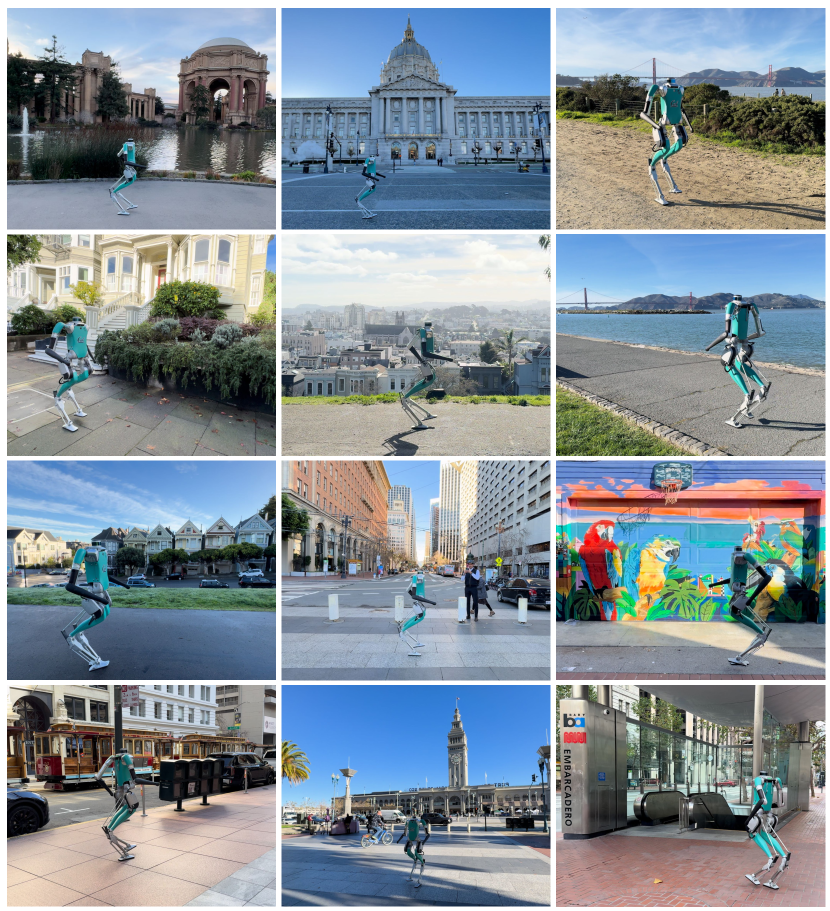
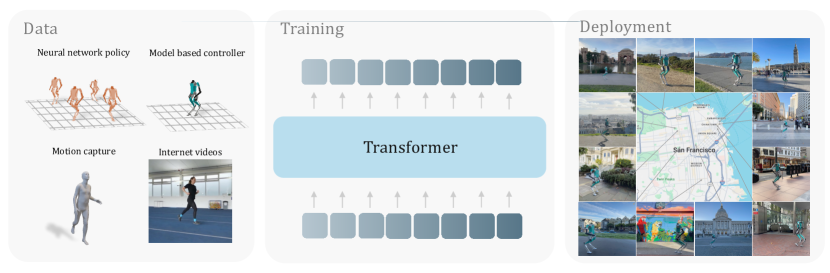
We cast real-world humanoid control as a next token prediction problem, akin to predicting the next word in language. Our model is a causal transformer trained via autoregressive prediction of sensorimotor trajectories. To account for the multi-modal nature of the data, we perform prediction in a modality-aligned way, and for each input token predict the next token from the same modality. This general formulation enables us to leverage data with missing modalities, like video trajectories without actions. We train our model on a collection of simulated trajectories coming from prior neural network policies, model-based controllers, motion capture data, and YouTube videos of humans. We show that our model enables a full-sized humanoid to walk in San Francisco zero-shot. Our model can transfer to the real world even when trained on only 27 hours of walking data, and can generalize to commands not seen during training like walking backward. These findings suggest a promising path toward learning challenging real-world control tasks by generative modeling of sensorimotor trajectories.
研究の動機と目的
- センサーモータ軌道の生成モデル化を通じて、現実世界の人型制御の学習を動機付ける。
- 不完全なデータソースを扱えるモダリティ整合の自己回帰トランスフォーマーを開発する。
- 人間の動画を含む多様なソースでの訓練が、現実世界でのzero-shot展開を可能にすることを示す。
- 予測品質が移動性能と一般化能力にどう関連するかを調査する。
提案手法
- センサモータ軌道をトークン化してトークン化して? すみません。正確には:センサモータ軌跡をトークン化し、因果トランスフォーマーを訓練して p(t) を負の対数尤度を用いて自己回帰的にモデル化する。
- 予測を、同じモダリティの次のトークンを入力トークンとしてモデリングすることで整列させる。
- 欠損モダリティは [M] トークンでマスキングし、マスクされた部分のロスは無視する。
- ニューラルポリシー、モデルベースのコントローラ、MoCap、YouTube動画などの異種データソースで、共同戦略または段階的戦略で訓練する。
- 別個のモダリティ射影と共有トランスフォーマーを用い、位置埋め込みと因果的自己注意を適用する。
実験結果
リサーチクエスチョン
- RQ1多様なセンサーモータデータで訓練した自己回帰型トランスフォーマーは、推論時に強化学習を行わずに現実世界の人型移動を達成できるか?
- RQ2モダリティ整合、欠損データ処理、ジョイント対ステージド訓練が性能と一般化にどう影響するか?
- RQ3不完全なデータ(例: 人間のビデオ)で訓練されたモデルは、現実世界の完全な人型へどの程度転移できるか?
- RQ4次のトークン予測誤差と移動追跡性能の関係は何か?
- RQ5データ量、文脈長、モデルサイズの拡大が、移動品質と未 seen コマンドへの一般化にどう影響するか?
主な発見
- このモデルは、フルサイズの人型が San Francisco でさまざまな地表を跨いで zero-shot で歩行することを可能にする。
- 現実世界でのzero-shotデプロイは、歩行データがわずか27時間で可能である。
- 予測誤差は追跡性能と相関する(r = 0.87)。
- 欠損アクションを含む不完全な軌道の含有は、完全データのみを用いる場合より性能を向上させる。
- モダリティ整合予測は、追跡と次のトークン予測の両方のタスクで、非整合設定より優れている。
- 本手法は、後ろ向き歩行を含む未知のコマンドへの一般化が可能で、データ、文脈、モデルサイズの拡大とともにスケールする。」],
- table_headers
- :[
この論文を読む
Nubintのビューアで原文を開き、読みながら気になる箇所をすぐに質問できます。
Nubintでこの論文を読むこのレビューはAIが論文の原文をもとに作成しました。引用する前に原文をご確認ください。