
[論文レビュー] Identifying and Characterizing Silently-Evolved Methods in the Android API
本論文では、ドキュメントの更新がないまま動作が変更されたメソッド(静黙的進化メソッド、SEMs)を同定・特徴付けるためのツール、AndroSeaを提案する。研究では10のAndroid APIバージョンにわたり4,769個のSEMsを同定し、手動で分析した562個のSEMsのうち363個(64.6%)が意味的変更を含んでおり、1,000個の実世界アプリのうち957個が少なくとも1つのSEMを利用していることが判明した。これは、検出されない動作変更による深刻な互換性リスクを示している。
With over 500,000 commits and more than 700 contributors, the Android platform is undoubtedly one of the largest industrial-scale software projects. This project provides the Android API, and developers heavily rely on this API to develop their Android apps. Unfortunately, because the Android platform and its API evolve at an extremely rapid pace, app developers need to continually monitor API changes to avoid compatibility issues in their apps (\ie issues that prevent apps from working as expected when running on newer versions of the API). Despite a large number of studies on compatibility issues in the Android API, the research community has not yet investigated issues related to silently-evolved methods (SEMs). These methods are functions whose behavior might have changed but the corresponding documentation did not change accordingly. Because app developers rely on the provided documentation to evolve their apps, changes to methods that are not suitably documented may lead to unexpected failures in the apps using these methods. To shed light on this type of issue, we conducted a large-scale empirical study in which we identified and characterized SEMs across ten versions of the Android API. In the study, we identified SEMs, characterized the nature of the changes, and analyzed the impact of SEMs on a set of 1,000 real-world Android apps. Our experimental results show that SEMs do exist in the Android API, and that 957 of the apps we considered use at least one SEM. Based on these results, we argue that the Android platform developers should take actions to avoid introducing SEMs, especially those involving semantic changes. This situation highlights the need for automated techniques and tools to help Android practitioners in this task.
研究の動機と目的
- Android APIメソッドの動作変更がドキュメントの更新と一致しない状況で、それがどの程度発生するかを調査すること。
- 複数のAndroid APIバージョンにわたり、静黙的進化メソッド(SEMs)を同定・特徴付けること。
- SEMsが既存のAndroidアプリケーションに与える実世界への影響を評価すること。
- 広く使われるAPIにおける文書化されていない意味的変更がもたらす互換性障害のリスクを浮き彫りにすること。
- Androidフレームワーク開発における文書化の改善と自動検出ツールの導入を提言すること。
提案手法
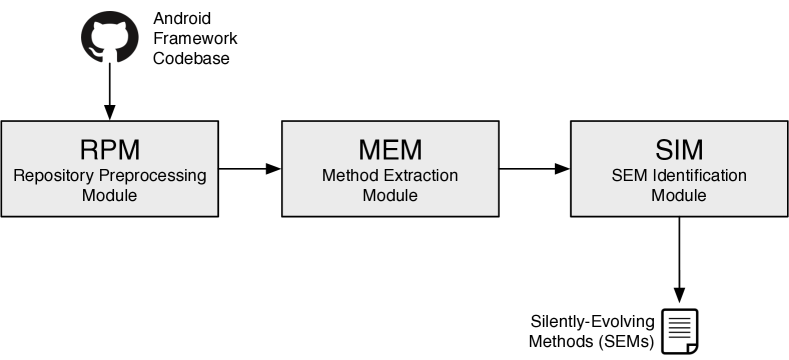
- Androidフレームワークのソースコードを分析して、連続するAPIバージョン間でのメソッド実装を比較することでSEMsを検出するプロトタイプツール「AndroSea」を構築した。
- 同一のJavadocコメントを保ちながら、メソッド実装の動作差異を検出することで、SEMsを自動的に同定した。
- 変更の性質(例:構文的 vs. 意味的)を分類するために、統計的に有意なサンプルとして562個のSEMsを手動で分析した。
- 実世界のAndroidアプリ1,000個のコーパスを収集・分析し、SEMsの使用状況を評価して実世界への影響を測定した。
- アプリコード内のバージョンチェックをシグナルとして用い、開発者がSEMs関連の互換性問題を検出・緩和しているかを推定した。
- 10のAndroid APIリリース(1.5から10.0まで)を対象とした実証的分析により、進化パターンの広範なカバーを確保した。
実験結果
リサーチクエスチョン
- RQ1複数のバージョンにわたり、Android APIに静黙的進化メソッド(SEMs)がどの程度存在するか。
- RQ2SEMsにおける変更の種類(構文的か意味的か)はどれが一般的で、API互換性にどのように影響を与えるか。
- RQ3SEMsは実世界のAndroidアプリでどの程度頻繁に使用されており、開発者はこれらの問題を検出または緩和しているか。
- RQ4SEMsが導入される際のパターン、例えば一度だけ追加されるか、特定のAPIカテゴリに限定されるかなどの傾向があるか。
- RQ5APIバージョンチェックなどの既存のアプリ開発実務が、SEMsに起因する互換性リスクへの認識を示しているか。
主な発見
- 10のAndroid APIバージョンにわたり合計4,769個のSEMsが同定され、そのうち2,271個がパブリックアクセス可能なメソッドであった。
- 手動で分析した562個のSEMsのうち363個(64.6%)が意味的変更を含んでおり、実行時エラーの高いリスクを示している。
- 本研究の1,000個の実世界Androidアプリのうち957個が、少なくとも1つのパブリックアクセス可能なSEMを利用していることが判明した。
- SEMsの大多数(特にPASEMs)は一度だけ導入されており、これはフレームワークメンテナーよりも変更の認識が不十分である可能性を示唆している。
- SEMsを利用している多くのアプリではAPIバージョンチェックが行われておらず、潜在的な互換性リスクにもかかわらず緩和策がとられていないことが判明した。
- 一部のアプリにバージョンチェックが存在するという事実から、開発者はAPI進化の問題に認識を示しているが、SEMs固有のリスクにはまだ前向きに対応していないことが確認された。

より良い研究を、今すぐ始めましょう
論文の読解から最終レビューまで、研究時間を劇的に削減しましょう。
クレジットカード登録不要
このレビューはAIが作成し、人間の編集者が確認しました。