
[論文レビュー] Improving Pretraining Data Using Perplexity Correlations
本論文は、90体のオープンウェイト大規模言語モデル(LLM)を用いて事前学習データの品質を特定するため、事前学習データのパープレキシティと下流ベンチマーク性能の相関関係を活用するトレーニングフリーなデータ選別手法を提案する。LLMのパープレキシティと下流ベンチマーク性能の強い相関を示すデータドメインを選別することで、160Mパラメータの設定で8つのベンチマークでDSIRを上回り、ハイパーパramータチューニングや人為的選別を一切行わずにDataComp-LMの最良手法と同等の性能を達成する。
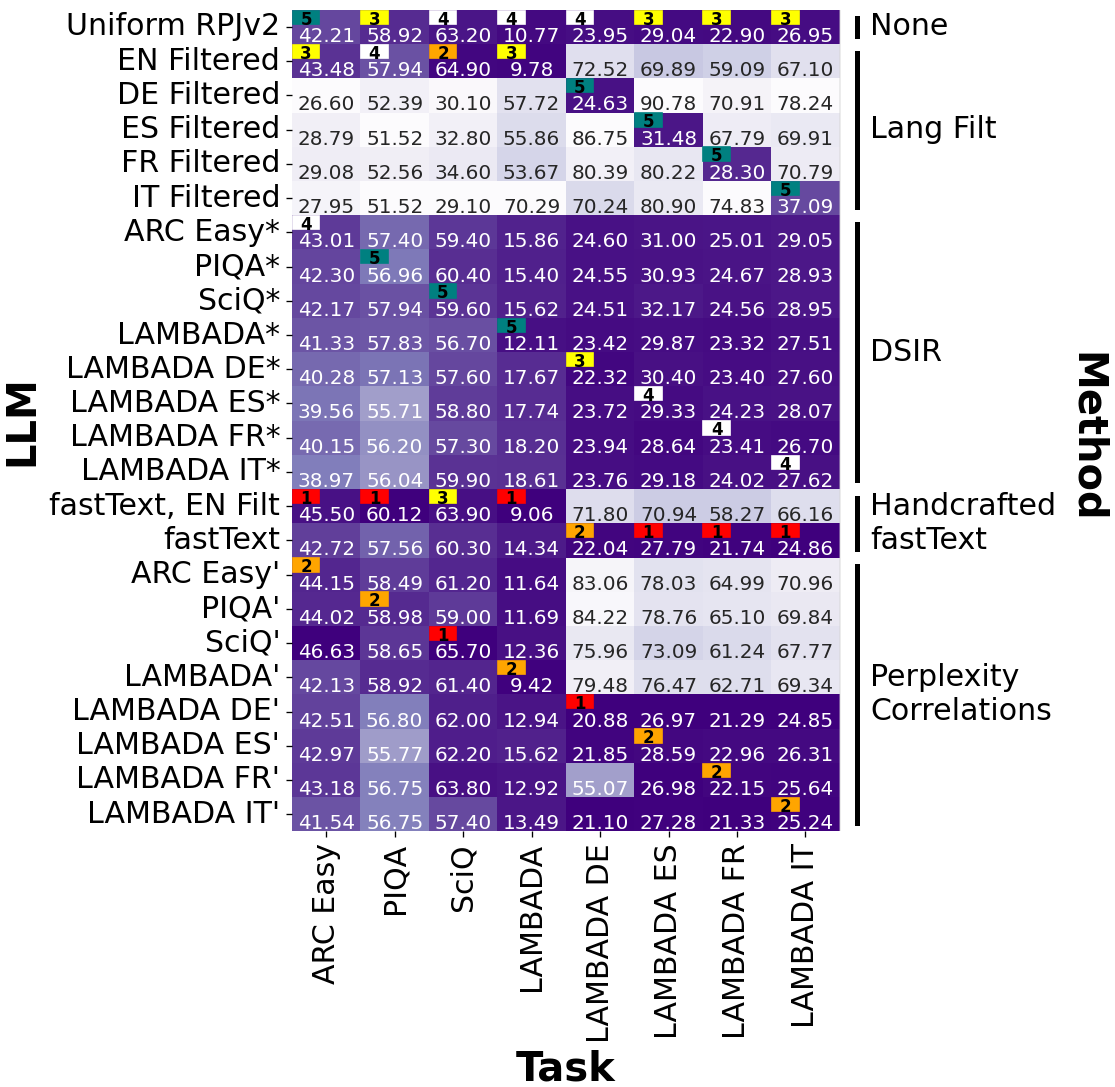
Quality pretraining data is often seen as the key to high-performance language models. However, progress in understanding pretraining data has been slow due to the costly pretraining runs required for data selection experiments. We present a framework that avoids these costs and selects high-quality pretraining data without any LLM training of our own. Our work is based on a simple observation: LLM losses on many pretraining texts are correlated with downstream benchmark performance, and selecting high-correlation documents is an effective pretraining data selection method. We build a new statistical framework for data selection centered around estimates of perplexity-benchmark correlations and perform data selection using a sample of 90 LLMs taken from the Open LLM Leaderboard on texts from tens of thousands of web domains. In controlled pretraining experiments at the 160M parameter scale on 8 benchmarks, our approach outperforms DSIR on every benchmark, while matching the best data selector found in DataComp-LM, a hand-engineered bigram classifier. We have now also updated this paper to include results from preregistered experiments with new pretraining data on an aggregation of 22 benchmarks up to the 1.4B scale, showing increasing improvements of our method over others with more scale. A pip package with full documentation can be found here: https://github.com/TristanThrush/perplexity-correlations.
研究の動機と目的
- データ選別にためのLLMのトレーニングコストを低減するため、再トレーニングを伴わず既存の公開モデルを活用すること。
- 事前学習データにおけるLLMのパープレキシティと下流ベンチマーク性能との相関関係が、データ品質の代替指標として信頼できるかを調査すること。
- 多様なオープンウェイトLLMの集合に対してパープレキシティ-ベンチマーク相関を推定する統計的フレームワークを構築すること。
- 160Mパラメータのスケールで8つのベンチマークを対象に、制御された事前学習実験を通じて手法の有効性を検証すること。
- 1.4Bパラメータのスケールでホールドアウトデータを用いたスケーリング実験を事前に登録し、外部妥当性と一般化性能を検証すること。
提案手法
- Hugging FaceのオープンLLMリーダーボードを用いて、数万のウェブドメインからのテキストに対して90体のオープンウェイトLLMのパープレキシティスコアを収集する。
- 複数のベンチマークにわたって、各LLMのドメインごとのパープレキシティと下流ベンチマーク性能との間のペアワイズ相関を計算する。
- これらの相関推定値を、事前学習データ選別用のデータドメインランク付けの代理指標として用いる。
- モデルのファインチューニングを一切行わず、相関に基づくドメインランクにfastText分類器を学習して最終的なデータセレクタを構築する。
- 選別されたデータを用いて、8つの多様なベンチマークで160Mパラメータの制御された事前学習実験を実施する。
- パイプラインの最終フィルタリングステップを置き換えることで、同じ手法を用いて1.4BパラメータのDataComp-LMベンチマークで大規模な評価を事前に登録する。
実験結果
リサーチクエスチョン
- RQ1多様なオープンウェイトLLMのパープレキシティ-ベンチマーク相関関係は、下流性能を信頼できる形で予測し、データ選別を支援できるか?
- RQ2トレーニングフリーな相関ベースのデータ選別手法は、制御された事前学習実験においてDSIRのような既存のトレーニングフリー基準手法を上回るか?
- RQ3ハイパーパramータチューニングなしで、OH-2.5 + ELI5 fastText分類器のような手作業で設計された分類器と同等またはそれ以上の性能を達成できるか?
- RQ4本手法は、異なるモデルスケールや評価ベンチマーク、多言語環境においても一般化可能か?
- RQ5ホールドアウトデータを用いた事前に登録されたスケーリング実験により、データ選別結果の信頼性と外部妥当性が向上するか?
主な発見
- 相関ベースのデータ選別手法は、160Mパラメータの制御された事前学習実験において、全8つのベンチマークでDSIRを上回った。
- ハイパーパramータチューニングや人為的選別を一切行わず、DataComp-LMの最良データセレクタ(OH-2.5 + ELI5 fastText分類器)と同等の性能を達成した。
- パープレキシティ-ベンチマーク相関関係は、多様なLLMとデータドメインにわたり、下流性能の代替指標として十分に頑健であることが示された。
- 事前に登録された1.4BパラメータのDataComp-LM評価を通じて、本手法が大規模な実験に効果的に一般化できることを実証した。
- 複雑なパイプラインの最終フィルタリングステップの直接的な置き換えとしても、本手法は強力な結果を示し、実用的価値が非常に高いことがわかった。
- 多言語ベンチマークにおける事前に登録された実験により、本手法がコアとなる英語ベンチマークを超えて有効であることが確認され、最先端のベースラインと同等の性能を示した。

この論文を読む
Nubintのビューアで原文を開き、読みながら気になる箇所をすぐに質問できます。
Nubintでこの論文を読むこのレビューはAIが論文の原文をもとに作成しました。引用する前に原文をご確認ください。