
[論文レビュー] Improving Retrieval-Augmented Generation in Medicine with Iterative Follow-up Questions
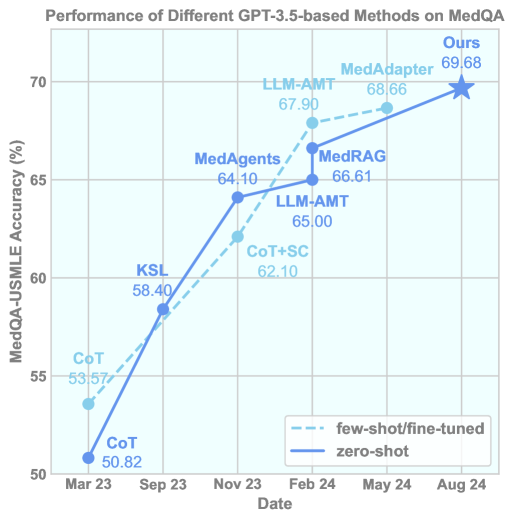
この論文では、大規模言語モデル(LLMs)が繰り返しフォローアップ質問を生成することで、医療QAのパフォーマンスを向上させる、i-MedRAGというリtrieval-augmented generationフレームワークを提案する。RAGを用いて複数ラウンドにわたってクエリを精錬することで、GPT-3.5を用いたMedQAデータセット上で69.68%の新しいゼロショット精度を達成し、従来のプロンプト工学およびファインチューニング手法をすべて上回った。
The emergent abilities of large language models (LLMs) have demonstrated great potential in solving medical questions. They can possess considerable medical knowledge, but may still hallucinate and are inflexible in the knowledge updates. While Retrieval-Augmented Generation (RAG) has been proposed to enhance the medical question-answering capabilities of LLMs with external knowledge bases, it may still fail in complex cases where multiple rounds of information-seeking are required. To address such an issue, we propose iterative RAG for medicine (i-MedRAG), where LLMs can iteratively ask follow-up queries based on previous information-seeking attempts. In each iteration of i-MedRAG, the follow-up queries will be answered by a conventional RAG system and they will be further used to guide the query generation in the next iteration. Our experiments show the improved performance of various LLMs brought by i-MedRAG compared with conventional RAG on complex questions from clinical vignettes in the United States Medical Licensing Examination (USMLE), as well as various knowledge tests in the Massive Multitask Language Understanding (MMLU) dataset. Notably, our zero-shot i-MedRAG outperforms all existing prompt engineering and fine-tuning methods on GPT-3.5, achieving an accuracy of 69.68% on the MedQA dataset. In addition, we characterize the scaling properties of i-MedRAG with different iterations of follow-up queries and different numbers of queries per iteration. Our case studies show that i-MedRAG can flexibly ask follow-up queries to form reasoning chains, providing an in-depth analysis of medical questions. To the best of our knowledge, this is the first-of-its-kind study on incorporating follow-up queries into medical RAG. The implementation of i-MedRAG is available at https://github.com/Teddy-XiongGZ/MedRAG.
研究の動機と目的
- 医療分野における複雑で多段階の臨床的推論タスクを処理する際の、vanilla RAGの限界を克服すること。
- フォローアップクエリを通じた繰り返しの情報探索によって、LLMsのホリダシネーションと知識の陳腐化を低減すること。
- ファインチューニングを必要としない一般化可能でゼロショットのフレームワークを開発し、LLMの医療QAパフォーマンスを向上させること。
- 繰り返しクエリ生成のスケーリング行動(反復回数および1回あたりのクエリ数)を定量化すること。
- 事例研究を通じて、繰り返し推論チェーンが複雑な臨床症例をどのように解消するかを示すこと。
提案手法
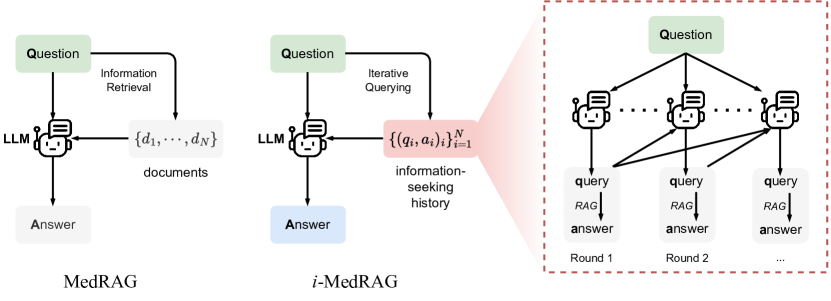
- フレームワークは、前回のリトリーブ結果と回答履歴に基づいて、LLMにフォローアップクエリを生成させる。
- 各フォローアップクエリは、vanilla RAGシステムを経由して処理され、関連ドキュメントのリトリーブと回答の生成が行われる。
- リトリーブされた回答が、次の反復におけるクエリ生成の精錬に使用され、推論チェーンが形成される。
- 各ステップで、得られる情報の的を絞る精度と関連性が向上するように、複数の反復を繰り返す。
- 最終的な回答は、すべてのリトリーブされた情報と推論ステップを統合してLLMが生成する。
- この手法はゼロショット設定で適用され、ファインチューニングやタスク固有のプロンプト工学を一切必要としない。
実験結果
リサーチクエスチョン
- RQ1繰り返しフォローアップクエリ生成は、複雑な医療QAタスクにおけるLLMsのパフォーマンスを向上させることができるか?
- RQ2反復回数および1回あたりのクエリ数が、リトリーブ拡張推論プロセスのパフォーマンスにどのように影響するか?
- RQ3モデルのファインチューニングを必要としないi-MedRAGは、既存のプロンプト工学およびファインチューニング手法を上回ることができるか?
- RQ4GPT-3.5やLlama-3.1-8Bなどの異なるLLMが、多様な医療データセットでi-MedRAGをどのように処理するか?
- RQ5繰り返しクエリを使用する際、LLMsが形成する推論チェーンの種類は何か?また、それらはどのように回答の正確性を向上させるか?
主な発見
- i-MedRAGは、GPT-3.5を用いたMedQAデータセットで69.68%の新しいゼロショット精度を達成し、すべての従来のプロンプト工学およびファインチューニング手法を上回った。
- フレームワークは、MedQAのUSMLEサブセットからの複雑な臨床的質問およびMMLU-Medデータセットでのパフォーマンスを顕著に向上させた。
- パフォーマンスは反復回数および1回あたりのクエリ数に比例して向上するが、ある閾値を超えると逓減効果が見られた。
- 事例研究では、i-MedRAGがLLMsが的を絞ったクエリを通じて診断や治療法を段階的に絞り込むことで、整合性のある推論チェーンを形成できることを示した。
- 複数回のリトリーブラウンドにわたって、得られた証拠に根拠を置くことで、ホリダシネーションが効果的に低減された。
- i-MedRAGは、閉鎖型(GPT-3.5)およびオープンソース型(Llama-3.1-8B)の両方のLLMで、多様な医療QAベンチマークにおいて一般化能力を示した。
この論文を読む
Nubintのビューアで原文を開き、読みながら気になる箇所をすぐに質問できます。
Nubintでこの論文を読むこのレビューはAIが論文の原文をもとに作成しました。引用する前に原文をご確認ください。