
[論文レビュー] In-Context Unlearning: Language Models as Few Shot Unlearners
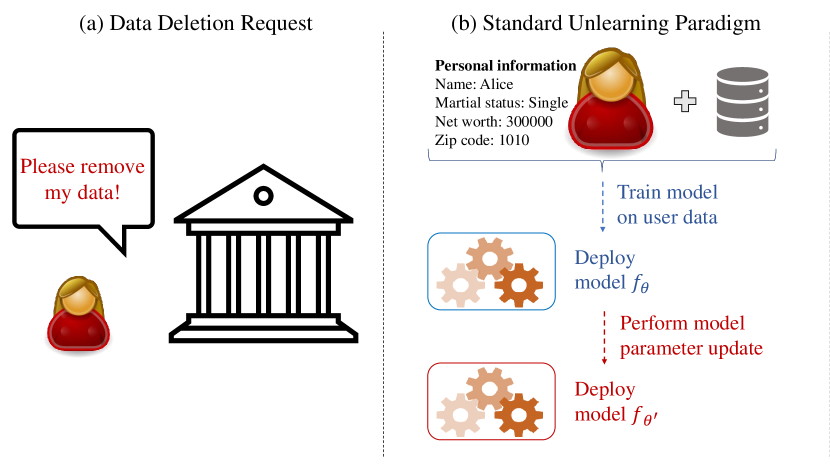
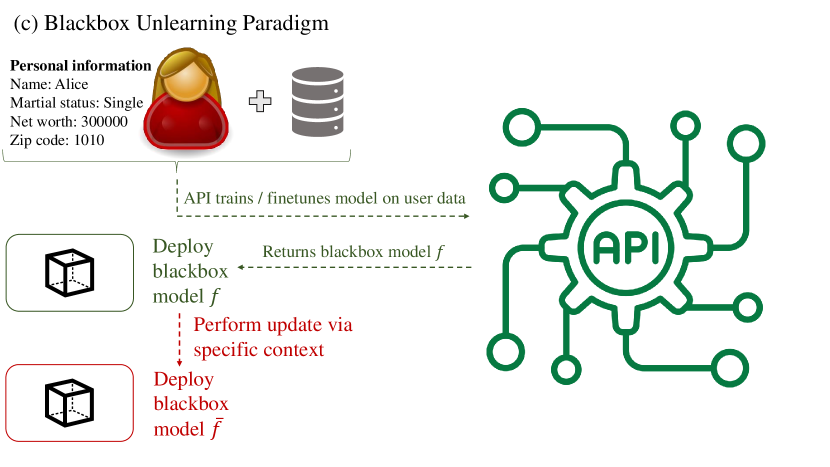
本論文は In-Context Unlearning (ICUL) を提案する。これはブラックボックス手法で、推論時に特定の学習点を反転させ、正しくラベル付けされた例を追加することで“忘却”を行い、テキスト分類タスクでパラメータアクセス型の忘却法と競合する性能を達成する。
Machine unlearning, the study of efficiently removing the impact of specific training instances on a model, has garnered increased attention in recent years due to regulatory guidelines such as the \emph{Right to be Forgotten}. Achieving precise unlearning typically involves fully retraining the model and is computationally infeasible in case of very large models such as Large Language Models (LLMs). To this end, recent work has proposed several algorithms which approximate the removal of training data without retraining the model. These algorithms crucially rely on access to the model parameters in order to update them, an assumption that may not hold in practice due to computational constraints or having only query access to the LLMs. In this work, we propose a new class of unlearning methods for LLMs called ``In-Context Unlearning.'' This method unlearns instances from the model by simply providing specific kinds of inputs in context, without the need to update model parameters. To unlearn specific training instances, we present these instances to the LLMs at inference time along with labels that differ from their ground truth. Our experimental results demonstrate that in-context unlearning performs on par with, or in some cases outperforms other state-of-the-art methods that require access to model parameters, effectively removing the influence of specific instances on the model while preserving test accuracy.
研究の動機と目的
- プライバシーと著作権上の懸念(忘れられる権利、モデルからのデータ削除)に基づく機械的忘却の必要性を動機づける。
- パラメータ更新や再訓練を必要としないLLM向けの新しい忘却パラダイムを提案する。
- インコンテキスト忘却が、タスク性能を維持しつつ特定の学習点の影響を効果的に消去できることを示す。
- ブラックボックスLLMを用いた実世界のテキスト分類データセットでICULの実用性を実証する。
提案手法
- インコンテスト学習を定義し、忘れられた点のラベルを反転させ、追加の正しくラベル付けされた文脈例を含めるプロンプトを構築することで、インコンテキスト忘却(ICUL)へ拡張する。
- 3ステップのICULプロンプトを構築する:(1) 忘却点のラベルを反転、(2) 正しくラベル付けされた訓練例sを追加、(3) 問い合わせ入力を付与し、温度0で予測。
- モデルパラメータにアクセスできない状態で、LiRA-Forgetに着想を得た統計を用いて、更新後モデルと再訓練したベースラインを比較評価する。
- パラメータアクセスを持つ勾配上昇型忘却ベースラインと、データセットとモデルサイズを横断してICULを比較する。
- アブレーションを通じて、プロンプト長さ(s)とラベル反転の必要性の影響を分析する。
- 微調整と評価には3つのデータセット(SST-2、Yelp、Amazon polarity)とBloom LLMs(560Mおよび1.1Bパラメータ)を使用する。
実験結果
リサーチクエスチョン
- RQ1ICULは、パラメータを更新せずに特定の学習点の影響を除去できるか?
- RQ2忘却点の識別性と全体的な精度の観点で、ICULは白-box忘却法とどう比較されるか?
- RQ3プロンプト長さとラベル反転が忘却効果に与える影響は?
- RQ4ICULの結果は異なるデータセットやモデルスケールで一般化するか?
主な発見
- ICUL のインコンテキスト忘却は LiRA-Forget スタイルのテストでランダム推測行動に近接しており、標的点の忘却が成功していることを示唆する。
- ICULはデータセットとモデルサイズを横断してGAベースラインより一貫して低いAUCを達成し、忘却点のリンク不可能性が強いことを示す。
- 忘却後に未知のテスト点で競争力のある全体性能を維持し、忘却点の精度はテスト点の性能に近づく。
- アブレーションから、特定のラベル反転と複数の正しくラベル付けされた文脈例を追加することが、ただ文脈を追加するだけではなく、効果的な忘却には不可欠であることが分かる。
- SST-2、Yelp、Amazon polarity での結果は、テキスト分類におけるLLMsのブラックボックス忘却の実現性を示す。
この論文を読む
Nubintのビューアで原文を開き、読みながら気になる箇所をすぐに質問できます。
Nubintでこの論文を読むこのレビューはAIが論文の原文をもとに作成しました。引用する前に原文をご確認ください。