
[論文レビュー] Inference-Time Intervention: Eliciting Truthful Answers from a Language Model
ITI は推論時に真実性に関連する注意ヘッドの疎な集合の活性化を選択的にシフトし、TruthfulQA での真実性を高める一方で、役立ちや追加計算の最小化のトレードオフを伴う。
We introduce Inference-Time Intervention (ITI), a technique designed to enhance the "truthfulness" of large language models (LLMs). ITI operates by shifting model activations during inference, following a set of directions across a limited number of attention heads. This intervention significantly improves the performance of LLaMA models on the TruthfulQA benchmark. On an instruction-finetuned LLaMA called Alpaca, ITI improves its truthfulness from 32.5% to 65.1%. We identify a tradeoff between truthfulness and helpfulness and demonstrate how to balance it by tuning the intervention strength. ITI is minimally invasive and computationally inexpensive. Moreover, the technique is data efficient: while approaches like RLHF require extensive annotations, ITI locates truthful directions using only few hundred examples. Our findings suggest that LLMs may have an internal representation of the likelihood of something being true, even as they produce falsehoods on the surface.
研究の動機と目的
- LLMs に出力に表れない潜在的な真実表現が存在するかを調査する。
- 完全なモデル微調整を伴わず、真実な出力を得るための最小限の侵襲的手法を開発する。
- TruthfulQA 及び関連ベンチマークにおける ITI の性能を評価し、有用性とのトレードオフを分析する。
- アプローチのデータ効率と計算オーバーヘッドを評価する。
- ITI の他データセットや指示調整済みモデルへの一般化を探る。
提案手法
- TruthfulQA で真実性と相関する活性化をもつスパースな注意ヘッドを同定する。
- 活性空間で真実性方向を計算する( probing directions )。
- 推論時に、トップ K ヘッドの真実性方向に沿って活性化をシフトする介入を適用する。強度パラメータ α を用いて x_{l+1}=x_{l}+ sum_h Q_l^h(Att_l^h(P_l^h x_l)) + alpha sigma_l^h theta_l^h の形で介入を行う。
- 各トークン予測ごとにオートレグレッシブに介入を適用する。
- 真実性(true*informative score)と他の側面の劣化(CE および KL で測定)とのトレードオフをとるよう K と α を調整する。
- ITI をベースライン(SFT、Few-shot prompting、IFT 変種)および他の方向戦略(probe weight、mass mean shift、CCS)と比較する。

実験結果
リサーチクエスチョン
- RQ1LLMs の活性化における潜在的な真実関連方向を特定・活用して、再訓練なしで真実度の高い出力を得られるか。
- RQ2最小限の介入的推論時介入が TruthfulQA の性能を実質的に改善し、モデル挙動と効率にどのような代償が生じるか。
- RQ3ITI は TruthfulQA を超える他の指示調整モデルや真実関連ベンチマークに一般化するか。
- RQ4真実性と有用性の最適なバランスはどのくらいで、ハイパーパラメータの K と α はこのトレードオフにどう影響するか。
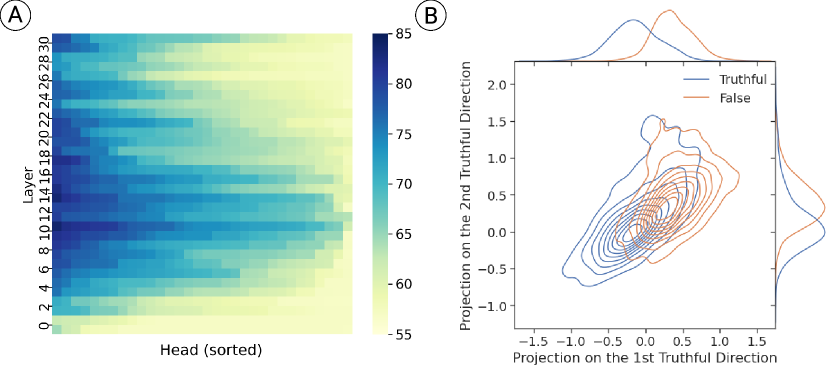
- RQ5真実関連方向はヘッドの一部に疎で局在的であり、その幾何学的構造はどうなっているか。
主な発見
- ITI は TruthfulQA において substantial な改善をもたらす(例: Alpaca は true*info が 32.5% から 65.1%、ITI で、Vicuna は 51.5% から 74.0% へ)。
- トップの真実関連ヘッドの疎な集合に介入することは効果的で、侵襲性が少ない。
- Mass mean shift は介入ベクトルの他の方向(ランダムや CCS を含む)より一般的に優れている。
- ITI は生成全体の分布を保持するか、適切な調整で modest な変化を示す(CE および KL は比較的低いまま)。
- ITI は TruthfulQA 以外の追加ベンチマークでも一定の改善を示すが、Natural Questions や TriviaQA では小さく、MMLU では大きく向上しており、部分的な一般化を示唆する。
- 真実関連の方向は数百のラベル付き例だけで学習可能であり、データ効率の良い probing で見つけることができる。
この論文を読む
Nubintのビューアで原文を開き、読みながら気になる箇所をすぐに質問できます。
Nubintでこの論文を読むこのレビューはAIが論文の原文をもとに作成しました。引用する前に原文をご確認ください。