
[論文レビュー] Investigating the Catastrophic Forgetting in Multimodal Large Language Models
本論文は EMT を導入し、マルチモーダル LLMs を画像分類器として扱うことで壊滅的忘却を評価するフレームワークを提案する。多くのファインチューニングされた MLLMs が元のビジョンエンコーダーとの整合性を失い、ファインチューニング中に幻覚を示すことを明らかにする。また、LLaVA の異なるファインチューニングレジームが一般化と幻覚にどのように影響するかを分析する。
Following the success of GPT4, there has been a surge in interest in multimodal large language model (MLLM) research. This line of research focuses on developing general-purpose LLMs through fine-tuning pre-trained LLMs and vision models. However, catastrophic forgetting, a notorious phenomenon where the fine-tuned model fails to retain similar performance compared to the pre-trained model, still remains an inherent problem in multimodal LLMs (MLLM). In this paper, we introduce EMT: Evaluating MulTimodality for evaluating the catastrophic forgetting in MLLMs, by treating each MLLM as an image classifier. We first apply EMT to evaluate several open-source fine-tuned MLLMs and we discover that almost all evaluated MLLMs fail to retain the same performance levels as their vision encoders on standard image classification tasks. Moreover, we continue fine-tuning LLaVA, an MLLM and utilize EMT to assess performance throughout the fine-tuning. Interestingly, our results suggest that early-stage fine-tuning on an image dataset improves performance across other image datasets, by enhancing the alignment of text and visual features. However, as fine-tuning proceeds, the MLLMs begin to hallucinate, resulting in a significant loss of generalizability, even when the image encoder remains frozen. Our results suggest that MLLMs have yet to demonstrate performance on par with their vision models on standard image classification tasks and the current MLLM fine-tuning procedure still has room for improvement.
研究の動機と目的
- マルチモーダル大規模言語モデル(MLLMs)における壊滅的忘却を動機づけ、定量化する。
- 視覚エンコーダの能力の記憶保持を評価するため、MLLMs を画像分類器として扱う評価フレームワークである EMT を開発する。
- オープンソースモデルと LLaVA を用いた実験を通じて、ファインチューニングが MLLMs に与える影響を調査する。
- 幻覚などの故障モードを検討し、中程度のファインチューニングが一般化を改善できる条件を特定する。
提案手法
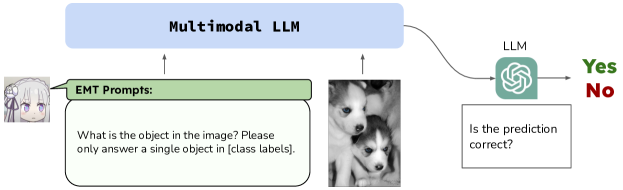
- EMT を導入する:MLLM に画像分類を促し、その出力を後処理して正確性を得る二段階の評価。
- 各 MLLM を画像分類器として扱い、ゼロショットの視覚エンコーダ性能をファインチューニング後の性能と比較する。
- 各データセットに対して MLLM 出力の正確さを評価するため、二次的な LLM(GPT-3.5)を用いる。
- オープンソース MLLMs(LLaVA, Otter, InstructBLIP, LENS)に EMT を適用し、忘却と幻覚を診断する。
- LLaVA(7b および 13b)を線形および LoRA アダプタでファインチューニングし、エポックごとの性能を監視するために EMT を適用する。
- 誤った予測、内在的幻覚、外在的幻覚などの故障モードを分析する。
実験結果
リサーチクエスチョン
- RQ1オープンソースのファインチューニング済み MLLMs は、標準的な画像タスクにおいてビジョンエンコーダと同等の分類性能を維持しているか?
- RQ2マルチモーダル LLM のファインチューニングは、データセット間の一般化能力と幻覚傾向にどのように影響するか?
- RQ3ファインチューニング中に MLLMs の性能低下の主な原因は何か?
- RQ4中程度のファインチューニングは、著しい忘却や幻覚を伴わずに特徴の整合を改善できるか?
主な発見
- 評価において、ほとんどのテスト済みオープンソース MLLMs は、視覚エンコーダと同じ分類精度を保持できない。
- 幻覚は性能低下の主要因であり、複数のラベルを出力したり検証不能な説明を含むことがある。
- LLaVA のファインチューニングは初期段階の調整でデータセット間の整合性を改善する可能性を示す一方で、過度のファインチューニングは幻覚と一般化の低下を招く。
- 中程度のファインチューニングはファインチューニングされていないタスクの性能を改善し、特徴の整合性が向上することを示す一方、過学習は忘却と幻覚を引き起こす。
- 基本の言語モデルの選択(例:LLaMA 対 Flan-T5)は忘却の程度に影響を及ぼす可能性があり、いくつかのモデルではより大きな欠陥を示す。
この論文を読む
Nubintのビューアで原文を開き、読みながら気になる箇所をすぐに質問できます。
Nubintでこの論文を読むこのレビューはAIが論文の原文をもとに作成しました。引用する前に原文をご確認ください。