
[論文レビュー] Investigating the role of model-based learning in exploration and transfer
本論文は、報酬なしの環境で内因的探索を用いてエージェントを事前学習し、その後のダウンストリームタスクで微調整することにより、モデルベース強化学習が転移学習をどのように向上させるかを調査する。モデルベースエージェントが転移性能においてモデルフリーのベースラインを上回ることを示しており、特に分布内条件下では、ダイナミクスモデルとポリシー事前分布が成功の鍵を握っていることが明らかになった。
State of the art reinforcement learning has enabled training agents on tasks of ever increasing complexity. However, the current paradigm tends to favor training agents from scratch on every new task or on collections of tasks with a view towards generalizing to novel task configurations. The former suffers from poor data efficiency while the latter is difficult when test tasks are out-of-distribution. Agents that can effectively transfer their knowledge about the world pose a potential solution to these issues. In this paper, we investigate transfer learning in the context of model-based agents. Specifically, we aim to understand when exactly environment models have an advantage and why. We find that a model-based approach outperforms controlled model-free baselines for transfer learning. Through ablations, we show that both the policy and dynamics model learnt through exploration matter for successful transfer. We demonstrate our results across three domains which vary in their requirements for transfer: in-distribution procedural (Crafter), in-distribution identical (RoboDesk), and out-of-distribution (Meta-World). Our results show that intrinsic exploration combined with environment models present a viable direction towards agents that are self-supervised and able to generalize to novel reward functions.
研究の動機と目的
- モデルベース学習が強化学習における転移学習をどのように改善するか、その時期と理由を理解すること。
- 転移過程における、ポリシー、ダイナミクスモデル、表現の各コンポonentが果たす寄与を分離して同定すること。
- 分布シフトの度合い(分布内 vs. 分布外)が異なる環境において、転移性能を評価すること。
- 同一のアーキテクチャと内因的探索メカニズムを用いたモデルベースとモデルフリーのエージェントを比較すること。
- 事前学習段階での環境ダイナミクスの学習と探索品質の向上が、ダウンストリームタスクにおける一般化性能に与える影響を評価すること。
提案手法
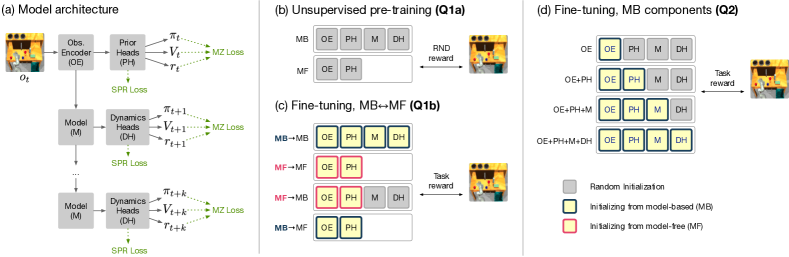
- 報酬なしの環境で、ランダムネットワーク分散(RND)を用いた内因的探索によりエージェントを事前学習する。
- 自己教師付きMuZeroの変種(自己予測表現(SPR)を備える)を用い、ポリシーとダイナミクスモデルを同時に学習する。
- タスク固有の報酬を用いて、事前学習済みエージェントをダウンストリームタスクで微調整し、特定のコンポーネント(例:ダイナミクスモデル、ポリシー事前分布)を転送する。
- 特定のコンポーネント(例:ポリシーまたはダイナミクス)を再初期化することでアブレーションスタディを実施し、転送に与える寄与を分離する。
- プロシージャル(Crafter)、同一(RoboDesk)、分布外(Meta-World)の3つのドメインで性能を評価する。
- リターン曲線とゼロショット転送指標を用いて、モデルベースとモデルフリーの転送性能を比較する。
実験結果
リサーチクエスチョン
- RQ1タスク報酬が存在しない状況下で、モデルベース探索はモデルフリー探索よりも優れた転送性能をもたらすか?
- RQ2モデルベースエージェントのうち、ポリシー、ダイナミクスモデル、または表現のどのコンポーネントが成功した転送に最も寄与しているか?
- RQ3環境のシフト(例:分布外のダイナミクス)は、事前学習から得た知識の微調整への転送性にどのように影響するか?
- RQ4モデルベース学習の利点は、プロシージャル、同一、分布外のさまざまな環境分布タイプにおいて一貫しているか?
主な発見
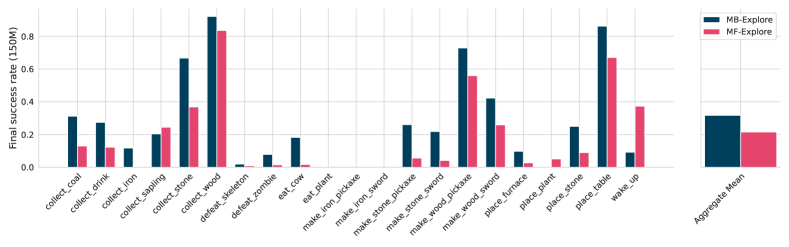
- モデルベースエージェントは、内因的探索およびダウンストリームの微調整の両方において、モデルフリーのベースラインを上回っており、特に分布内設定下で顕著である。
- ダイナミクスモデルとポリシー事前分布の両方を転送することで、最も高い転送パフォーマンスが達成され、両コンポーネントが不可欠であることが示された。
- ダイナミクスモデルがダウンストリームタスクと同じ環境で学習された場合、モデルベースの利点が最も顕著に現れた。
- Meta-Worldのような分布外設定では、転送パフォーマンスが著しく低下し、エージェントのダイナミクス知識が正の転送に十分でないことがわかった。
- Meta-Worldでは、モデルベースの転送は、ランダム初期化に比べて最大約2000万フレームの早期学習段階でのみわずかな利点を示すにとどまり、高い分布シフト下での一般化能力が限られていることが示唆された。
- Crafterにおけるプロシージャルな変化は、事前学習段階でのダイナミクスの豊富な露出により、新しい報酬関数への一般化が促進されるため、転送を向上させる要因となっている可能性がある。
この論文を読む
Nubintのビューアで原文を開き、読みながら気になる箇所をすぐに質問できます。
Nubintでこの論文を読むこのレビューはAIが論文の原文をもとに作成しました。引用する前に原文をご確認ください。