
[論文レビュー] Is ChatGPT a General-Purpose Natural Language Processing Task Solver?
本論文は、7つのタスクカテゴリーで20のデータセットにわたるChatGPTのゼロショットNLP能力を実証的に分析し、推論・対話の性能は高い一方で、シーケンスタグ付けの制約とタスク特化の微調整と比較した場合の全体的な同等性には限界があると結論付けている。
Spurred by advancements in scale, large language models (LLMs) have demonstrated the ability to perform a variety of natural language processing (NLP) tasks zero-shot -- i.e., without adaptation on downstream data. Recently, the debut of ChatGPT has drawn a great deal of attention from the natural language processing (NLP) community due to the fact that it can generate high-quality responses to human input and self-correct previous mistakes based on subsequent conversations. However, it is not yet known whether ChatGPT can serve as a generalist model that can perform many NLP tasks zero-shot. In this work, we empirically analyze the zero-shot learning ability of ChatGPT by evaluating it on 20 popular NLP datasets covering 7 representative task categories. With extensive empirical studies, we demonstrate both the effectiveness and limitations of the current version of ChatGPT. We find that ChatGPT performs well on many tasks favoring reasoning capabilities (e.g., arithmetic reasoning) while it still faces challenges when solving specific tasks such as sequence tagging. We additionally provide in-depth analysis through qualitative case studies.
研究の動機と目的
- 多様なタスクにわたって、ChatGPTがゼロショットの汎用NLPタスク解決者として機能し得るかを評価する。
- 推論を要するタスクを特に含む、ChatGPTが優れているタスクを特徴づけ、苦手とするタスクを特定する。
- ChatGPTのゼロショット性能をGPT-3.5および微調整済みまたはfew-shotモデルの結果と比較する。
- 定性的な例を通じて、ChatGPTの強みと限界について洞察を提供する。
提案手法
- 7つのタスクカテゴリーにまたがる20のNLPデータセットで、ChatGPT(gpt-3.5-turbo)とGPT-3.5(text-davinci-003)を評価する。
- 推論タスクに対してゼロショットの連鎖思考を得るために、二段階 promptingを用いて推論過程と最終解を引き出す。
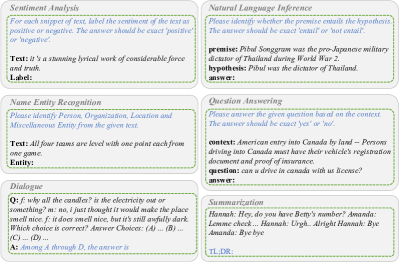
- 既存の研究の確立されたプロンプトに基づくタスク指示を取り入れて、入力を標準化する。
- 文献の few-shot および微調整済みベースラインと、チェーン・オブ・思考有無のゼロショットの結果を比較する。
- 算術、常識、記号的/論理的推論、NLI、QA、対話、要約、NER、感情分析にわたる結果を分析する。
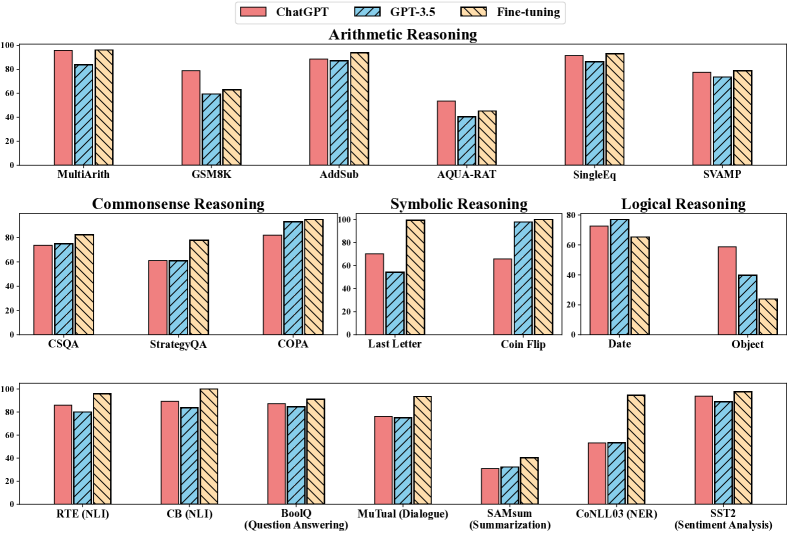
実験結果
リサーチクエスチョン
- RQ1ゼロショット設定におけるChatGPTは汎用NLPタスク解決手段となり得るか。
- RQ2ゼロショット設定でChatGPTはどのタスクタイプで良いまたは悪いパフォーマンスを示すか。
- RQ3特定タスクでChatGPTがタスク固有のモデルや微調整済みモデルを上回るまたは下回るのはなぜか。
主な発見
- 推論と対話能力を活かすタスクでChatGPTは高い性能を示す。
- 多くのタスク、特にシーケンスタグ付けでは、ChatGPTはタスク固有の微調整モデルと比較してしばしば劣る。
- 自然言語推論と推論に依存する特定のQAタスクで、ChatGPTはGPT-3.5より改善されている。
- 算術推論ではChatGPTがGPT-3.5を上回り、ゼロショット-CoTはデータセット全体で性能をさらに向上させる。
- ChatGPTはGPT-3.5より長く、制御が弱い要約を生成するため、長さが制約されていない場合ROUGEスコアを低下させる。
- 専門的な微調整モデルと比べると、ChatGPTとGPT-3.5はNERを含むシーケンスタグ付けに難を示す。
- 感情分析では、ChatGPTは一般的にGPT-3.5を上回るが、トレーニングデータの差に起因するクラス条件的なばらつきがある可能性がある。
この論文を読む
Nubintのビューアで原文を開き、読みながら気になる箇所をすぐに質問できます。
Nubintでこの論文を読むこのレビューはAIが論文の原文をもとに作成しました。引用する前に原文をご確認ください。