
[論文レビュー] JADES: Carbon enrichment 350 Myr after the Big Bang in a gas-rich galaxy
この論文は z=12.5 の銀河(ターゲット)を深い JWST/NIRSpec 分析で報告しており、堅牢な C iii] 放出線を示唆し、太陽系または超太陽系の C/O および膨大なガス貯蔵を意味しており、Cosmic Dawn における標準的な化学的富化シナリオに挑戦する。
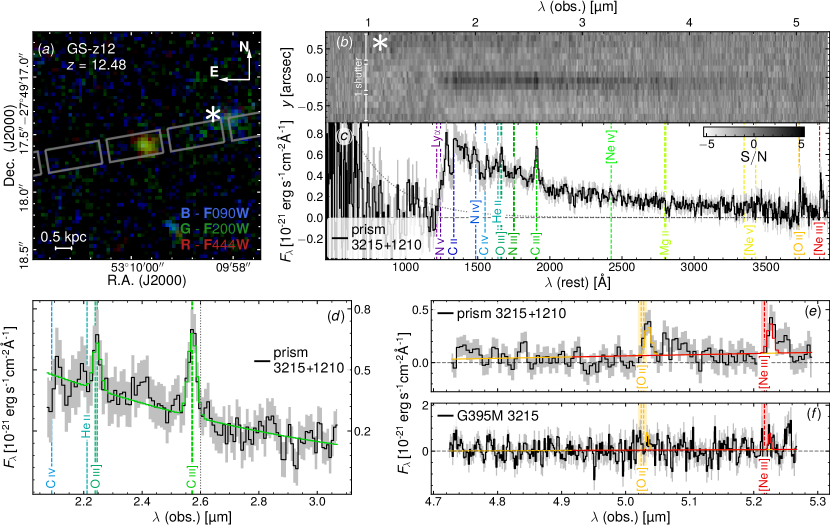
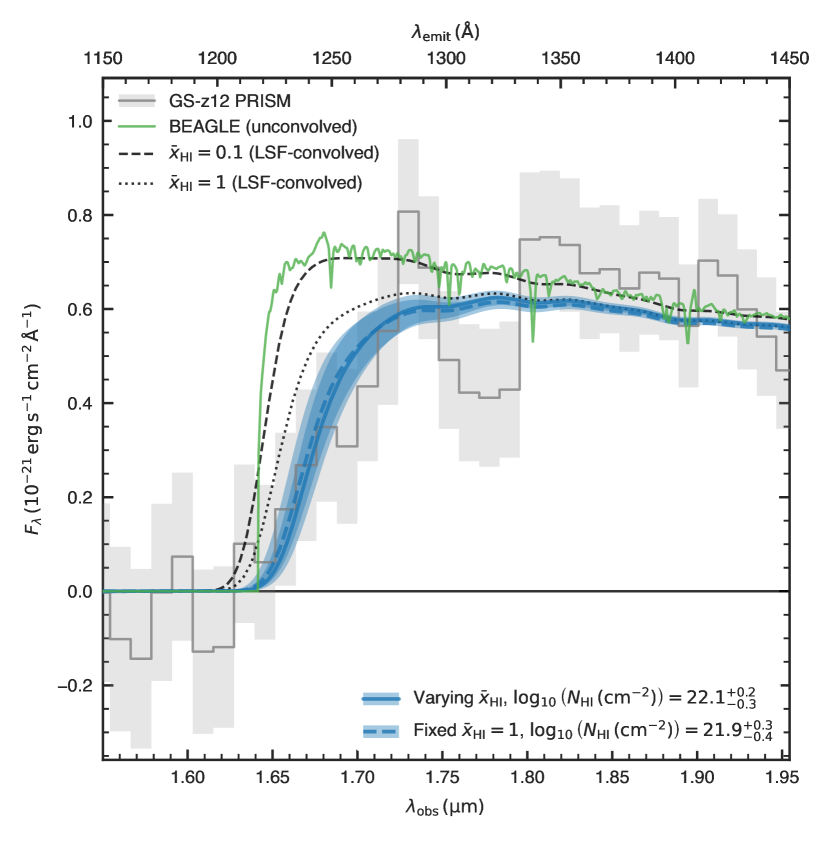
Finding the emergence of the first generation of metals in the early Universe, and identifying their origin, are some of the most important goals of modern astrophysics. We present deep JWST/NIRSpec spectroscopy of GS-z12, a galaxy at z=12.5, in which we report the detection of C III]$λλ$1907,1909 nebular emission. This is the most distant detection of a metal transition and the most distant redshift determination via emission lines. In addition, we report tentative detections of [O II]$λλ$3726,3729 and [Ne III]$λ$3869, and possibly O III]$λλ$1661,1666. By using the accurate redshift from C III], we can model the Ly$α$ drop to reliably measure an absorbing column density of hydrogen of $N_{HI} \approx 10^{22}$ cm$^{-2}$ - too high for an IGM origin and implying abundant ISM in GS-z12 or CGM around it. We infer a lower limit for the neutral gas mass of about $10^7$ MSun which, compared with a stellar mass of $\approx4 imes 10^7$ MSun inferred from the continuum fitting, implies a gas fraction higher than about 0.1-0.5. We derive a solar or even super-solar carbon-to-oxygen ratio, tentatively [C/O]>0.15. This is higher than the C/O measured in galaxies discovered by JWST at z=6-9, and higher than the C/O arising from Type-II supernovae enrichment, while AGB stars cannot contribute to carbon enrichment at these early epochs and low metallicities. Such a high C/O in a galaxy observed 350 Myr after the Big Bang may be explained by the yields of extremely metal poor stars, and may even be the heritage of the first generation of supernovae from Population III progenitors.
研究の動機と目的
- z=12.5 の銀河における金属線を深い JWST/NIRSpec 分光法で識別・特徴付けする。
- Nebular 放出線と連続体モデル化を通じて赤方偏移、ガス含量、および金属量を制約する。
- 初期宇宙における炭素-酸素比と可能性のある富化経路を推定する。
提案手法
- プリズムおよび G140M/G395M グレーティングを用い、約100 時間の積分で深い NIRSpec 分光を取得する。
- 5-シグマ検出閾値を用いた局所ピクセル統合ガウスモデルで放出線フィッティングを行い、安全な線を確保する。
- BEAGLE を用いて星間連続体、霧膜放出、塵減衰、SFH(遅延指数形)および IMF 上限質量を 300 M_sun としてモデル化する。
- intrinsic BEAGLE スペクトルと DLA および IGM 吸収モデルを組み合わせて Ly-α 抑制翼吸収を制約し N_HI を導出する。
- τ_V を基準とした減衰と DLA様金属量推定からガス質量と金属量を導出し、減衰処理と減衰の系統誤差を認識する。
実験結果
リサーチクエスチョン
- RQ1Big Bang 後 350 Myr に観測された銀河の化学組成と C/O 比はどのようになるか。
- RQ2銀河の ISM/CGM に Cold で金属乏しいガスの大規模貯蔵が存在するか。
- RQ3C iii] および他の Nebular 線が z>12 でのガス質量、金属量、および星形成特性を制約できるか。
- RQ4観測された豊富さは Population III/初期星の生産性増大による富化源を示唆するか。
主な発見
- 5-sigma での C iii] 1907,1909 の検出、これまでで最も遠い金属線検出。
- 赤方偏移は z = 12.482 ± 0.012 に制約(C iii] のみでは z = 12.479 ± 0.014)。
- ガス相酸素 abundance は log O/H = 7.9 ± 0.2 と推定され、C/O が log C/O > 0.15(BEAGLE フィットでは C/O ≳ 1.4 倍太陽)に相当する太陽系以上の割合。
- ISM/CGM における中性水素カラム密度は log10 N_HI(cm^-2) = 22.1^{+0.2}_{-0.3}(基準値)、IGM の寄与を超える致密な中性ガスを示唆。
- 推定された原子ガス質量 log(M_gas/M_sun) = 7.0 ± 0.25、ガス相の仮定により星質量の10–50% を占める substantial ガス貯蔵を示唆。
- 高い C/O および金属乏しいガスは非常に金属量が乏しい星の生成物に一致する兆候を示唆し、Population III 起源と関連する可能性がある。
より良い研究を、今すぐ始めましょう
論文設計から論文執筆まで、研究時間を劇的に削減しましょう。
クレジットカード登録不要
このレビューはAIが作成し、人間の編集者が確認しました。