
[論文レビュー] Label-Retrieval-Augmented Diffusion Models for Learning from Noisy Labels
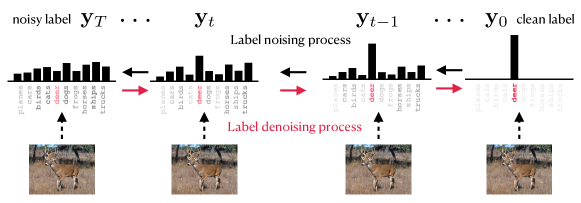
この論文は、ノイズのあるラベルからの学習を確率的条件付きラベル生成問題として再定義し、LRA-diffusionを導入します。これは近傍ラベル検索と事前学習エンコーダ(例:CLIP、SimCLR)を用いた拡散モデルを活用して、ノイズ付きラベルのベンチマークで最先端の性能を達成します。
Learning from noisy labels is an important and long-standing problem in machine learning for real applications. One of the main research lines focuses on learning a label corrector to purify potential noisy labels. However, these methods typically rely on strict assumptions and are limited to certain types of label noise. In this paper, we reformulate the label-noise problem from a generative-model perspective, $ extit{i.e.}$, labels are generated by gradually refining an initial random guess. This new perspective immediately enables existing powerful diffusion models to seamlessly learn the stochastic generative process. Once the generative uncertainty is modeled, we can perform classification inference using maximum likelihood estimation of labels. To mitigate the impact of noisy labels, we propose the $ extbf{L}$abel-$ extbf{R}$etrieval-$ extbf{A}$ugmented (LRA) diffusion model, which leverages neighbor consistency to effectively construct pseudo-clean labels for diffusion training. Our model is flexible and general, allowing easy incorporation of different types of conditional information, $ extit{e.g.}$, use of pre-trained models, to further boost model performance. Extensive experiments are conducted for evaluation. Our model achieves new state-of-the-art (SOTA) results on all the standard real-world benchmark datasets. Remarkably, by incorporating conditional information from the powerful CLIP model, our method can boost the current SOTA accuracy by 10-20 absolute points in many cases.
研究の動機と目的
- ノイズ付きラベルを従来の分類/維持法ではなく、生成プロセスの観点から学習させる動機付け。
- ノイズ下での条件付きラベル生成をモデル化する拡散ベースのフレームワークを開発。
- ラベル検索による近傍の一貫性を活用し、拡散学習のための疑似クリーンターゲットを作成。
- 強力な事前学習エンコーダ(例:CLIP、SimCLR)を組み込んで拡散過程を条件付け、性能を向上。
- 実世界のノイズ付きベンチマークでの最先端結果を示し、推論の加速で効率を評価。
提案手法
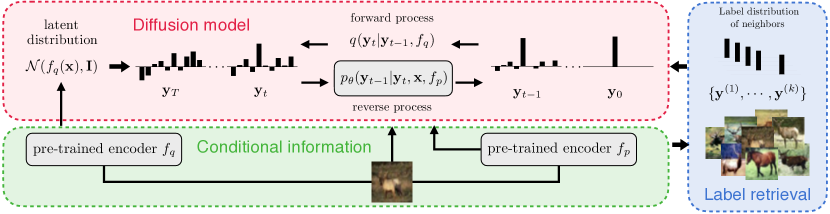
- 画像を条件としてラベルの条件付き分布を学習する拡散モデルのボディー(CARD)を採用。
- ラベル取得拡張を導入:学習済み特徴空間のk近傍からラベルを取得し、学習用の疑似クリーンターゲットを形成。
- 2つのエンコーダを使用:f_q(y_Tの平均推定値、場合により0)とf_p(高次元特徴抽出器)で拡散過程を条件付け。
- ELBO目的で訓練し、拡散ステップで予測ノイズを真のノイズと一致させる単純な損失を用いる。
- 一般化DDIMベースのサンプリングで推論を加速し、周辺分布を維持しつつステップ数を減らす。
- f_q = f_pを強制せず、CLIPのような大規模事前学習モデルをf_pとして統合する柔軟な条件付けを許容。
実験結果
リサーチクエスチョン
- RQ1ノイズ下でのラベル生成の確率過程を拡散モデルでどのようにモデル化できるか。
- RQ2学習済み特徴空間で近傍ラベルを取得することで、拡散ベースの分類器のノイズ耐性が向上するか。
- RQ3事前学習エンコーダ(例:CLIP、SimCLR)は条件付けを通じてノイズ付きラベルからの拗学習を強化できるか。
- RQ4拡散ベースのラベル推論におけるDDIMによる加速技術の効率向上は精度にどのように影響するか。
- RQ5LRA-diffusionは合成ノイズと実世界ノイズのベンチマークで、最先端手法と比べてどのように性能を発揮するか。
主な発見
- LRA-diffusionは標準的な実世界のノイズ付きラベルベンチマークで最先端の性能を達成。
- CLIP条件付き特徴の組み込みによって精度が大幅に向上し、従来手法より顕著な改善を示す。
- ラベル取得の拡張により拡散モデルが近傍ラベルから学習でき、ラベルノイズへの頑健性が向上。
- 一般化DDIMによる加速推論は、ステップ数を減らしても性能を維持しつつ計算量を削減。
- 合成ノイズベンチマーク(CIFAR-10/100)では、CLIPを用いたLRA-diffusionがPMDと混合ノイズ設定の基準法を大幅に上回る。
- 実世界の結果は、WebVision、ILSVRC2012、Food-101Nデータセットで従来手法を上回る強い改善を示す。
この論文を読む
Nubintのビューアで原文を開き、読みながら気になる箇所をすぐに質問できます。
Nubintでこの論文を読むこのレビューはAIが論文の原文をもとに作成しました。引用する前に原文をご確認ください。