
[論文レビュー] LaMAGIC: Language-Model-based Topology Generation for Analog Integrated Circuits
LaMAGIC は、仕様からアナログ回路トポロジを単一次元で生成するために言語モデルの教師付きファインチューニングを用い、0.01の許容度で最大 0.96 の成功率を達成し、より複雑な6部品回路への堅牢な転移を示す。
In the realm of electronic and electrical engineering, automation of analog circuit is increasingly vital given the complexity and customized requirements of modern applications. However, existing methods only develop search-based algorithms that require many simulation iterations to design a custom circuit topology, which is usually a time-consuming process. To this end, we introduce LaMAGIC, a pioneering language model-based topology generation model that leverages supervised finetuning for automated analog circuit design. LaMAGIC can efficiently generate an optimized circuit design from the custom specification in a single pass. Our approach involves a meticulous development and analysis of various input and output formulations for circuit. These formulations can ensure canonical representations of circuits and align with the autoregressive nature of LMs to effectively addressing the challenges of representing analog circuits as graphs. The experimental results show that LaMAGIC achieves a success rate of up to 96\% under a strict tolerance of 0.01. We also examine the scalability and adaptability of LaMAGIC, specifically testing its performance on more complex circuits. Our findings reveal the enhanced effectiveness of our adjacency matrix-based circuit formulation with floating-point input, suggesting its suitability for handling intricate circuit designs. This research not only demonstrates the potential of language models in graph generation, but also builds a foundational framework for future explorations in automated analog circuit design.
研究の動機と目的
- 複雑な仕様と拡大するカスタマイズ要件を考慮した自動化されたアナログ回路設計のニーズに対応する。
- 単一パスで回路トポロジをグラフとして生成する言語モデルベースのアプローチを開発する。
- 回路の標準表現を自動回帰に適した表現として生成する入力/出力形式を調査する。
- より複雑な(6部品)回路へのスケーラビリティと学習設計の転移性を評価する。
提案手法
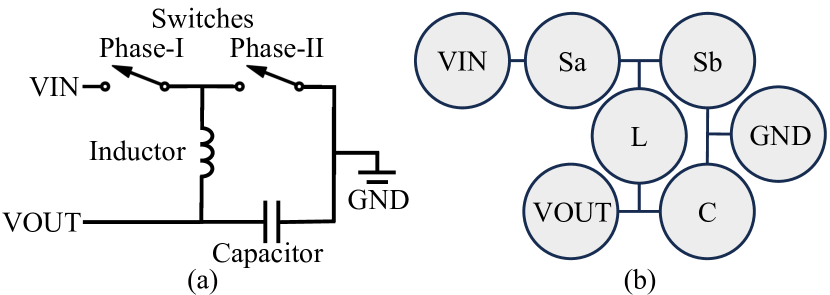
- エンコーダ-デコーダ型トランスフォーマー(Flan-T5-base, 248M parameters)によって生成される系列を用いて、回路設計をグラフ生成として定式化する。
- Naive Formulation (NF)、Canonical Form (CF)、New Duty Cycle Encodingを用いたCanonical Form (CFDC)、テキスト入力を伴う隣接行列ベース (PM)、および浮動小数点入力の隣接ベース (FM) の複数の入力/出力形式を比較する。
- 回路をエッジ生成とトポロジ生成タスクとして表現し、オート回帰損失とT5スタイルのマスク付き言語モデルを用いたグラフ生成を適用する。
- データをランダムな頂点順序の置換で増強し、順序不変性と一般化を向上させる。
- 3–6 コンポーネントで様々なデューティサイクルを含む、合成された NGSPICE 検証済み電力変換器データセットでモデルをファインチューニングし、許容度 t での成功率とターゲット仕様とシミュレーション性能の間の MSE で評価する。
実験結果
リサーチクエスチョン
- RQ1仕様から直接有効なアナログ回路トポロジを生成するように言語モデルをファインチューニングできるか?
- RQ2回路のオート回帰グラフ生成を最もサポートする入力/出力形式はどれか?
- RQ3より複雑な(6部品)回路へのスケールと、より小さなトポロジからの転移学習の性能はどの程度か?
- RQ4データ拡張と頂点順序置換が生成性能に与える影響は何か?
主な発見
- 最良の形式は naïve baseline を上回り、0.01 の許容度で最大 0.96 の成功率を達成する。
- 浮動小数点入力を用いる隣接ベースの形式(FM)は、複雑な6部品回路に対して高い性能と有益な転移性を示す。
- PM(テキストベースの隣接)と CF/CFDC はエッジ生成とトポロジ生成で強力な結果を示し、FM はより広い許容度でトポロジタスクにおいて優れている。
- エンコーダーのみのLMは回路生成で収束せず、オート回帰グラフ生成モデルの必要性を浮き彫りにする。
- データ拡張によるランダム頂点順序の置換は生成性能を向上させ、特に数値入力の形式で顕著。
- 6-component 転移実験では FM と PM が CF/CFDC より高い MSE耐性を示し、規模への頑健性を示唆。
この論文を読む
Nubintのビューアで原文を開き、読みながら気になる箇所をすぐに質問できます。
Nubintでこの論文を読むこのレビューはAIが論文の原文をもとに作成しました。引用する前に原文をご確認ください。