
[論文レビュー] LaneRCNN: Distributed Representations for Graph-Centric Motion Forecasting
LaneRCNNは、局所的な地図トポロジーと過去の軌跡を符号化するためのアクター固有のLaneRoI表現を用いるグラフ中心の運動予測モデルを提案する。これにより、グローバルなレーングラフを介したマップ認識型で分散型の相互作用モデリングが可能となり、Argoverseベンチマークにおいて最先端の性能を達成し、過去の手法と顕著な向上を示してリーダーボード1位を獲得した。
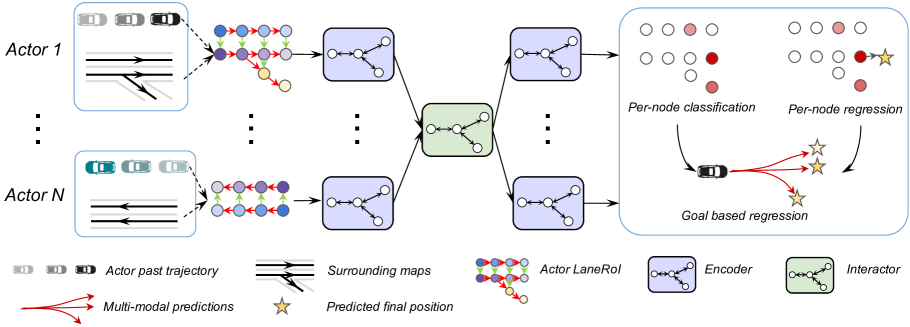
Forecasting the future behaviors of dynamic actors is an important task in many robotics applications such as self-driving. It is extremely challenging as actors have latent intentions and their trajectories are governed by complex interactions between the other actors, themselves, and the maps. In this paper, we propose LaneRCNN, a graph-centric motion forecasting model. Importantly, relying on a specially designed graph encoder, we learn a local lane graph representation per actor (LaneRoI) to encode its past motions and the local map topology. We further develop an interaction module which permits efficient message passing among local graph representations within a shared global lane graph. Moreover, we parameterize the output trajectories based on lane graphs, a more amenable prediction parameterization. Our LaneRCNN captures the actor-to-actor and the actor-to-map relations in a distributed and map-aware manner. We demonstrate the effectiveness of our approach on the large-scale Argoverse Motion Forecasting Benchmark. We achieve the 1st place on the leaderboard and significantly outperform previous best results.
研究の動機と目的
- 運動予測における単一ベクトル符号化の限界、特に空間的および地図構造の損失を解消すること。
- 完全に接続された相互作用グラフにおける単純化された仮定を避けるマップ認識型のアクター相互作用モデリング。
- 出力パrameterizationにおけるレーントポロジーをインダクティブバイアスとして活用することで、軌跡予測の正確性を向上させること。
- 局所化されたレーングラフ領域(LaneRoI)を通じて、アクターの文脈のより表現力があり分散型の表現を可能にすること。
提案手法
- 各アクターに対して、関連するレーンに沿ったノードを埋め込むことでLaneRoIを構築し、各ノードが局所的な運動と地図の意味を符号化する。
- 各LaneRoIを処理する専用エンコーダーが、細粒度の空間的およびトポロジカル情報の保持を可能にするノードレベルの埋め込みを生成する。
- アクター表現を共有のグローバルレーングラフに投影することで、重複するまたは相互作用するLaneRoI領域間での効率的なメッセージパッシングが可能になる。
- 学習可能なグラフ演算子を用いた相互作用モジュールが、LaneRoIノード間での情報伝搬を実現するが、アクターの過去の軌跡に沿って特徴をプールするショートカット機構により受容 field が強化される。
- LaneRoI内のノードをアンカーとして用い、完全に畳み込み型の方法で将来の軌跡を予測する。出力パrameterizationはレーン構造に基づく。
- デコードヘッドは、レーングラフ上の予測位置からの回帰によって、地図整合性のある完全な軌跡を生成する。

実験結果
リサーチクエスチョン
- RQ1分散型でグラフベースのアクター文脈表現は、単一ベクトル符号化を上回る運動予測性能を実現できるか?
- RQ2共有のグローバルレーングラフを介したマップ認識型相互作用モデリングは、完全に接続されたグラフと比較して予測精度をどのように向上させるか?
- RQ3将来の軌跡のパrameterizationにレーングラフを用いることで、非現実的または道路外の予測をどの程度低減できるか?
- RQ4軌跡認識型ショートカット機構は、特徴伝搬およびモデル性能にどのような影響を与えるか?
主な発見
- LaneRCNNは、Argoverseの運動予測リーダーボードで1位を獲得し、過去の最先端手法を顕著に上回った。
- モデルは、カーブレーン、交差点、障害物回避を含む複雑なシナリオにおいて優れた一般化性能を示し、正確なマルチモーダル予測を実現した。
- アクターの過去の軌跡に沿って特徴をプールする提案されたショートカット機構は、グローバル平均プーリングやセンター基準プーリングと比較して顕著な性能向上をもたらした。
- アブレーションスタディの結果、グローバルレーングラフを用いたマップ認識型相互作用は、容量を同等にした場合でも、完全に接続されたGNNやアテンション機構を上回った。
- 定性的な結果から、LaneRCNNは地図整合性のある軌跡を生成しており、カーブ旋回やレーン変更時の適切な速度を再現していることが確認された。
- 本手法は、譲り合い、追い越し、交差点付近での速度調整といった現実的な行動を効果的に捉えている。
より良い研究を、今すぐ始めましょう
論文の読解から最終レビューまで、研究時間を劇的に削減しましょう。
クレジットカード登録不要
このレビューはAIが作成し、人間の編集者が確認しました。