
[論文レビュー] Language models are weak learners
本論文は、プロンプトベースの大規模言語モデルが弱学習者として機能し、データ記述プロンプトを用いたブースティングのフレームワークに組み込むと、ゼロショット/少数ショット、さらにはいくつかのファインチューニングに基づくベースラインよりも表形式データで優れていることを示している。
A central notion in practical and theoretical machine learning is that of a $ extit{weak learner}$, classifiers that achieve better-than-random performance (on any given distribution over data), even by a small margin. Such weak learners form the practical basis for canonical machine learning methods such as boosting. In this work, we illustrate that prompt-based large language models can operate effectively as said weak learners. Specifically, we illustrate the use of a large language model (LLM) as a weak learner in a boosting algorithm applied to tabular data. We show that by providing (properly sampled according to the distribution of interest) text descriptions of tabular data samples, LLMs can produce a summary of the samples that serves as a template for classification and achieves the aim of acting as a weak learner on this task. We incorporate these models into a boosting approach, which in some settings can leverage the knowledge within the LLM to outperform traditional tree-based boosting. The model outperforms both few-shot learning and occasionally even more involved fine-tuning procedures, particularly for tasks involving small numbers of data points. The results illustrate the potential for prompt-based LLMs to function not just as few-shot learners themselves, but as components of larger machine learning pipelines.
研究の動機と目的
- プロンプトベースのLLMsが表形式データのブースティング設定で弱学習者として機能できるかを検討する。
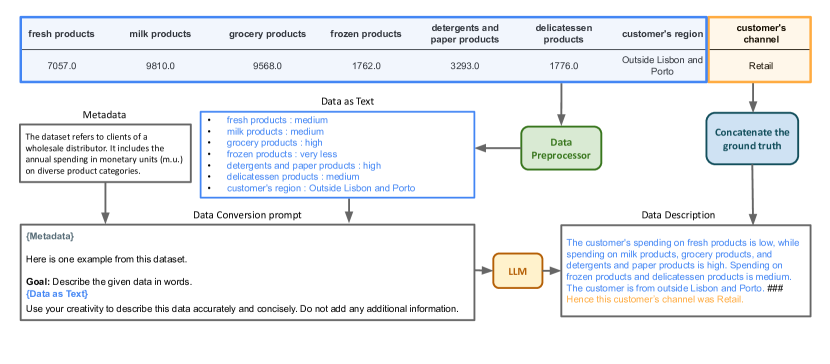
- 表形式データをLLMプロンプティングに適したテキスト記述へ変換するパイプラインを開発する。
- LLMのファインチューニングを行わずに、効果的な弱学習者を作成する機構として要約を検討する。
提案手法
- ゼロショット prompting による表形式記録の自然言語データ記述への変換。
- サンプルデータ記述から要約(弱学習者)を生成するためにLLMsを使用。
- LLMのコンテキスト制限内で代表サブセットを選択するためにクラスタリングベースのサンプリングを適用。
- 要約をAdaBoostフレームワークに統合して弱学習者のアンサンブルを形成。
- SummaryとSummary Boostingを、ゼロショット、少数ショット、および従来の表形式法と比較する。
実験結果
リサーチクエスチョン
- RQ1LLMはプロンプト駆動の要約を介して表形式データのブースティング設定内で弱学習者として機能できるか?
- RQ2データ記述の要約は、単純な少数ショットのプロンプトより優れた弱学習者を生み出すか?
- RQ3提案されたSummary Boostingアプローチは、従来の表形式法および prompting ベースラインとどのように比較されるか?
主な発見
- ゼロショットの性能は不安定で、データセット間で一般的に劣る。
- 大半のデータセットで少数ショットはゼロショットより改善するが、例外もある。
- Summaryはデータセット全体でFew-shotおよびZero-shotを上回る。
- Summary BoostingはしばしばSummaryと他の prompting ベースラインを上回る。
- 非常に小規模なデータセットでは、Summary Boostingがファインチューニング済みまたは非プロンプトベースのベースラインを上回ることがある。
- 連続属性が多いデータセットではLLMsをファインチューニングするか新しいモデルを使用しない限り性能が低下する。

この論文を読む
Nubintのビューアで原文を開き、読みながら気になる箇所をすぐに質問できます。
Nubintでこの論文を読むこのレビューはAIが論文の原文をもとに作成しました。引用する前に原文をご確認ください。