
[論文レビュー] Language Models Enable Simple Systems for Generating Structured Views of Heterogeneous Data Lakes
この論文は、巨大言語モデルを用いて異種データレイクから構造化ビューを生成するプロトタイプシステム Evaporate を提案し、直接抽出、コード合成、弱教師ありアンサンブルを比較した結果、低コストでサブリニア処理の文書を実現する高品質を達成することを示す。
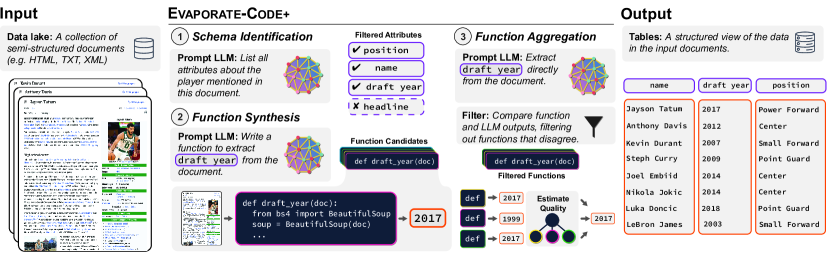
A long standing goal of the data management community is to develop general, automated systems that ingest semi-structured documents and output queryable tables without human effort or domain specific customization. Given the sheer variety of potential documents, state-of-the art systems make simplifying assumptions and use domain specific training. In this work, we ask whether we can maintain generality by using large language models (LLMs). LLMs, which are pretrained on broad data, can perform diverse downstream tasks simply conditioned on natural language task descriptions. We propose and evaluate EVAPORATE, a simple, prototype system powered by LLMs. We identify two fundamentally different strategies for implementing this system: prompt the LLM to directly extract values from documents or prompt the LLM to synthesize code that performs the extraction. Our evaluations show a cost-quality tradeoff between these two approaches. Code synthesis is cheap, but far less accurate than directly processing each document with the LLM. To improve quality while maintaining low cost, we propose an extended code synthesis implementation, EVAPORATE-CODE+, which achieves better quality than direct extraction. Our key insight is to generate many candidate functions and ensemble their extractions using weak supervision. EVAPORATE-CODE+ not only outperforms the state-of-the art systems, but does so using a sublinear pass over the documents with the LLM. This equates to a 110x reduction in the number of tokens the LLM needs to process, averaged across 16 real-world evaluation settings of 10k documents each.
研究の動機と目的
- 汎用的な LLM がドメイン固有のトレーニングなしに多様な半構造化文書から構造化ビューを生成できることを実証する。
- これらのビューを構築するための実装戦略として直接抽出とコード合成の2つを比較する。
- 多くの合成関数を用いた弱教師あり学習で抽出品質を向上させる Evaporate-Code+ を導入する。
- 複数のデータセットとモデルに渡るコスト-品質トレードオフとスケーラビリティを定量化する。
提案手法
- 半構造化文書の集合を入力とし、属性と文書ごとのレコードを含む表を出力する形式タスクを定義する。
- Evaporate-Direct(LLM が直接値を抽出)と Evaporate-Code(LLM が再利用可能な抽出コードを合成)を 16 の実世界設定で評価する。
- Evaporate-Code+ は多くの候補関数と弱教師あり学習を用いて抽出をアンサンブルし、精度を向上させることを示す。
- スキーマ合成に小規模サンプルを用い、属性ごとに多数の候補関数を生成し、適切な弱教師ありアルゴリズムで集約する。
- スキーマ発見と抽出を全文書集合から切り離してサブリニアな LLM 処理を実証する。
- 三つの LLM 提供者から四つのモデルで性能を評価し、頑健性を確認する。
実験結果
リサーチクエスチョン
- RQ1ドメイン固有のトレーニングを要せず、一般的なプロンプト駆動の LLM システムは異種文書から構造化ビューを生成できるか?
- RQ2このタスクにおける直接抽出とコード合成のコストと品質のトレードオフはどうなるか?
- RQ3多くの合成関数に対する弱教師ありアンサンブルは低コストを維持しつつ抽出品質を向上させるか?
- RQ4異なる LLM 提供者や文書タイプに対して結果はどれくらい堅牢か?
主な発見
- Evaporate-Direct は一部の設定で競争力のある品質を達成するが、データレイクサイズに対する線形トークン処理のためスケールが制約される。
- Evaporate-Code はスキーマの小規模サンプルを処理して抽出の関数を合成することでコストをサブリニアに抑えるが、初期は直接抽出より品質が低い。
- 弱教師あり学習を用いる Evaporate-Code+ は設定間で平均ペアF1スコア 67.5 を達成し、Evaporate-Direct に対して 12.1 ポイントの改善。
- Evaporate-Code+ は事前定義スキーマに対して Evaporate-Direct より抽出性能を平均で 22% 向上させる。
- 10k 文書/データレイクに対し LLM が処理するトークン数を約 110 倍削減するなど、評価設定で大きな削減を実現。
- 結果は三つの LLM 提供者の四モデルで検証され、Evaporate-Direct と Evaporate-Code+ の相対品質が一貫して安定している。
この論文を読む
Nubintのビューアで原文を開き、読みながら気になる箇所をすぐに質問できます。
Nubintでこの論文を読むこのレビューはAIが論文の原文をもとに作成しました。引用する前に原文をご確認ください。