
[論文レビュー] Language Models for Text Classification: Is In-Context Learning Enough?
この論文は、大規模言語モデルのゼロショット・ファーストショット prompting を、16データセットで微調整済みの小型モデルと比較する大規模評価を行い、微調整済みの小型モデルがしばしばファーストショットLLMより優れていることを示す一方、特定のタスクにおいてリソースが少ない設定では prompting に強みが見られる。
Recent foundational language models have shown state-of-the-art performance in many NLP tasks in zero- and few-shot settings. An advantage of these models over more standard approaches based on fine-tuning is the ability to understand instructions written in natural language (prompts), which helps them generalise better to different tasks and domains without the need for specific training data. This makes them suitable for addressing text classification problems for domains with limited amounts of annotated instances. However, existing research is limited in scale and lacks understanding of how text generation models combined with prompting techniques compare to more established methods for text classification such as fine-tuning masked language models. In this paper, we address this research gap by performing a large-scale evaluation study for 16 text classification datasets covering binary, multiclass, and multilabel problems. In particular, we compare zero- and few-shot approaches of large language models to fine-tuning smaller language models. We also analyse the results by prompt, classification type, domain, and number of labels. In general, the results show how fine-tuning smaller and more efficient language models can still outperform few-shot approaches of larger language models, which have room for improvement when it comes to text classification.
研究の動機と目的
- 大規模言語モデル(LLMs)を用いたゼロショットおよびファーストショット prompting が、微調整済みの小型モデルと比較してテキスト分類タスクでどれだけうまく機能するかを評価する。
- 二値・多クラス・多ラベルタスクにおける prompting とファインチューニングの長所と短所を特定する。
- ドメイン、データセット特性、ラベル数にわたるパフォーマンスの傾向を分析し、一般化可能性と制限を理解する。
提案手法
- 5つのモデルタイプ(生成系LLM、RoBERTa base/large、T5、Flan-T5、FastText)を、二値・多クラス・多ラベルタスクを含む16データセットで評価する。
- LLaMA-1、LLaMA-2、Flan-T5、GPT-3.5-Turbo のゼロショットおよびワンショット prompting を、ファインチューニングのベースライン(RoBERTa、T5、FastText)と比較する。
- 3つのプロンプトスタイル(汎用、タスク、ドメイン)を用いてプロンプト感度を評価する。
- 各データセットで RoBERTa と T5 を微調整し、 prompting のベースラインと比較する。
- データセットとドメインを跨いで、マイクロF1およびマクロF1、さらに間違ったラベルのカウントを報告する。
実験結果
リサーチクエスチョン
- RQ1LLMのゼロショットおよびワンショット prompting は、テキスト分類タスクで小型言語モデルのファインチューニングと比較してどうか。
- RQ2二値・多クラス・多ラベル分類タスクにおいて、 prompting ベースのアプローチはファインチューニングよりデータ効率が高いか。
- RQ3異なるドメインとラベル数におけるLLM promptingとファインチューニングの長所と短所は何か。
- RQ4プロンプト設計(汎用・タスク・ドメイン)がモデル間の性能と堅牢性に与える影響はどのようか。
- RQ5ドメイン特有またはタスク特有のデータセットは、 prompting 対ファインチューニングで異なる傾向を示すか。
主な発見
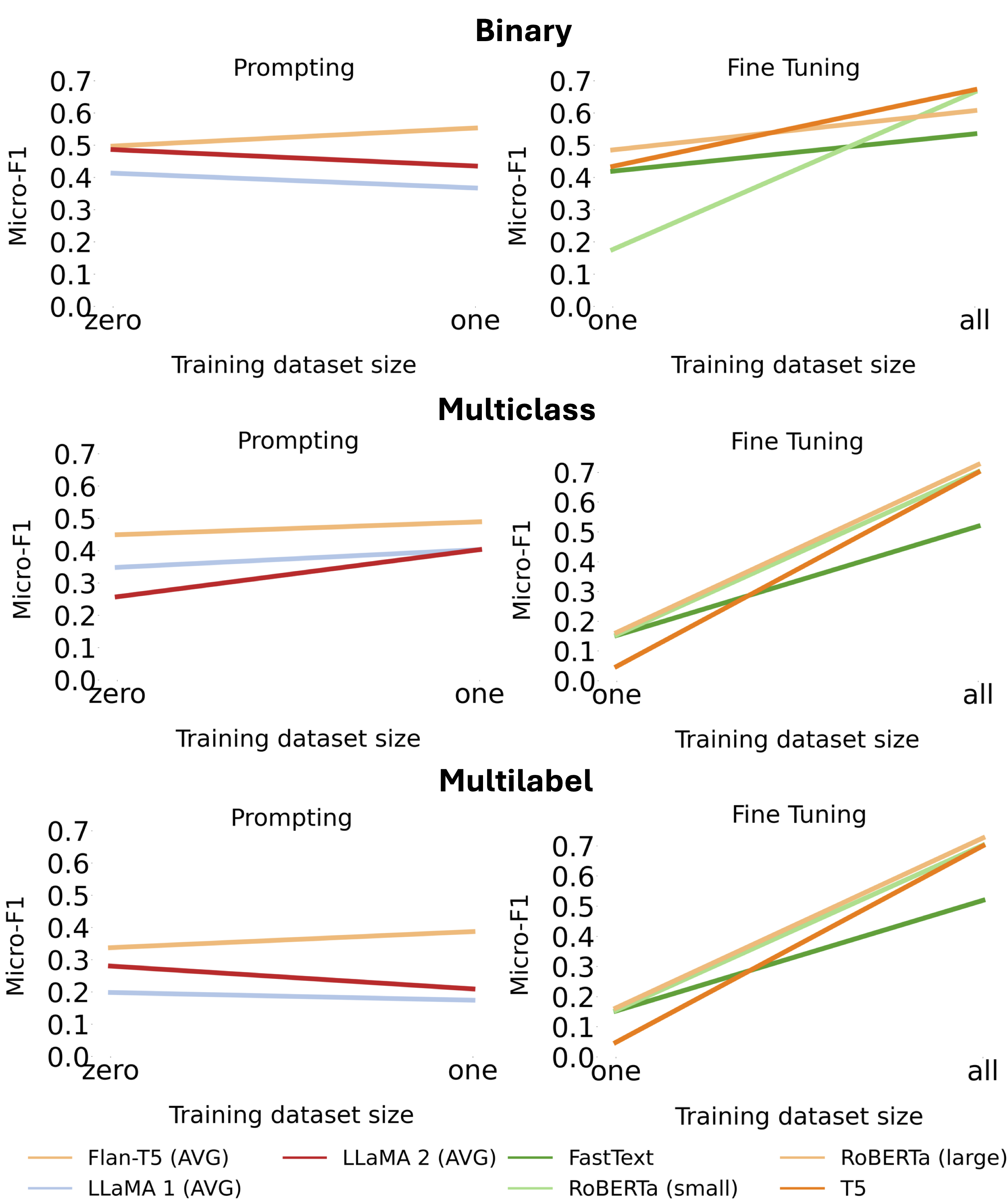
- 微調整済みの小型言語モデル(例: RoBERTa)は、テキスト分類タスクでしばしば大規模LLMの少数ショット prompting よりも優れている。
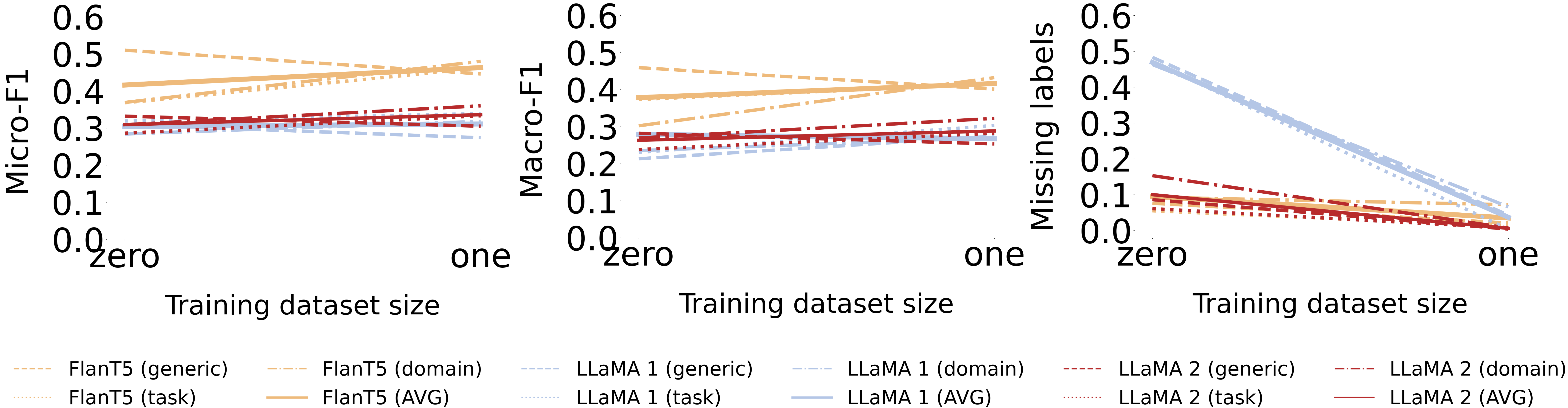
- prompting モデルの中では、Flan-T5 が LLaMA系と比較してゼロ/1ショット設定でより高い micro-F1 および macro-F1 を達成する傾向である。
- ワンショット prompting は一般に性能を向上させ、誤ラベルを減らす。Flan-T5 は顕著な改善を示す。
- 多クラスおよび多ラベルタスクでは、微調整済みマスクド言語モデルが prompting アプローチを上回すことが多く、複雑な分類におけるLLM prompting の改善余地を示している。
- プロンプト選択のモデル挙動への影響は全体として限定的だが、Flan-T5 のような小型モデルはゼロショット設定でプロンプトに敏感になり得る。
- 法務・医療・犯罪を含む多様なドメインで、微調整は多くのデータセットで競争力があるか優れている一方、 prompting はリソースが乏しい状況で価値を提供する。
この論文を読む
Nubintのビューアで原文を開き、読みながら気になる箇所をすぐに質問できます。
Nubintでこの論文を読むこのレビューはAIが論文の原文をもとに作成しました。引用する前に原文をご確認ください。