
[論文レビュー] Language models scale reliably with over-training and on downstream tasks
本稿は、過学習状態における言語モデルの信頼性の高いスケーリング法則を確立し、パower法則を介して言語モデリングのパープレキシティと下流タスクのパフォーマンスを結びつける。3つのデータセットで訓練された104のモデルを用いて、直接訓練に必要な計算量の最大300倍と20倍少ない計算量で、大規模モデルの検証損失および平均下流トップ-1誤差を予測する。
Scaling laws are useful guides for derisking expensive training runs, as they predict performance of large models using cheaper, small-scale experiments. However, there remain gaps between current scaling studies and how language models are ultimately trained and evaluated. For instance, scaling is usually studied in the compute-optimal training regime (i.e., "Chinchilla optimal" regime). In contrast, models are often over-trained to reduce inference costs. Moreover, scaling laws mostly predict loss on next-token prediction, but models are usually compared on downstream task performance. To address both shortcomings, we create a testbed of 104 models with 0.011B to 6.9B parameters trained with various numbers of tokens on three data distributions. First, we fit scaling laws that extrapolate in both the amount of over-training and the number of model parameters. This enables us to predict the validation loss of a 1.4B parameter, 900B token run (i.e., 32$ imes$ over-trained) and a 6.9B parameter, 138B token run (i.e., a compute-optimal run)$\unicode{x2014}$each from experiments that take 300$ imes$ less compute. Second, we relate the perplexity of a language model to its downstream task performance by proposing a power law. We use this law to predict top-1 error averaged over downstream tasks for the two aforementioned models, using experiments that take 20$ imes$ less compute. Our experiments are available at https://github.com/mlfoundations/scaling.
研究の動機と目的
- 大規模言語モデル開発における計算量最適化のスケーリング法則と現実の過学習実践との間のギャップを埋める。
- モデルが計算量最適化の範囲を超えて訓練された場合でも、スケーリング法則が予測可能であるかを調査する。
- 言語モデリングのパープレキシティと下流タスクパフォーマンスの間の定量的関係を確立し、モデル効果の早期予測を可能にする。
- モデルサイズと訓練計算量の両方の範囲でスケーリング法則の外挿が可能かどうかを検証するスケーラブルな実験的ベッドを提供する。
- 正確な低計算量外挿により、大規模なフルスケール訓練ランの必要性を減らし、効率的なモデル開発を実現する。
提案手法
- RedPajama、C4、RefinedWebの3つのデータ分布にわたって、パラメータ数が0.011Bから6.9Bの104の言語モデルを訓練する。
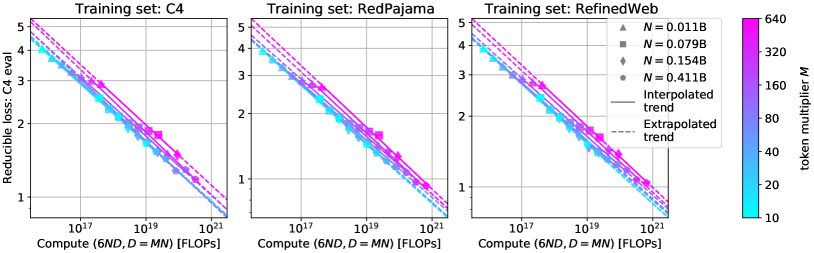
- 訓練計算量(C)とトークン対パラメータ比(M = D/N)との関係を、L′ = λ·C^(-α_C) のパワーロー形式でスケーリング法則に適合させる。
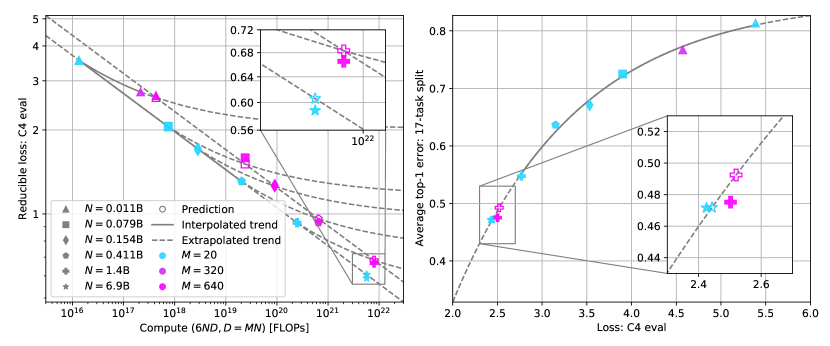
- 小さなモデルで学習したスケーリング法則を、300倍多くの計算量(例:1.4Bパラメータ、900Bトークン)で訓練された大規模モデルの性能に外挿する。
- 17のタスクにわたるモデルのパープレキシティと平均下流トップ-1誤差の間のパワーロー関係を確立し、低計算量実験からの誤差予測を可能にする。
- ブートストラップ信頼区間と計算量対誤差トレードオフ分析を用いて、スケーリング法則予測の信頼性と効率性を検証する。
- すべての実験結果とコードを https://github.com/mlfoundations/scaling で公開し、再現性とさらなる研究を支援する。
実験結果
リサーチクエスチョン
- RQ1訓練時に使用された計算量よりもはるかに多く計算量を割り当てて訓練されたモデルに対して、スケーリング法則が信頼性を持って外挿可能か、特に過学習状態においては?
- RQ2トークン対パラメータ比Mの変化に伴い、スケーリング指数α_Cはどのように変化するか。また、異なるデータ分布やモデルサイズにおいて安定しているか?
- RQ3次トークン予測タスクにおけるモデルのパープレキシティが、多様なベンチマークにわたる平均下流トップ-1誤差をどの程度正確に予測できるか?
- RQ4スケーリング法則の適合に要する計算量と、その結果得られる損失予測と下流誤差予測の精度との間のトレードオフはいかなるものか?
- RQ5計算量最適化の小さなモデルで学習したスケーリング法則が、大規模で過学習されたモデルの性能を正確に予測できるか?
主な発見
- 計算量最適化の小さなモデルで学習したスケーリング法則は、1.4Bパラメータのモデルが900Bトークンで訓練された場合の検証損失を、わずか2.4×10^19 FLOPsで正確に予測可能であり、これは直接訓練に必要な計算量の300倍少ない。
- スケーリング指数α_Cは、異なるトークン対パラメータ比Mの間でほぼ一定であり、過学習状態におけるスケーリング行動の一般化が一貫していることを示している。
- パープレキシティと平均下流トップ-1誤差の間のパワーロー関係により、6.9Bパラメータのモデルが138Bトークンで訓練された場合(2.7×10^20 FLOPs)、直接訓練に必要な計算量の20倍少ない計算量で17のタスクにおけるモデルパフォーマンスを1パーセンテージポイント未満の誤差で予測可能である。
- 損失予測よりも誤差予測の方が相対誤差を達成するための計算量が多く必要であり、誤差予測は損失予測よりも感受性が高く、効率が悪いことが示された。
- 3つのデータセットにわたる104のモデルの実験ベッドは、過学習が顕著に進行してもスケーリング法則が依然として頑健で予測可能であることを示している。
- 結果は、過学習状態および下流タスクパフォーマンス予測の両方において、信頼性のある外挿が可能であることを確認しており、効率的なモデル開発ワークフローの実現を可能にする。
この論文を読む
Nubintのビューアで原文を開き、読みながら気になる箇所をすぐに質問できます。
Nubintでこの論文を読むこのレビューはAIが論文の原文をもとに作成しました。引用する前に原文をご確認ください。