
[論文レビュー] Latent Stochastic Differential Equations for Modeling Quasar Variability and Inferring Black Hole Properties
本稿では、不規則なサンプリングや長期間の欠損を伴う状況下でも、ブラックホールの質量、傾き、温度勾配などの物理的性質を推定できる、潜在的な確率微分方程式(SDE)モデルを導入する。LSSTのシミュレートデータで訓練された本モデルは、多出力ガウス過程回帰よりも再構成精度に優れ、確率的変動からの物理的パラメータの推定を安定的に行える。
Quasars are bright and unobscured active galactic nuclei (AGN) thought to be powered by the accretion of matter around supermassive black holes at the centers of galaxies. The temporal variability of a quasar's brightness contains valuable information about its physical properties. The UV/optical variability is thought to be a stochastic process, often represented as a damped random walk described by a stochastic differential equation (SDE). Upcoming wide-field telescopes such as the Rubin Observatory Legacy Survey of Space and Time (LSST) are expected to observe tens of millions of AGN in multiple filters over a ten year period, so there is a need for efficient and automated modeling techniques that can handle the large volume of data. Latent SDEs are machine learning models well suited for modeling quasar variability, as they can explicitly capture the underlying stochastic dynamics. In this work, we adapt latent SDEs to jointly reconstruct multivariate quasar light curves and infer their physical properties such as the black hole mass, inclination angle, and temperature slope. Our model is trained on realistic simulations of LSST ten year quasar light curves, and we demonstrate its ability to reconstruct quasar light curves even in the presence of long seasonal gaps and irregular sampling across different bands, outperforming a multioutput Gaussian process regression baseline. Our method has the potential to provide a deeper understanding of the physical properties of quasars and is applicable to a wide range of other multivariate time series with missing data and irregular sampling.
研究の動機と目的
- 不規則なサンプリングと長期間の欠損を伴う多次元クェーサー光度曲線に対してスケーラブルで微分可能なモデルの開発。
- 観測された光度曲線の同時再構成と、ブラックホール質量、傾き、温度勾配といった内在的物理的パラメータの同時推定。
- LSSTのような大規模な調査から、クェーサーのパラメータの集団レベルの分布を階層的に推論することの実現。
- 観測上の課題に直面しても、既存のガウス過程回帰ベースラインを上回る光度曲線の再構成と構造関数の回復。
- 欠損データを伴う確率的天体物理学的時系列における物理的推論に、潜在的SDEを用いる可能性の検証。
提案手法
- 本モデルは、クェーサーの明るさ変動の背後にある確率的ダイナミクスを連続時間の拡散過程として表す、潜在的SDEフレームワークを用いる。
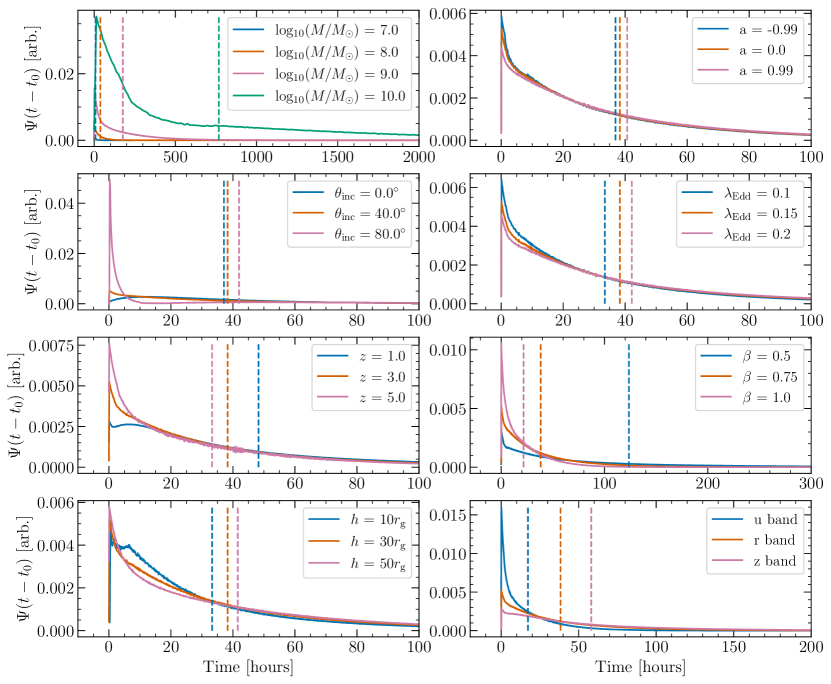
- バンドごとの光度曲線を共通の潜在プロセスの観測とし、波長依存の遅延をモデル化するバンド固有の転送関数を組み込む。
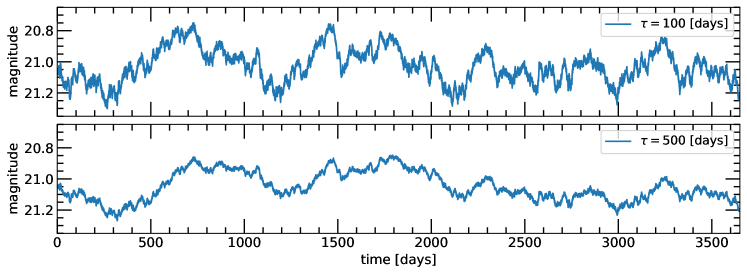
- 不規則な観測間隔と季節的欠損を伴う10年間のLSSTシミュレート光度曲線を、エンドツーエンドで訓練。
- SDEのドリフト関数と拡散関数をニューラルネットワークでパrameter化し、複雑な変動を柔軟にデータ駆動でモデル化可能にする。
- 不確実性の定量化と事後分布推定を可能にする、確率的勾配サンプリングを用いた変分推論により推論を実施。
- 本フレームワークは、光度曲線の同時再構成と物理的パラメータ推定(集団分布の階層的モデリングを含む)をサポートする。
実験結果
リサーチクエスチョン
- RQ1潜在的SDEモデルは、不規則なサンプリングと長期間の欠損を伴う多次元クェーサー光度曲線を正確に再構成できるか?
- RQ2潜在的SDEは、ブラックホール質量、傾き角、温度勾配といった物理的パラメータを、確率的変動からどの程度正確に推定できるか?
- RQ3潜在的SDEの性能は、多出力ガウス過程回帰と比較して、光度曲線再構成および構造関数回復の面でどのように異なるか?
- RQ4本モデルは、クェーサーのパラメータの集団レベルの分布を安定的に階層的に推論可能か?
- RQ5観測上の要因(観測間隔や欠損)が、物理的パラメータの回復可能性に及ぼす影響は何か?
主な発見
- 潜在的SDEモデルは、不規則なサンプリングと季節的長期間欠損を伴う状況下でも、多出力ガウス過程回帰を上回るクェーサー光度曲線の再構成性能を示した。
- 本モデルは、シミュレートされたクェーサー光度曲線の真の構造関数を成功裏に回復し、平均予測値が真値に非常に近い結果を得た。
- ブラックホール質量、傾き、温度勾配といった物理的パラメータは、中央値推定値が真値に近く、95%のテストケースで真値が1σの不確実性範囲内に収容された。
- 本モデルは階層的推論を可能とし、温度勾配のようなパラメータの集団レベルの分布推定が可能となり、降着円盤および風モデルの制約に寄与できる。
- 潜在的SDEフレームワークは、欠損データや不規則な観測間隔といった観測上の課題に対しても頑健であるため、LSSTスケールの調査に適している。
- 時間遅延や変動幅が時間チャンクに対して十分に大きい場合にのみ、パラメータの回復が可能である。12時間未満の効果を持つパラメータは、回復が困難である可能性がある。
この論文を読む
Nubintのビューアで原文を開き、読みながら気になる箇所をすぐに質問できます。
Nubintでこの論文を読むこのレビューはAIが論文の原文をもとに作成しました。引用する前に原文をご確認ください。