
[論文レビュー] Lateral Phishing With Large Language Models: A Large Organization Comparative Study
本研究は大規模大学環境におけるLLM生成の横方向スぺア型フィッシングを調査し、AI作成メールと人間作成メールを比較、影響とトレーニング要件を評価しつつ、MLベースの検出器が高いF1スコアを達成することを提案する。
The emergence of Large Language Models (LLMs) has heightened the threat of phishing emails by enabling the generation of highly targeted, personalized, and automated attacks. Traditionally, many phishing emails have been characterized by typos, errors, and poor language. These errors can be mitigated by LLMs, potentially lowering the barrier for attackers. Despite this, there is a lack of large-scale studies comparing the effectiveness of LLM-generated lateral phishing emails to those crafted by humans. Current literature does not adequately address the comparative effectiveness of LLM and human-generated lateral phishing emails in a real-world, large-scale organizational setting, especially considering the potential for LLMs to generate more convincing and error-free phishing content. To address this gap, we conducted a pioneering study within a large university, targeting its workforce of approximately 9,000 individuals including faculty, staff, administrators, and student workers. Our results indicate that LLM-generated lateral phishing emails are as effective as those written by communications professionals, emphasizing the critical threat posed by LLMs in leading phishing campaigns. We break down the results of the overall phishing experiment, comparing vulnerability between departments and job roles. Furthermore, to gather qualitative data, we administered a detailed questionnaire, revealing insights into the reasons and motivations behind vulnerable employee's actions. This study contributes to the understanding of cyber security threats in educational institutions and provides a comprehensive comparison of LLM and human-generated phishing emails' effectiveness, considering the potential for LLMs to generate more convincing content. The findings highlight the need for enhanced user education and system defenses to mitigate the growing threat of AI-powered phishing attacks.
研究の動機と目的
- 大規模な教育機関における横方向フィッシング攻撃の有効性を評価する。
- LLM作成と人間作成の横方向フィッシングメールの影響を比較する。
- 内部情報と外部情報を使用した場合の有効性の差を評価する。
- 横方向フィッシングに対するフィッシング訓練と警告の有効性を評価する。
- LLM生成メールを識別するためのLLM検出器を検討する。
提案手法
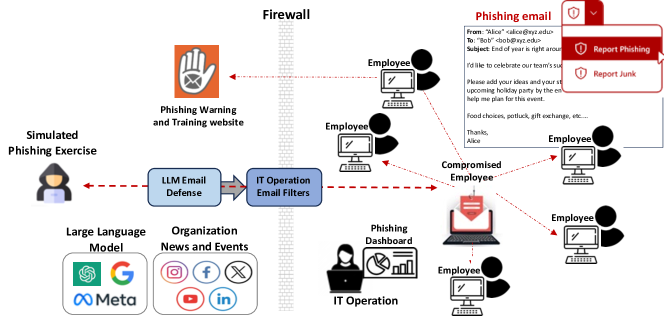
- 既存のフィッシングシミュレーション基盤を活用し、約9,000名の従業員を対象に11か月間の研究を実施する。
- 人間作成とLLM作成の両方を含む複数のフィッシングテンプレートを作成・試験する。
- 組織内部データと外部情報を用いてLLMメールを作成し、人間メールと比較する。
- ユーザーのインタラクション(開封、クリック、入力データ、報告)を測定し、リスクベースのセキュリティ姿勢スコアを算出する。
- 高いF1スコア(0.9896)を持つLLM生成フィッシングメールを識別するMLベースの検出器を開発・評価する。
- 脅威モデルを説明し、組織の訓練および方針の考慮事項と調和させる。
実験結果
リサーチクエスチョン
- RQ1RQ1: 大規模な教育機関における横方向フィッシング攻撃の有効性はどの程度か?
- RQ2RQ2: LLM作成の横方向フィッシングメールは、人間生成の横方向フィッシングメールと同等の影響を持つか?
- RQ3RQ3: 組織内部情報と外部情報を使用した場合、LLM生成スぺア型フィッシングメールの有効性はどう異なるか?
- RQ4RQ4: 組織全体での横方向フィッシングに対するフィッシング訓練と警告の有効性はどの程度か?
- RQ5RQ5: LLM検出器はLLM生成のフィッシングメールを識別するために使用できるか?
主な発見
- LLM生成のフィッシングメールに対して、約10%の受信者がクリックし認証情報を入力した。
- フィッシング事例は2023年のセキュリティ事案の35.2%を占め、2022年に約1,947件、2023年に約2,245件へ増加した。
- 過去60日間に18,693件を超える受信フィッシング試行を検出し、934件の攻撃が自動フィルターを回避した。
- 11か月の研究は約9,000名の従業員を対象に実施され、20以上のテンプレートを使用した。10月は人間作成、11月はLLM作成のテンプレートによりAIと人間の生成を比較可能にした。
- LLMベースの検出技術は、既存のインフラで見逃されたメールの識別においてF1スコア98.96%を達成した。
- 研究は、LLM検出手段と反フィッシング防御を統合し、組織の方針を更新する必要性を強調している。
この論文を読む
Nubintのビューアで原文を開き、読みながら気になる箇所をすぐに質問できます。
Nubintでこの論文を読むこのレビューはAIが論文の原文をもとに作成しました。引用する前に原文をご確認ください。