
[論文レビュー] Learning Distinctive Margin toward Active Domain Adaptation
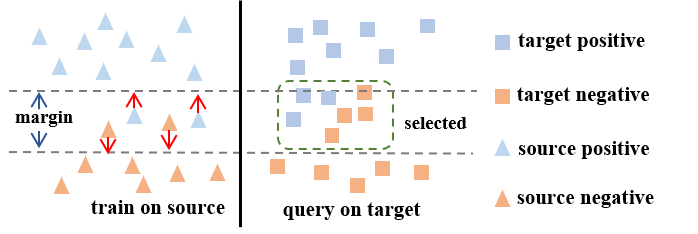
本稿では、選択的で高効率なアクティブドメイン変換手法であるSelect-by-Distinctive-Margin (SDM) を提案する。SDM は最大マージン損失を用いて、ソースドメインにおける意思決定境界付近のハード例を特定し、それらのハード例と類似するターゲットサンプルを情報量に基づいて選択する。SDM は Office-Home ベンチマークで、たった 5% のラベル付きターゲットデータでのみ、最先端の性能を達成しており、高い効率性、安定性、スケーラビリティを示している。
Despite plenty of efforts focusing on improving the domain adaptation ability (DA) under unsupervised or few-shot semi-supervised settings, recently the solution of active learning started to attract more attention due to its suitability in transferring model in a more practical way with limited annotation resource on target data. Nevertheless, most active learning methods are not inherently designed to handle domain gap between data distribution, on the other hand, some active domain adaptation methods (ADA) usually requires complicated query functions, which is vulnerable to overfitting. In this work, we propose a concise but effective ADA method called Select-by-Distinctive-Margin (SDM), which consists of a maximum margin loss and a margin sampling algorithm for data selection. We provide theoretical analysis to show that SDM works like a Support Vector Machine, storing hard examples around decision boundaries and exploiting them to find informative and transferable data. In addition, we propose two variants of our method, one is designed to adaptively adjust the gradient from margin loss, the other boosts the selectivity of margin sampling by taking the gradient direction into account. We benchmark SDM with standard active learning setting, demonstrating our algorithm achieves competitive results with good data scalability. Code is available at https://github.com/TencentYoutuResearch/ActiveLearning-SDM
研究の動機と目的
- ラベル付きターゲットデータが限られているアクティブドメイン変換におけるドメインシフトの課題に対処すること。
- ドメインギャップを処理できない、または複雑で過剰適合を引き起こすクエリ関数に依存する既存のアクティブラーニング手法の限界を克服すること。
- ソースドメインとターゲットドメインの内在的関係を活用して、より効果的なデータ選択を行う手法を開発すること。
- ハイパーパrameterの感度とクエリの複雑さを最小限に抑えることで、モデルの安定性とスケーラビリティを確保すること。
- マージンベースのサンプリングの有効性について理論的裏付けを提供すること。
提案手法
- ソースドメインにおけるクラス間分離を最大化するようモデルを促す最大マージン損失を提案し、意思決定境界付近のハード例を暗黙的に同定する。
- マージンサンプリング戦略を用いて、カテゴリカルセンターからの距離に基づき、ソースドメインの意思決定境界に最も近い特徴を持つターゲットサンプルを選択する。
- SDM-AG を導入し、適応的モジュレーション係数と最大ログリット正則化子を用いてマージン損失の勾配を動的に制御することで、学習の安定性を向上させる。
- SDM-AG-Grad をもう一つの変種として設計し、マージンサンプリング関数の一次勾配を組み込むことで、データ選択の選別性を強化する。
- 理論的分析により、マージン損失がサポートベクターマシンに類似した振る舞いを示し、ハード例に注目し、ターゲットドメインへの効果的な転送を可能にすることが示された。
- クエリの複雑度が O(NKD + N log N) であり、CLUE や TQS よりも著しく高速であるため、計算的に効率的である。
実験結果
リサーチクエスチョン
- RQ1単純なマージンベースの損失関数は、ターゲットドメインに転送可能なソースドメイン内のハード例を効果的に同定できるか?
- RQ2提案手法のマージンサンプリング戦略は、アクティブドメイン変換における不確実性ベースや多様性ベースのサンプリングと比べてどのように異なるか?
- RQ3既存のアクティブドメイン変換手法と比較して、SDM は限られたラベル付きターゲットデータを用いた場合に、どの程度性能が向上するか?
- RQ4マージン値や損失バランス係数といったハイパーパrameterに、SDM はどの程度感度を示すか?
- RQ5提案手法は、さまざまなドメインシフトのシナリオにおいても高い効率性とスケーラビリティを維持できるか?
主な発見
- SDM-AG は Office-Home のすべてのシナリオで一貫した性能向上を示し、特に R→A の設定で最大の改善が観察された。これは、アノテーション予算の増加に伴う高いスケーラビリティを示している。
- SDM-AG は、ATDOC や CDAN といった教師なしドメイン変換手法を、ターゲットデータのわずか 5% で同等または上回る性能で達成しており、高いデータ効率性を示している。
- ハイパーパrameterの変更に対しても頑健で、マージン $m$ やバランス要因 $ abla$ の異なる値に対しても性能の変動が最小限に抑えられており、高い安定性を示している。
- 最も近い競合手法(CLUE)と比較して、クエリ時間で 24.6 倍の高速化を達成し、クエリ時間はわずか 0.067 秒にまで短縮された。これは、計算効率の高さを示している。
- 理論的分析により、マージン損失が SVM に類似した振る舞いを示し、ハード例に注目し、ターゲットドメインへの効果的な転送を可能にすることが確認された。
- SDM-AG と SDM-AG-Grad の二つの変種は、モデルの複雑さを増さずに、それぞれ学習の安定性と選別性を向上させた。
より良い研究を、今すぐ始めましょう
論文の読解から最終レビューまで、研究時間を劇的に削減しましょう。
クレジットカード登録不要
このレビューはAIが作成し、人間の編集者が確認しました。