
[論文レビュー] LEGO-Prover: Neural Theorem Proving with Growing Libraries
LEGO-Proverはモジュラーで成長するスキルライブラリを導入し、LLMベースの証明者が補題を取得・発展させて定理を証明できるようにします。新しく作成・進化させた補題を活用して miniF2F の合格率を改善します。
Despite the success of large language models (LLMs), the task of theorem proving still remains one of the hardest reasoning tasks that is far from being fully solved. Prior methods using language models have demonstrated promising results, but they still struggle to prove even middle school level theorems. One common limitation of these methods is that they assume a fixed theorem library during the whole theorem proving process. However, as we all know, creating new useful theorems or even new theories is not only helpful but crucial and necessary for advancing mathematics and proving harder and deeper results. In this work, we present LEGO-Prover, which employs a growing skill library containing verified lemmas as skills to augment the capability of LLMs used in theorem proving. By constructing the proof modularly, LEGO-Prover enables LLMs to utilize existing skills retrieved from the library and to create new skills during the proving process. These skills are further evolved (by prompting an LLM) to enrich the library on another scale. Modular and reusable skills are constantly added to the library to enable tackling increasingly intricate mathematical problems. Moreover, the learned library further bridges the gap between human proofs and formal proofs by making it easier to impute missing steps. LEGO-Prover advances the state-of-the-art pass rate on miniF2F-valid (48.0% to 57.0%) and miniF2F-test (45.5% to 47.1%). During the proving process, LEGO-Prover also manages to generate over 20,000 skills (theorems/lemmas) and adds them to the growing library. Our ablation study indicates that these newly added skills are indeed helpful for proving theorems, resulting in an improvement from a success rate of 47.1% to 50.4%. We also release our code and all the generated skills.
研究の動機と目的
- モジュラー補題再利用による形式的推論の自動化を促進し、ますます複雑になる定理に取り組む。
- 証明者と evolver コンポーネントを通じて検証済みスキルライブラリの動的成長を可能にする。
- Isabelle/Lean風環境で補題を再利用・進化させることで、非公式・公式の証明を橋渡しする。
提案手法
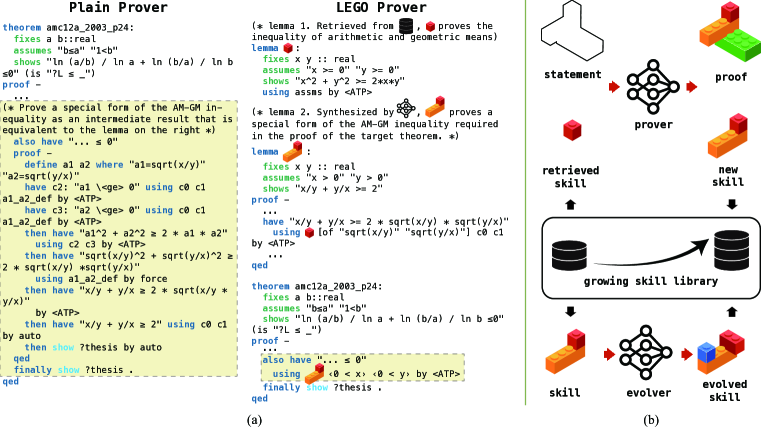
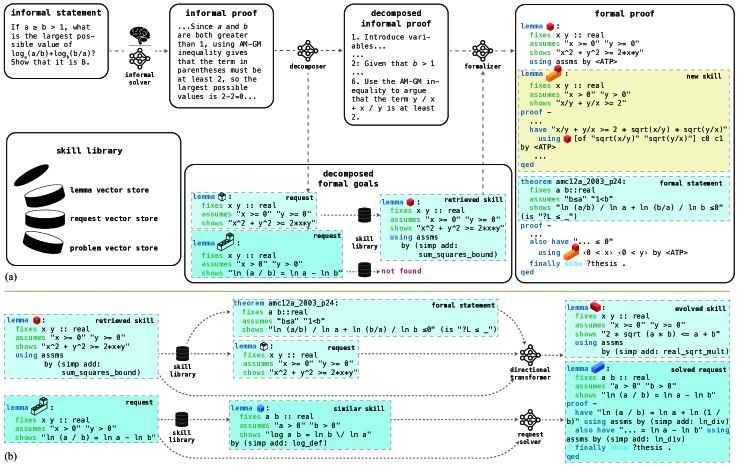
- 証明者は定理をサブゴールに分解し、成長するスキルライブラリから関連する補題を取得してモジュラーな Isabelle 証明を構築する。
- Evolver は既存の補題をより一般的で再利用可能な形に変換し、未解決のリクエストを解決して新しい補題を生成する。
- 3つのベクトルストア(lemma、request、problem)を用いて埋め込みとk-NN検索でスキルをエンコード・取得し、 prompting に情報を提供する。
- LLMs は非公式の証明を下書きし、取得した補題と検証器のフィードバックを用いて Isabelle の証明スクリプトとして形式化する。
- Isabelle/Sledgehammer ベースの検証とヒューリスティック戦術が必要に応じて証明を自動修正し、検証済みの補題をライブラリに追加する。
- 成長ループ: 証明者/進化者からの新しい補題を検証して追加し、将来の証明のためにライブラリを拡張する。
実験結果
リサーチクエスチョン
- RQ1成長するモジュラーなスキルライブラリは、LLMsと統合した際にニューラル定理証明を改善できるだろうか?
- RQ2進化した補題は元の問題を超えて他の証明を支援する一般化が可能か?
- RQ3モジュラーな証明構築は単一ブロックの証明と比較して、証明の成功率と効率にどのような差があるか?
- RQ4補題ライブラリを削除した場合の証明性能への影響は?
- RQ5得られたスキルライブラリはどれくらい大規模かつ多様で、どのように活用されているか?
主な発見
- LEGO-Prover は 57.0% の miniF2F-valid と 50.0% の miniF2F-test パス率を達成(人間の非公式証明つき)し、52.4%/45.5%(モデルの非公式証明)を達成。
- LEGO-Prover は miniF2F で従来のアプローチを平均約6.75パーセントポイント上回る。
- 成長するスキルライブラリは持続的な改善を可能にする:ライブラリなしのアブレーションは検証で50回の試行内において50.4%から47.1%へ低下。
- ライブラリには最終的に22,532個のスキルが含まれ、証明者(10.8%)、リクエスト駆動型 Evolver(38.2%)、方向性トランスフォーマ Evolver(51.1%)。
- 補題は直接使用するか、新しい補題を着想する参考として利用でき、LLMによる証明生成を促進する。
この論文を読む
Nubintのビューアで原文を開き、読みながら気になる箇所をすぐに質問できます。
Nubintでこの論文を読むこのレビューはAIが論文の原文をもとに作成しました。引用する前に原文をご確認ください。