
[論文レビュー] Leveraging ChatGPT As Text Annotation Tool For Sentiment Analysis
本研究は感情分析のテキスト注釈ツールとしての ChatGPT を評価し、2つのデータセット(サッカーツイートと Amazon レビュー)で語彙ベースの手法に比べて大幅な精度向上を報告している。
Sentiment analysis is a well-known natural language processing task that involves identifying the emotional tone or polarity of a given piece of text. With the growth of social media and other online platforms, sentiment analysis has become increasingly crucial for businesses and organizations seeking to monitor and comprehend customer feedback as well as opinions. Supervised learning algorithms have been popularly employed for this task, but they require human-annotated text to create the classifier. To overcome this challenge, lexicon-based tools have been used. A drawback of lexicon-based algorithms is their reliance on pre-defined sentiment lexicons, which may not capture the full range of sentiments in natural language. ChatGPT is a new product of OpenAI and has emerged as the most popular AI product. It can answer questions on various topics and tasks. This study explores the use of ChatGPT as a tool for data labeling for different sentiment analysis tasks. It is evaluated on two distinct sentiment analysis datasets with varying purposes. The results demonstrate that ChatGPT outperforms other lexicon-based unsupervised methods with significant improvements in overall accuracy. Specifically, compared to the best-performing lexical-based algorithms, ChatGPT achieves a remarkable increase in accuracy of 20% for the tweets dataset and approximately 25% for the Amazon reviews dataset. These findings highlight the exceptional performance of ChatGPT in sentiment analysis tasks, surpassing existing lexicon-based approaches by a significant margin. The evidence suggests it can be used for annotation on different sentiment analysis events and taskss.
研究の動機と目的
- 人間のラベリングを大幅に要さず、効率的で高品質な感情注釈の必要性を動機づける。
- ChatGPT がドメインを横断してゼロショットのテキスト注釈者として機能し得るかを評価する。
- 標準的な指標を用いて、ChatGPT を lexicon-based のベースライン(VADER, TextBlob)と比較する。
- 絵文字、皮肉、長文レビューの感情ラベリングにおける ChatGPT の可能性を示す。
提案手法
- 固定プロンプトを用いて、 API 応答から抽出した感情スコアをラベル付けするために GPT-3.5 turbo (ChatGPT) を使用。
- 2つのデータセットで評価: soccer tweets (6,201 行; 1,214 個の絵文字; 2,551 ポジティブ, 2,710 ネガティブ, 943 ニュートラル) および 2,000 の Amazon レビュー (ポジティブ 1,002, ネガティブ 998)。
- ベースラインとして lexicon-based ツール VADER および TextBlob と比較。
- ChatGPT の出力から数値的な感情スコアを抽出してラベルを割り当てる。
- 各ラベルおよびデータセットについて、精度、再現率、F1、および正確さを報告。
- 絵文字の取り扱いや皮肉認識などの定性的側面を議論。
実験結果
リサーチクエスチョン
- RQ1ChatGPT は異なるドメインで効果的なゼロショットの感情分析用テキスト注釈者として機能するか?
- RQ2ソーシャルメディアと長文レビューにおいて、ChatGPT の感情ラベリングは語彙ベースの手法とどう比較されるか?
- RQ3ChatGPT は絵文字、皮肉、アイロニーを従来の語彙ベース手法よりもうまく扱えるか?
- RQ4注釈タスクに ChatGPT を使用する際の実務的考慮事項(速度、コスト、偏見)とは何か?
主な発見
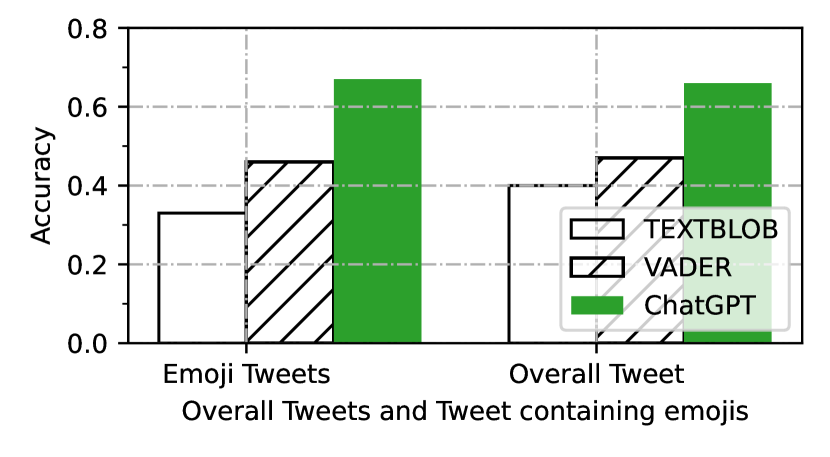
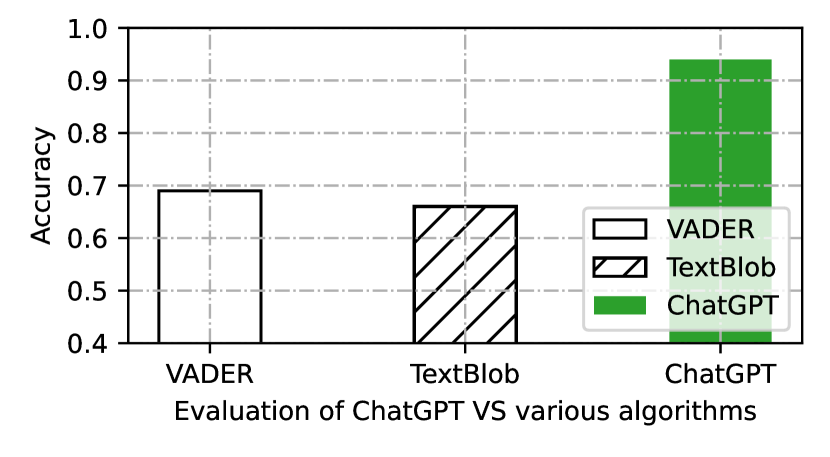
- ChatGPT は両データセットで VADER および TextBlob より高い精度を達成(例:Soccer Tweets: 全体 67% 対 47% VADER、40% TextBlob)、Amazon レビュー: 94% 対 69% VADER、66% TextBlob。
- ChatGPT は感情分類で絵文字の取り扱いに効果的で、絵文字を含むツイートの性能を向上させる。
- ChatGPT は報告された表で、正、ニュートラル、負の各クラスに対して、ラベルごとの精度、再現率、F1 がより高いことを示す。
- ChatGPT のゼロショット感情分析は高い性能を示し、長文レビューだけでなく短文のソーシャルメディア文本に対して語彙法を上回る顕著な向上を示す。
- 本研究は、プロンプト依存、応答の潜在的バイアス、いくつかのツールと比較した処理速度/コストの遅さといった限界を指摘している。
この論文を読む
Nubintのビューアで原文を開き、読みながら気になる箇所をすぐに質問できます。
Nubintでこの論文を読むこのレビューはAIが論文の原文をもとに作成しました。引用する前に原文をご確認ください。