
[論文レビュー] Leveraging Large Language Models in Conversational Recommender Systems
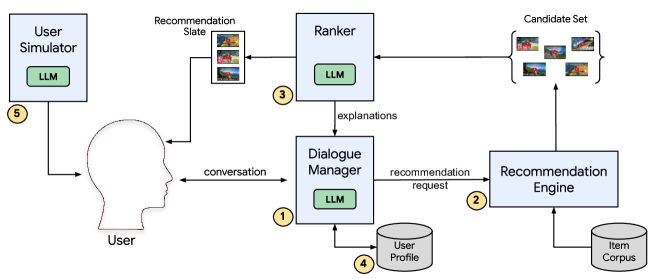
本論文は RecLLM を紹介する。エンドツーエンドの大規模言語モデル駆動の対話型推薦システムアーキテクチャであり、対話管理、検索、説明付きランキング、ユーザープロファイルを統合し、さらに制御可能な LLM ベースのユーザーシミュレーターによる合成データ生成を可能にする。LaMDA を用いて YouTube コンテンツで実証されている。
A Conversational Recommender System (CRS) offers increased transparency and control to users by enabling them to engage with the system through a real-time multi-turn dialogue. Recently, Large Language Models (LLMs) have exhibited an unprecedented ability to converse naturally and incorporate world knowledge and common-sense reasoning into language understanding, unlocking the potential of this paradigm. However, effectively leveraging LLMs within a CRS introduces new technical challenges, including properly understanding and controlling a complex conversation and retrieving from external sources of information. These issues are exacerbated by a large, evolving item corpus and a lack of conversational data for training. In this paper, we provide a roadmap for building an end-to-end large-scale CRS using LLMs. In particular, we propose new implementations for user preference understanding, flexible dialogue management and explainable recommendations as part of an integrated architecture powered by LLMs. For improved personalization, we describe how an LLM can consume interpretable natural language user profiles and use them to modulate session-level context. To overcome conversational data limitations in the absence of an existing production CRS, we propose techniques for building a controllable LLM-based user simulator to generate synthetic conversations. As a proof of concept we introduce RecLLM, a large-scale CRS for YouTube videos built on LaMDA, and demonstrate its fluency and diverse functionality through some illustrative example conversations.
研究の動機と目的
- 大規模言語モデルを活用して透明かつ対話的で多ターンの対話型推奨を可能にする動機づけ。
- 単一の LLM が対話管理、検索、ランキング、および説明を処理するエンドツーエンドのアーキテクチャを提案する。
- LLMs と互換性のある複数の検索戦略を通じて大規模アイテムコーパスのスケーラブルな検索を実現する。
- 対話セッションの文脈を個人化するための解釈可能な自然言語のユーザープロファイルを組み込む。
- システムモジュールの調整のための合成会話を生成する制御可能な LLM ベースのユーザーシミュレータを提供する。
提案手法
- 統一された LLM ベースの対話管理により、システムアクションと応答を単一の言語モデル化タスクとして出力する。
- Generalized Dual Encoder、Direct LLM Search、Concept Based Search、Search API Lookup などの手法を用いて、候補生成を実現する大規模コーパス向けの一般的な検索フレームワーク。
- アイテムと文脈の要約に基づいて、アイテムをスコア付けし自然言語の説明を生成する結合型 LLM ランカー。
- LLM に入力として恒常的で解釈可能な自然言語のユーザープロファイルを使用してセッション文脈を調整する。
- 合成会話を生成する制御可能な LLM ベースのユーザーシミュレーターの開発により、スケーラブルな調整と評価を実現する。
実験結果
リサーチクエスチョン
- RQ1CRS において対話管理、検索、ランキングを統合するために LLM をどのように活用できるか。
- RQ2LLM ベースの CRS の大規模候補生成を実現する検索戦略は何か。
- RQ3LLM は CRS 内で推奨事項の intelligible explanations を生成できるか。
- RQ4解釈可能な自然言語のユーザープロファイルは CRS の個人化をどのように改善できるか。
- RQ5制御可能な LLM ベースのシミュレーターによって生成された合成会話は CRS コンポーネントの調整と評価に効果的か。
主な発見
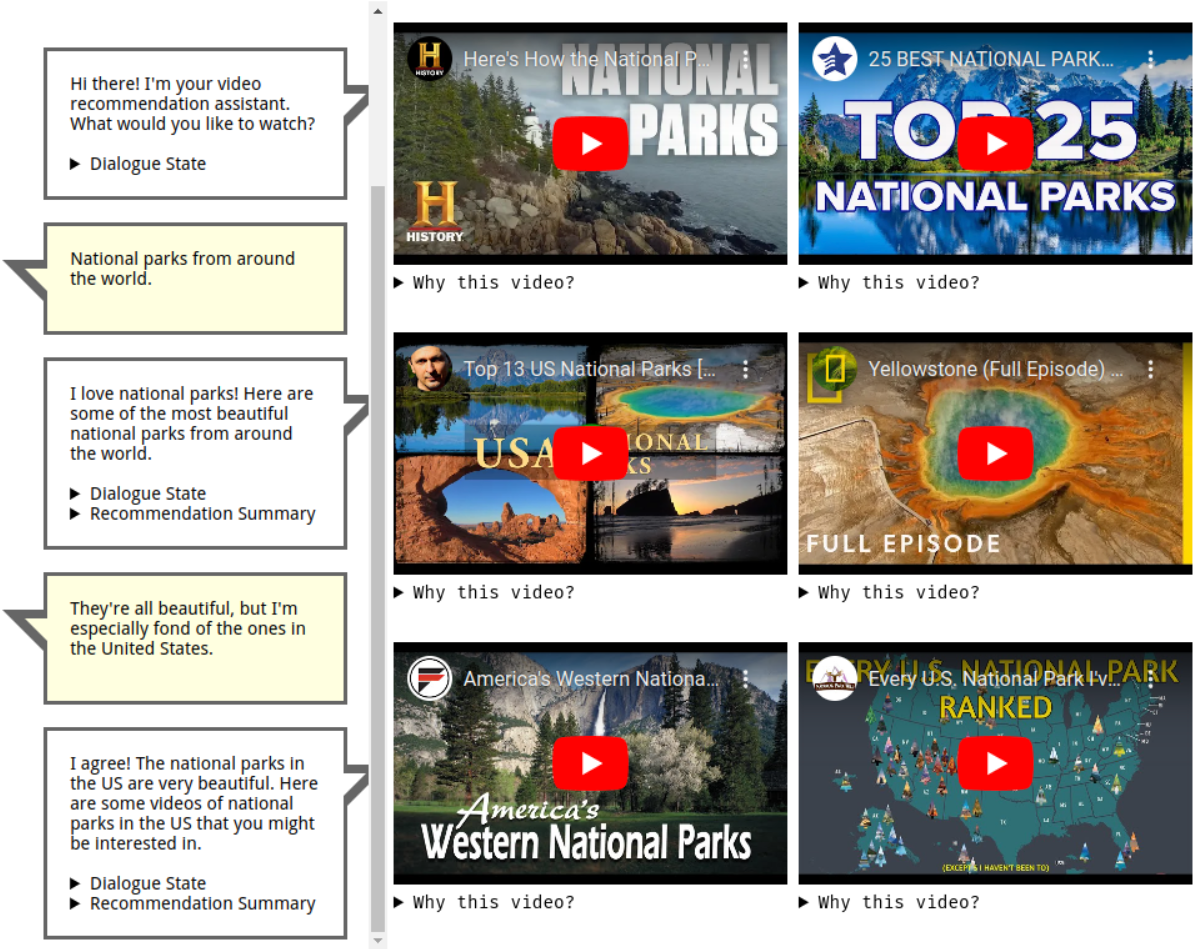
- 統合された LLM フレームワーク内で文脈追跡、API 呼び出し、および応答生成を処理する機能的なエンドツーエンドの RecLLM アーキテクチャを実証。
- 大規模アイテムコーパスに適した複数の検索アプローチを提案し、効率と精度のバランスを取る。
- LLM ベースのランカーが、アイテムと文脈の要約に基づくスコアと自然言語の説明を生成できることを示す。
- 対話管理に組み込んでセッションを個人化する解釈可能な自然言語のユーザープロファイルを導入。
- 合成会話を生成してシステムの調整と評価を行うことができる制御可能な LLM ベースのユーザーシミュレーターを提示。
この論文を読む
Nubintのビューアで原文を開き、読みながら気になる箇所をすぐに質問できます。
Nubintでこの論文を読むこのレビューはAIが論文の原文をもとに作成しました。引用する前に原文をご確認ください。