
[論文レビュー] LIVABLE: Exploring Long-Tailed Classification of Software Vulnerability Types
LIVABLE は、ソフトウェア脆弱性タイプの長尾分布分類のための新規な GNN アプローチであり、差別化された伝播メカニズムと適応的再重み付け損失を用いて、過剰平滑化とクラス不均衡の問題に対処する。Fan らのデータセットにおいて、最先端手法よりも24.18%高い正確性を達成し、末尾クラスの予測を7.7%向上させる。
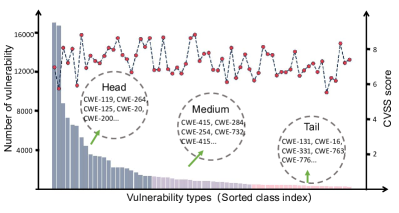
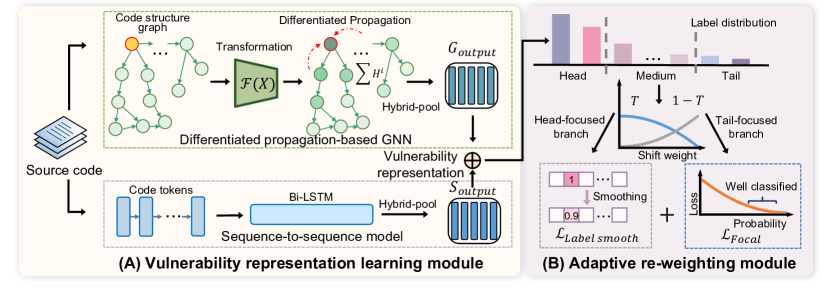
Prior studies generally focus on software vulnerability detection and have demonstrated the effectiveness of Graph Neural Network (GNN)-based approaches for the task. Considering the various types of software vulnerabilities and the associated different degrees of severity, it is also beneficial to determine the type of each vulnerable code for developers. In this paper, we observe that the distribution of vulnerability type is long-tailed in practice, where a small portion of classes have massive samples (i.e., head classes) but the others contain only a few samples (i.e., tail classes). Directly adopting previous vulnerability detection approaches tends to result in poor detection performance, mainly due to two reasons. First, it is difficult to effectively learn the vulnerability representation due to the over-smoothing issue of GNNs. Second, vulnerability types in tails are hard to be predicted due to the extremely few associated samples.To alleviate these issues, we propose a Long-taIled software VulnerABiLity typE classification approach, called LIVABLE. LIVABLE mainly consists of two modules, including (1) vulnerability representation learning module, which improves the propagation steps in GNN to distinguish node representations by a differentiated propagation method. A sequence-to-sequence model is also involved to enhance the vulnerability representations. (2) adaptive re-weighting module, which adjusts the learning weights for different types according to the training epochs and numbers of associated samples by a novel training loss.
研究の動機と目的
- 少数のサンプルしか持たないが、高い深刻度を持つ末尾クラスが多数存在するソフトウェア脆弱性タイプの長尾分布に対処すること。
- 深層アーキテクチャにおいてノード表現学習の性能を低下させる GNN の過剰平滑化問題を克服すること。
- 通常のモデルが無視しがちなレア(末尾)脆弱性タイプの分類性能を向上させること。
- 長尾データ設定下で、脆弱性タイプ分類と検出性能の両方を向上させる統合フレームワークを構築すること。
- 高深刻度で低頻度の脆弱性タイプを正確に特定することで、より効果的な脆弱性トライアージと是正を可能にすること。
提案手法
- ノードの中心性と局所構造に基づいてメッセージ伝達を調整する差別化された GNN 伝播メカニズムを提案し、過剰平滑化を低減する。
- コードトークン内の順序的パターンを捉えることで、脆弱性表現を豊かにするためのシーケンス・ツー・シーケンスモデルを統合する。
- クラス頻度とトレーニングエポックに応じて損失重みを動的に調整する適応的再重み付けモジュールを設計する。
- クラス頻度とモデルの信頼度を組み合わせた新しい訓練損失関数を定式化し、ヘッドクラスへのバイアスを低減する。
- 強化された GNN 表現と適応的再重み付け戦略を統合し、表現学習と長尾分類の両方を同時に最適化する。
- 標準的な指標(正確性、F1スコア)を用いて、Fan らのベンチマークを含む実世界のデータセット上でフレームワークを評価する。
実験結果
リサーチクエスチョン
- RQ1脆弱性タイプの長尾分布が、既存の GNN を用いた脆弱性検出モデルの性能にどのように影響するか?
- RQ2差別化された GNN 伝播戦略は、脆弱性グラフにおける過剰平滑化を効果的に緩和し、ノード表現学習を向上させることができるか?
- RQ3クラス頻度とトレーニング進行状況に基づく適応的再重み付けは、レア(末尾)脆弱性タイプの分類にどの程度向上効果をもたらすか?
- RQ4提案された LIVABLE フレームワークは、脆弱性タイプ分類およびエンドツーエンドの脆弱性検出タスクの両方で最先端手法を上回る性能を示すか?
- RQ5CWE-507 や CWE-912 のような高深刻度で低頻度の脆弱性タイプに対して、モデルはどのように性能を発揮するか?
主な発見
- LIVABLE は、Fan らのデータセットにおける脆弱性タイプ分類において、最先端手法よりも24.18%の絶対的な正確性向上を達成した。
- モデルは末尾クラスの予測正確性を7.7%向上させ、高深刻度で低頻度の脆弱性を効果的に同定できることを示した。
- 脆弱性表現学習モジュールは、3つのベンチマークデータセット全体で平均4.03%の正確性向上をベースラインモデルにもたらした。
- アブレーションスタディにより、差別化された GNN 伝播と適応的再重み付けの両コンponentが性能向上に不可欠であることが確認された。
- 末尾クラスの平均 CVSS スコアは7.01であり、深刻度が高いことを示しており、LIVABLE はこれらの重要な脆弱性を効果的に同定している。
- クロスデータセット評価により、複数のプログラミング言語に対応しており、未観測の脆弱性タイプに対しても一般化性能が高く、フレームワークの有効性が示された。
この論文を読む
Nubintのビューアで原文を開き、読みながら気になる箇所をすぐに質問できます。
Nubintでこの論文を読むこのレビューはAIが論文の原文をもとに作成しました。引用する前に原文をご確認ください。