
[論文レビュー] LLM-Enhanced User-Item Interactions: Leveraging Edge Information for Optimized Recommendations
この論文は、第一・第二次のグラフエッジ情報を注意機構に注入するグラフアテンションGPT-2ベースの推薦システムを提案し、専用プロンプトと事前学習/微調整を通じて複数のAmazonデータセットで推奨精度を向上させる。
Graph recommendation methods, representing a connected interaction perspective, reformulate user-item interactions as graphs to leverage graph structure and topology to recommend and have proved practical effectiveness at scale. Large language models, representing a textual generative perspective, excel at modeling user languages, understanding behavioral contexts, capturing user-item semantic relationships, analyzing textual sentiments, and generating coherent and contextually relevant texts as recommendations. However, there is a gap between the connected graph perspective and the text generation perspective as the task formulations are different. A research question arises: how can we effectively integrate the two perspectives for more personalized recsys? To fill this gap, we propose to incorporate graph-edge information into LLMs via prompt and attention innovations. We reformulate recommendations as a probabilistic generative problem using prompts. We develop a framework to incorporate graph edge information from the prompt and attention mechanisms for graph-structured LLM recommendations. We develop a new prompt design that brings in both first-order and second-order graph relationships; we devise an improved LLM attention mechanism to embed direct the spatial and connectivity information of edges. Our evaluation of real-world datasets demonstrates the framework's ability to understand connectivity information in graph data and to improve the relevance and quality of recommendation results.
研究の動機と目的
- 推奨のために大規模言語モデル(LLMs)とグラフ構造データを統合することを動機づけ、エッジ情報を活用して複雑なユーザー-アイテムの関係を捉える。
- 第一歩および第二歩のグラフ接続性を注意機構に組み込むグラフアテンションLLMベースを開発する。
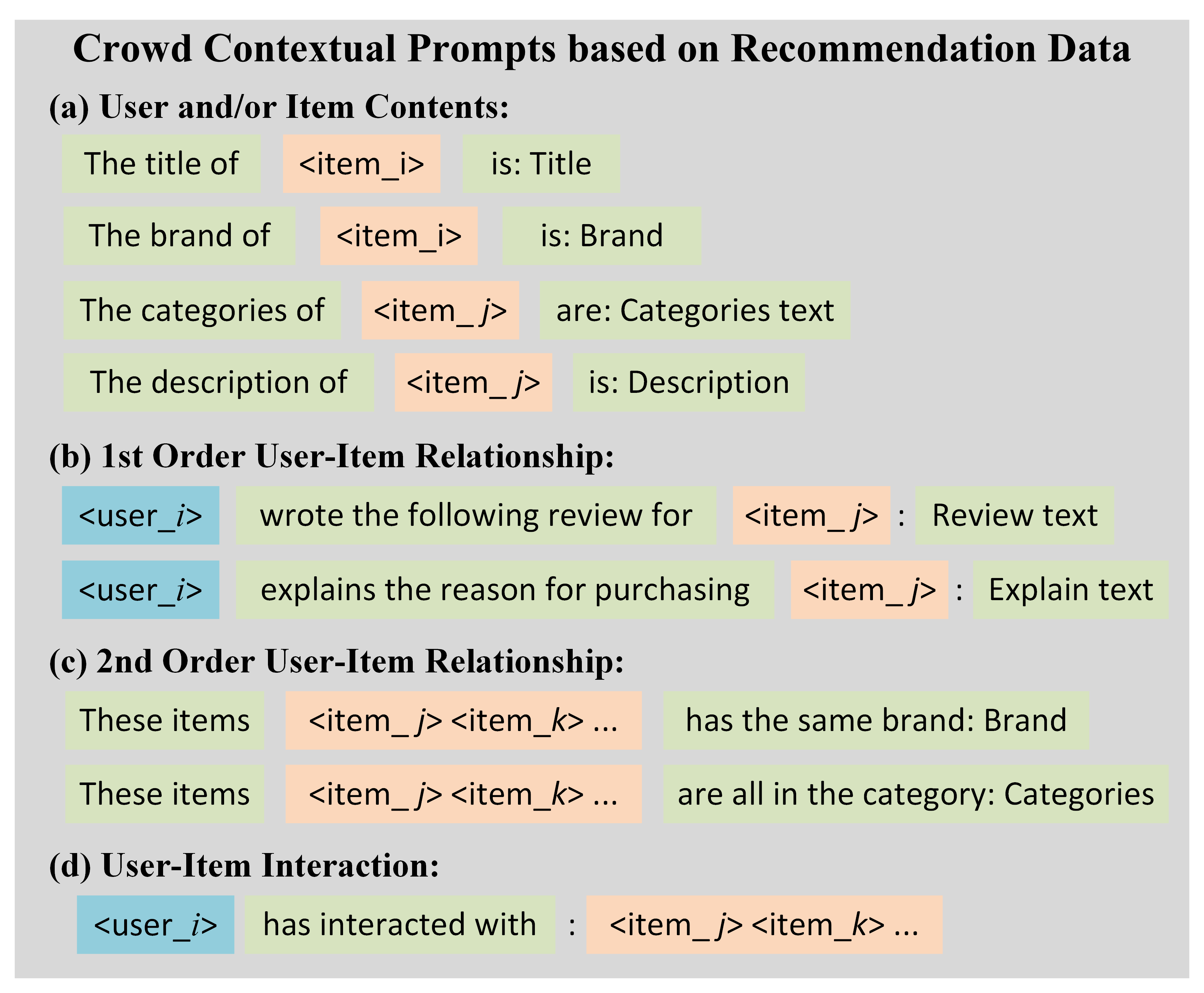
- 事前学習用のクラウド環境での文脈 prompts を用い、微調整時には個人化予測 prompts を用いて推奨品質を最適化する。
提案手法
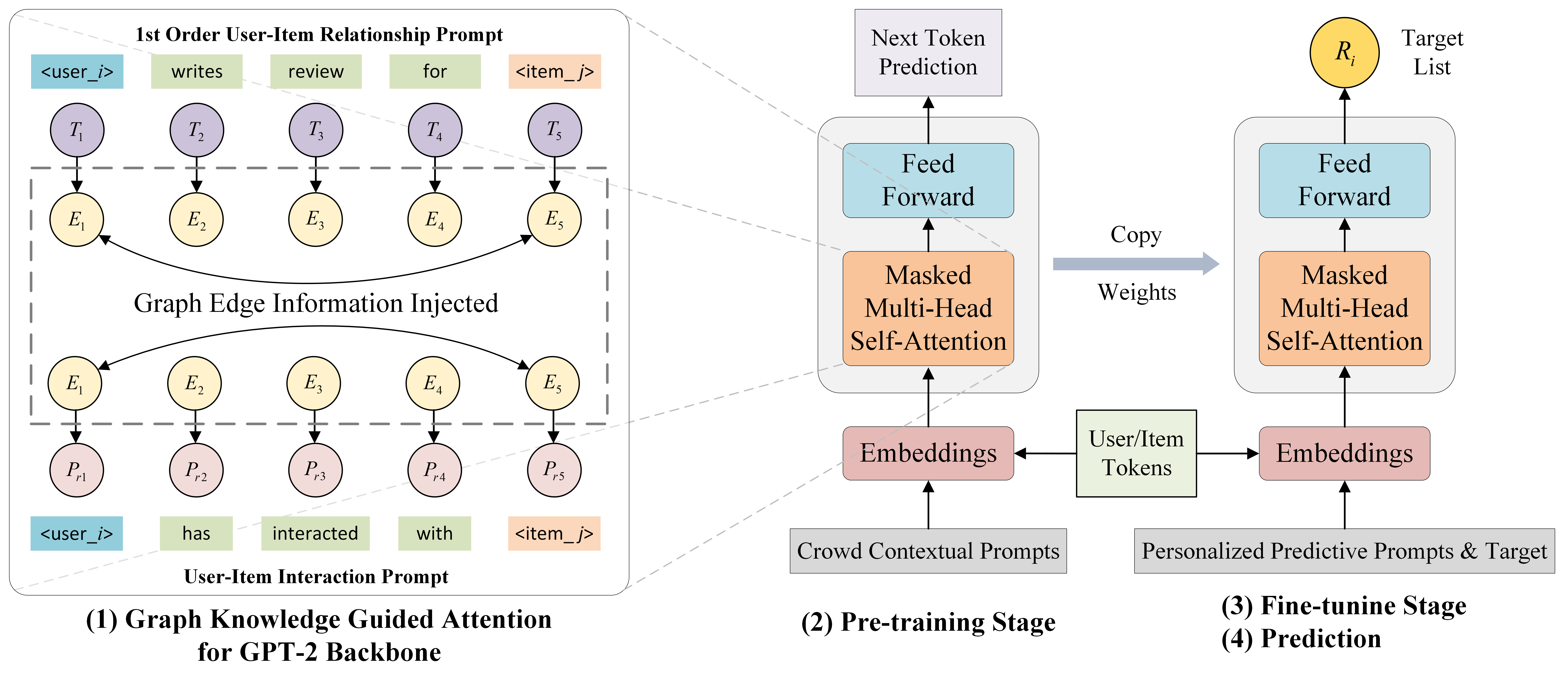
- 基盤LLMとしてGPT-2を用い、エッジコード化項Rを注意計算に埋め込み、エッジ知識をアテンションに組み込む。
- 直接(一次)および間接(二次)のグラフ接続性をR = R^conn + R^pathとして表現し、R^connを隣接行列様の項とし、R^pathを正規化された最短経路スコアから導出する。
- ユーザー/アイテムトークン、アイテム属性、ユーザー-itemの相互作用イベントを含むクラウド文脈 promptsでグラフアテンションLLMを事前学習し、トークン生成尤度を最大化する。
- 過去形プロンプトを未来形トリガーに変換する個人化予測 prompts で微調整し、推奨精度を最適化する。
- プロダクション環境で prompts を用いてユーザー-アイテムペアの推奨スコアを生成し、オフラインのバッチ処理とオンラインキャッシュを用いて待機時間を管理する。
- 7つのAmazonデータセットを対象にRecall@20、Recall@40、NDCG@100を評価し、前処理学習、微調整、GKIA(グラフ知識を注意へ)、GHIP(グラフ/履歴 prompts)のアブレーションを実施する。
実験結果
リサーチクエスチョン
- RQ1グラフアテンションLLMのフレームワークは、実データセット上でベースラインより推奨精度を向上させるか。
- RQ2一次および二次のグラフ接続性が推奨性能に与える寄与はどの程度か。
- RQ3事前学習、微調整、およびグラフ強化された注意構成要素が結果にどのように影響するか。
- RQ4アイテムの背景情報と二次的な関係を組み込むことは推奨を高めるか。
- RQ5グラフ情報を組み込むための異なる prompts 構造と注意注入手法は、LLMベースのグラフ情報推奨にとってどれほど有効か。
主な発見
- 提案されたグラフアテンションLLMは、7つのAmazonデータセット全体でベースラインよりRecall@20、Recall@40、NDCG@100が高い。
- アブレーションにより、前処理学習と微調整が性能に大きく影響することが示され、学習パイプラインの妥当性を裏付けた。
- GKIAアテンション機構を介してグラフエッジ情報を組み込み、二次関係を用いることで結果が改善された。
- 二次的なアイテム関係とアイテム背景情報を含む prompts は、これらの要素を欠くモデルよりも良い性能を発揮した。
- 異なるアテンション注入手法は、 edge-knowledge をLLMのアテンションダイナミクスへ組み込む重要性を示した。
この論文を読む
Nubintのビューアで原文を開き、読みながら気になる箇所をすぐに質問できます。
Nubintでこの論文を読むこのレビューはAIが論文の原文をもとに作成しました。引用する前に原文をご確認ください。