
[論文レビュー] Local Implicit Normalizing Flow for Arbitrary-Scale Image Super-Resolution
本論文は、局所的非線形ニューラル表現と座標条件付き正規化フローを組み合わせることで、任意スケールの画像超解像を実現する新規フレームワーク、Local Implicit Normalizing Flow (LINF) を提案する。低解像度入力、スケーリング要因、フーリエ特徴量を条件として、局所的なテクスチャパッチの分布をモデル化することで、任意の拡大率において詳細で視認的に現実的な画像を生成する。従来手法に比べて、知覚的品質と推論速度の両面で優れた性能を達成する。
Flow-based methods have demonstrated promising results in addressing the ill-posed nature of super-resolution (SR) by learning the distribution of high-resolution (HR) images with the normalizing flow. However, these methods can only perform a predefined fixed-scale SR, limiting their potential in real-world applications. Meanwhile, arbitrary-scale SR has gained more attention and achieved great progress. Nonetheless, previous arbitrary-scale SR methods ignore the ill-posed problem and train the model with per-pixel L1 loss, leading to blurry SR outputs. In this work, we propose "Local Implicit Normalizing Flow" (LINF) as a unified solution to the above problems. LINF models the distribution of texture details under different scaling factors with normalizing flow. Thus, LINF can generate photo-realistic HR images with rich texture details in arbitrary scale factors. We evaluate LINF with extensive experiments and show that LINF achieves the state-of-the-art perceptual quality compared with prior arbitrary-scale SR methods.
研究の動機と目的
- 超解像の不適切な定式化を解消するため、高解像度画像生成を決定的回帰タスクではなく分布問題としてモデル化すること。
- アーキテクチャの変更なしに任意の拡大率に一般化できない固定スケールの超解像モデルの限界を克服すること。
- ピxls単位のL1損失に代えて、テクスチャの詳細分布を捉えるフローに基づく生成アプローチを導入することで、知覚的品質を向上させること。
- フーリエ特徴量のアンサンブルを用いたパッチベースの座標条件付き正規化フロー構造により、任意スケールの超解像における効率的な推論を可能にすること。
- 正規化フローにおけるサンプリング温度の制御により、PSNRとLPIPSの指標の間で適合性と知覚的品質のトレードオフを調整できること。
提案手法
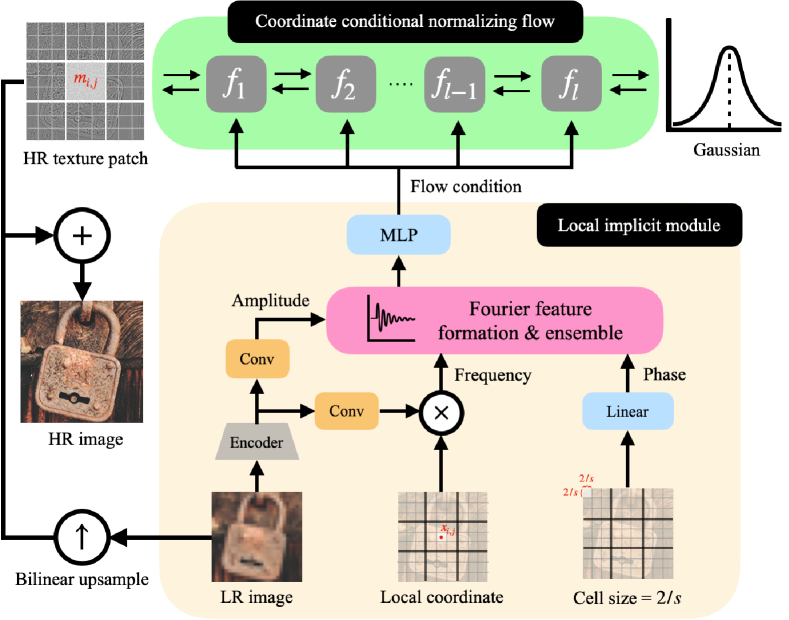
- LINFは、座標条件付き正規化フローを用いて、局所的テクスチャパッチの分布を学習することで超解像を定式化する。
- フロー・モデルは、低解像度画像、各パッチの中心座標、および希望されるスケーリング要因に条件付けられる。
- 各パッチ位置でのフーリエ特徴量を推定する局所的非線形ニューラル表現が、フロー・モデルの条件信号を提供する。
- より効率的でない局所アンサンブル機構に代わり、推論速度と性能を向上させるためにフーリエ特徴量のアンサンブルが採用される。
- 生成時の前方伝搬回数を減らし、局所的テクスチャの一貫性を保つために、パッチベースのアプローチ(n×n領域)が用いられる。
- 正規化フローにおけるサンプリング温度の制御により、適合性(PSNR)と知覚的品質(LPIPS)のバランスを調整でき、トレードオフ最適化が可能になる。

実験結果
リサーチクエスチョン
- RQ1正規化フローは、任意スケールの超解像に効果的に適応可能であり、高い知覚的品質を維持できるか?
- RQ2ピxls単位の回帰と比較して、局所的テクスチャパッチの分布をモデル化することで、画像の詳細回復がどのように向上するか?
- RQ3局所的非線形表現は、任意スケールで多様で現実的なテクスチャを生成するための正規化フローに十分な条件付き監視を提供できるか?
- RQ4パッチサイズは、フローに基づく超解像におけるテクスチャの一貫性と推論効率にどのような影響を及ぼすか?
- RQ5正規化フローにおける温度制御されたサンプリングは、任意スケールの超解像においてPSNRとLPIPSのトレードオフにどのように影響を与えるか?
主な発見
- LINFは、DIV2K検証セットにおいて最先端の知覚的品質を達成し、τ=0.6のときLPIPSが0.158にまで低下し、従来手法を大きく上回った。
- 局所アンサンブルベースラインと比較して、推論時間を約33%短縮し、TITAN Xで1枚あたり1.44秒の速度を達成した。
- フーリエ特徴量のアンサンブル機構により、自己回帰モデルに比べて27.2倍高速な推論が可能となり、フローに基づくベースラインに比べて2.6倍高速になった。
- パッチベースのモデル(n>1)は、ピxlsベースのモデル(n=1)よりもより知覚的に一貫性のある結果を生成し、ランダムサンプリングによる局所的不整合を回避した。
- τ=0のとき、ピxlsベースのモデルは高いPSNR(28.85)を達成したが、LPIPSは0.273と知覚的品質が低かった。一方、パッチベースのモデルはτ=0.6でLPIPSが0.158にまで低下し、視覚的品質が向上した。
- フーリエ特徴量のアンサンブルにおける振幅スケーリングの除去は、わずかな性能低下(LPIPS 0.271 vs. 0.270)を引き起こし、重み付き振幅スケーリングの重要性を裏付けた。
この論文を読む
Nubintのビューアで原文を開き、読みながら気になる箇所をすぐに質問できます。
Nubintでこの論文を読むこのレビューはAIが論文の原文をもとに作成しました。引用する前に原文をご確認ください。