
[論文レビュー] LoRA Land: 310 Fine-tuned LLMs that Rival GPT-4, A Technical Report
本論文は10のベースモデルと31のタスクにわたって310のLoRA微調整済みLLMを評価し、4-bit LoRA微調整は平均的にベースモデルやGPT-4を上回ることを示し、LoRAXとLoRA Landを用いた実運用展開で1つのA100 GPUに25個の微調整済みMistral-7Bモデルをホスティングすることを実証する。
Low Rank Adaptation (LoRA) has emerged as one of the most widely adopted methods for Parameter Efficient Fine-Tuning (PEFT) of Large Language Models (LLMs). LoRA reduces the number of trainable parameters and memory usage while achieving comparable performance to full fine-tuning. We aim to assess the viability of training and serving LLMs fine-tuned with LoRA in real-world applications. First, we measure the quality of LLMs fine-tuned with quantized low rank adapters across 10 base models and 31 tasks for a total of 310 models. We find that 4-bit LoRA fine-tuned models outperform base models by 34 points and GPT-4 by 10 points on average. Second, we investigate the most effective base models for fine-tuning and assess the correlative and predictive capacities of task complexity heuristics in forecasting the outcomes of fine-tuning. Finally, we evaluate the latency and concurrency capabilities of LoRAX, an open-source Multi-LoRA inference server that facilitates the deployment of multiple LoRA fine-tuned models on a single GPU using shared base model weights and dynamic adapter loading. LoRAX powers LoRA Land, a web application that hosts 25 LoRA fine-tuned Mistral-7B LLMs on a single NVIDIA A100 GPU with 80GB memory. LoRA Land highlights the quality and cost-effectiveness of employing multiple specialized LLMs over a single, general-purpose LLM.
研究の動機と目的
- 実世界のアプリケーションでLoRA微調整済みLLMのトレーニングと提供を現実的に行えるかを評価する。
- 標準化されたプロンプトの下で、さまざまなベースモデルとタスクに対するLoRA微調整による性能向上を定量化する。
- どのベースモデルとタスク特性が微調整の恩恵を最も予測するかを調査する。
- 生産環境でLoRAXを用いて複数のLoRAアダプタを提供する際の待ち時間、同時実行性、実用性を評価する。
提案手法
- LoRAを用いた4-bit量子化とランク8で10個のベースモデルに対して310のLLMを標準化して微調整する。
- 統一的なトレーニング設定:40,000ステップ、バッチサイズ1、PagedAdam、学習率0.002、サインカーネススケジュール、ウォームアップ3%、16のアキュームレーションステップ。
- 出力を地上真の語彙へマッピングするための正規表現抽出を用いたゼロショットまたは1ショットのプロンプトでの評価。
- 生成タスクにはROUGE-L、分類には正確度、回帰にはMAEを用い、タスク固有の適用(WikiSQLROUGEを代理)を実施。
- LoRAXを用いて動的アダプター読み込みと単一GPUでの多モデル提供を可能にし、LoRA Landで25のLoRA微調整済みMistral-7Bモデルをデプロイする。
実験結果
リサーチクエスチョン
- RQ1標準化されたプロンプトの下で、幅広いベースモデルとタスクに対してLoRA微調整はどれくらい効果的か。
- RQ2どのベースモデルがLoRA微調整の恩恵を最も受けやすく、モデルサイズは gainsにどのように影響するか。
- RQ3タスクの複雑さのヒューリスティックは微調整の利得とベースラインをどの程度予測できるか。
- RQ4LoRAXを使用して本番環境で複数のLoRAアダプタを効率的にデプロイ・提供することは実現可能か。
主な発見
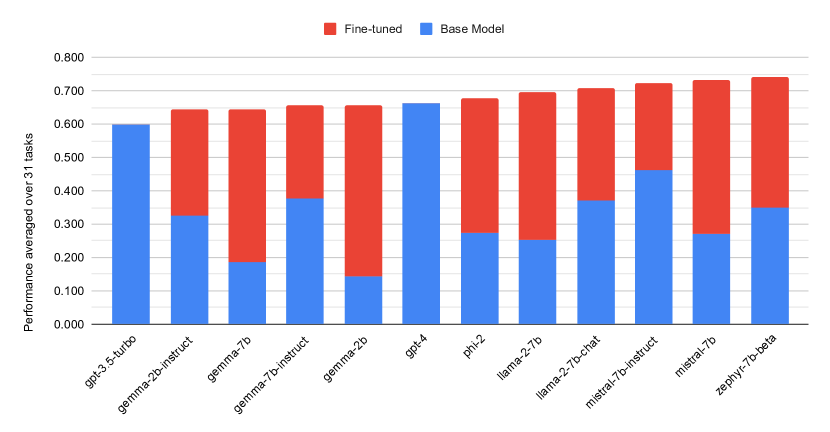
- 4-bit LoRA微調整済みモデルは平均でベースモデルより34ポイント、GPT-4よりも平均で10ポイント高く、31タスクと10ベースモデル全体で優れている。
- 最良の微調整済みLLMは310タスクのうち301でベースモデルを上回り、310タスク中224でGPT-4を上回った。
- Phi-2(2B)は微調整後にGPT-4と競合する水準であり、7Bモデルは一般に2Bの後に得られた調整後の方が上回る。
- LoRA微調整のための基盤モデルとしてMistral-7BとZephyr-7b-betaがトップとなり、タスクを通じて最も頻繁にMistral-7Bがトップ、Zephyr-7b-betaが全体平均で最高を達成。
- LoRAXは単一のA100で25のLoRA微調整済みMistral-7Bモデルの提供を可能にし、実用的でコスト効果の高いマルチモデル展開を実証。
この論文を読む
Nubintのビューアで原文を開き、読みながら気になる箇所をすぐに質問できます。
Nubintでこの論文を読むこのレビューはAIが論文の原文をもとに作成しました。引用する前に原文をご確認ください。