
[論文レビュー] LoRA-XS: Low-Rank Adaptation with Extremely Small Number of Parameters
LoRA-XSは、SVDを用いてLoRA射影行列を固定し、それらの間にのみ$ r \times r $のアダプタ行列を学習することで、7Bモデルにおいて学習パラメータを100倍以上削減する、極めてパrameter効率の高い微調整手法を導入する。このアプローチは、LoRAやVeRAと比較して優れたパrameter効率と競争力ある性能を達成しており、100万規模のパーソナライズドモデルにおいてストレージ要件を1500倍以上削減する。
The growth of large language models underscores the need for parameter-efficient fine-tuning. Despite its popularity, LoRA encounters storage and computational challenges when deploying multiple task- or user-specific modules. To address this, we introduce LoRA-XS, a novel fine-tuning method backed by a theoretical derivation. LoRA-XS drastically reduces trainable parameters by incorporating a small, trainable weight matrix between frozen low-rank matrices derived from the Singular Value Decomposition of pre-trained weights. This design enables LoRA-XS to reduce storage requirements by over 100x in 7B models compared to LoRA. Additionally, unlike other methods, LoRA-XS imposes no lower bound on trainable parameters - it can scale from a single parameter per module to arbitrarily large values, adapting to any storage or computational constraint. Evaluations on GLUE, GSM8K, MATH, and commonsense reasoning benchmarks across different model scales reveal that LoRA-XS consistently outperforms or matches LoRA and VeRA in accuracy, offering unmatched parameter efficiency. Our ablation studies highlight the significance of singular vectors in transformer weights, establishing LoRA-XS as a powerful, storage-efficient solution for scaling and personalizing large language models.
研究の動機と目的
- 大規模言語モデルに多数のタスク固有またはパーソナライズドLoRAアダプタをデプロイする際の増大するストレージおよび計算負荷に対処すること。
- LoRA や VeRA などの既存のPEFT手法がモデルの隠れ次元に依存していることによる、より大きなモデルにおけるスケーラビリティの制限を克服すること。
- パフォーマンスを損なわせることなく極めて高いパrameter効率を達成し、パーソナライズドモデルの柔軟かつ低メモリなデプロイを可能にすること。
- アーキテクチャの変更や推論時の追加遅延を避けることで、推論効率を維持すること。
- 超低パラメータ領域における収束速度および最終パフォーマンスに与える初期化戦略の影響を調査すること。
提案手法
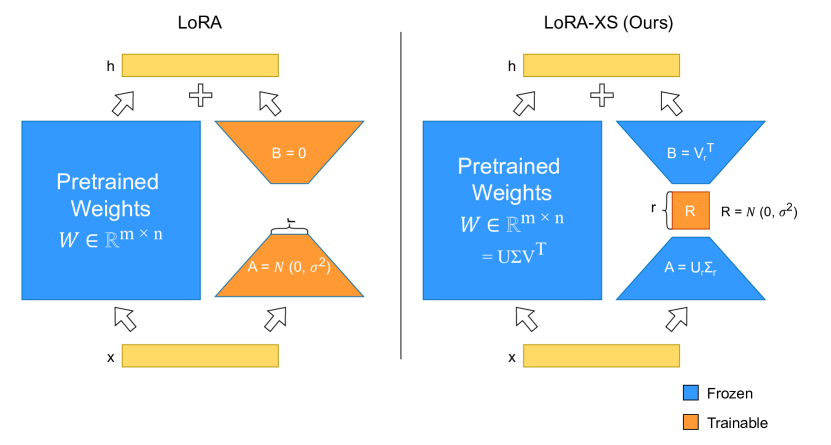
- 事前学習された重み行列を、固定され、凍結されたLoRA射影行列$ A $と$ B $に、元の重みの上位主成分に初期化することで、特異値分解(SVD)を用いて分解する。
- 固定された$ A $と$ B $の間に、小さな学習可能な$ r \times r $アダプタ行列$ R $を導入し、低ランクの適応を実現する。
- 学習可能なパラメータは$ r \times r $行列$ R $のみを訓練することで、学習パラメータ数がモデルサイズや隠れ次元に依存しなくなるようにする。
- 低ランク$ r $で、複数のアテンション層およびフィードフォワード層(Query, Key, Value, Output, FFN)にLoRA-XSアダプタを適用し、パラメータの分散配置を可能にする。
- 事前学習重みの主要な特異成分と一致するように、$ A $と$ B $をSVDに基づいて初期化することで、収束性とパフォーマンスの向上を図る。
- アーキテクチャの変更や追加モジュールを一切行わないため、標準的なTransformer推論と完全に互換性を持つ。
実験結果
リサーチクエスチョン
- RQ1モデルの隠れ次元に依存しない学習パラメータ数の分離によって、微調整における極めて高いパrameter効率を達成できるか?
- RQ2SVDに基づくLoRA行列の初期化は、低ランク適応において収束速度および最終パフォーマンスを向上させるか?
- RQ3GLUE、GSM8k、MATHベンチマークにおいて、LoRA-XSはLoRAやVeRAと比較してパラメータ効率およびパフォーマンスで優れているか?
- RQ4LoRA-XSは、大幅にストレージオーバーヘッドを削減することで、大規模モデルのスケーラブルなパーソナライズを可能にするか?
- RQ5低ランクで複数の層にわたってLoRA-XSモジュールを分散配置した場合、全体のパフォーマンスおよびパラメータ効率にどのような影響を与えるか?
主な発見
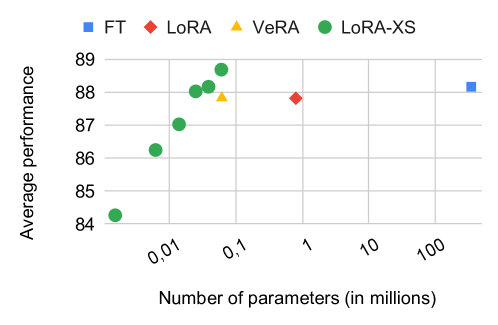
- 7Bモデルにおいて、標準的なLoRAと比較して、LoRA-XSは学習パラメータ数を100倍以上削減し、極めて高いパrameter効率を達成した。
- GPT-3(ランク16)において、100万個のパーソナライズドモデルのストレージを、LoRAの144TBからLoRA-XSでは96GBにまで1500倍削減した。
- GLUE、GSM8k、MATHベンチマークにおいて、LoRA-XSはパラメータ効率でLoRAやVeRAを上回り、はるかに少ないパラメータで高いまたは同等のパフォーマンスを達成した。
- SVDに基づく初期化により、特に低ランク領域において、ランダム初期化よりも収束が速く、パフォーマンスが優れた結果が得られた。
- 7Bモデルを用いたインstructチューニングタスクにおいて、極めて少ない学習可能なパラメータ数にもかかわらず、LoRA-XSは競争力あるパフォーマンスを維持し、強力な一般化能力を示した。
- 低ランク$ r $と層間でのモジュラ配備を可能にすることで、パラメータ数の正確な制御が可能となり、柔軟なメモリ使用が実現した。
この論文を読む
Nubintのビューアで原文を開き、読みながら気になる箇所をすぐに質問できます。
Nubintでこの論文を読むこのレビューはAIが論文の原文をもとに作成しました。引用する前に原文をご確認ください。