
[論文レビュー] Machine Learning for Predicting Chaotic Systems
本論文は、新しいベンチマークデータベースDeebLorenzとDystsデータセットを用いて、カオス的システムの予測に向けた軽量および重量級の機械学習モデルを評価し、累積的最大誤差(CME)という新しい指標を導入している。結果として、適切にチューニングされた単純なモデルやチューニングされていないベースラインモデルが、複雑なディープラーニングアーキテクチャを上回ることが多く、カオス的システム予測における手法とデータの整合性、計算効率の重要性が浮き彫りになった。
Predicting chaotic dynamical systems is critical in many scientific fields, such as weather forecasting, but challenging due to the characteristic sensitive dependence on initial conditions. Traditional modeling approaches require extensive domain knowledge, often leading to a shift towards data-driven methods using machine learning. However, existing research provides inconclusive results on which machine learning methods are best suited for predicting chaotic systems. In this paper, we compare different lightweight and heavyweight machine learning architectures using extensive existing benchmark databases, as well as a newly introduced database that allows for uncertainty quantification in the benchmark results. In addition to state-of-the-art methods from the literature, we also present new advantageous variants of established methods. Hyperparameter tuning is adjusted based on computational cost, with more tuning allocated to less costly methods. Furthermore, we introduce the cumulative maximum error, a novel metric that combines desirable properties of traditional metrics and is tailored for chaotic systems. Our results show that well-tuned simple methods, as well as untuned baseline methods, often outperform state-of-the-art deep learning models, but their performance can vary significantly with different experimental setups. These findings highlight the importance of aligning prediction methods with data characteristics and caution against the indiscriminate use of overly complex models.
研究の動機と目的
- カオス的システムの予測における最良の機械学習手法について、文献にまだ合意が得られていない現状を是正すること。
- 多様なカオス的システムにおいて、広範な軽量および重量級モデルを、きめ細やかで再現可能なベンチマークを用いて評価すること。
- 100回の繰り返しが含まれる100回の繰り返しを含む、不確実性の定量化と信頼性の高い性能評価を可能にする新規データセットDeebLorenzを提供すること。
- カオス的ダイナミクスに特化した、累積的最大誤差(CME)という新しい誤差指標の開発と適用。
- ハイパーパrameterチューニング、ノイズ、タイムステップスキーム、モデルアーキテクチャの影響が、予測性能に与える影響を調査すること。
提案手法
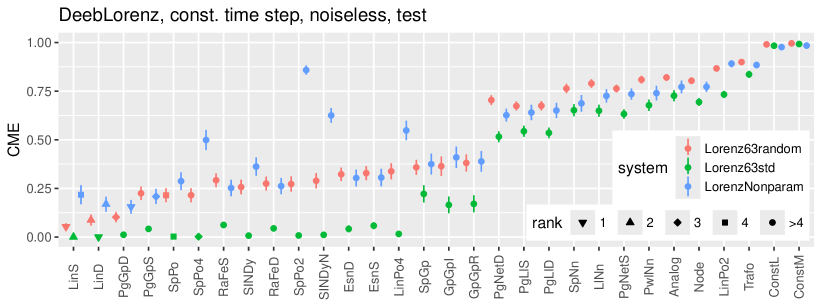
- カオス的ダイナミクスの特徴を捉えるために、Lorenz63システムの3つのバリエーションを含む、新しいベンチマークデータセットDeebLorenzを提案。各システムに対して100回の繰り返しシミュレーションを実施し、耐性と不確実性の定量化を可能にした。
- 従来の指標の利点を統合し、カオス的分散に感受性が高いように最適化された、累積的最大誤差(CME)指標を導入。
- 計算コストを考慮したハイパーパrameterチューニングを実施。軽量モデルにはより多くのリソースを、重量級モデルには少ないリソースを割り当てた。
- 多様な21種類のモデル(多項式フィッティング、ガウス過程、リザボアーキテクチャ、ディープラーニングアーキテクチャなど)を、複数のデータ設定で評価。
- DystsデータベースとDeebLorenzを併用し、クロスデータセット比較を実施。ノイズ、タイムステップ、初期条件のスケームの違いに起因する性能評価を実施。
- 統計的検定とランク付け分析を用いて、実験的条件下での手法の差異と耐性を評価。
実験結果
リサーチクエスチョン
- RQ1多様なデータセットと設定において、カオス的システムの予測において、どの機械学習モデルが一貫して他のモデルを上回るか?
- RQ2ハイパーパrameterチューニングは、軽量モデルと重量級モデルの両方において、カオス的システム予測性能にどのように影響を与えるか?
- RQ3ノイズ、固定ステップとランダムステップのタイムステップ、観測スキームの違いが、モデルの汎化性能と誤差指標に及ぼす影響はどの程度か?
- RQ4従来の指標(sMAPE や RMSE など)と比較して、提案された累積的最大誤差(CME)指標は、カオス的システムの予測分散をどの程度的確に捉えられるか?
- RQ5多項式フィッティングや線形回帰といった単純でチューニングされていないモデルが、カオス的ダイナミクスにおいて、複雑なディープラーニングモデルを上回る可能性はあるか?
主な発見
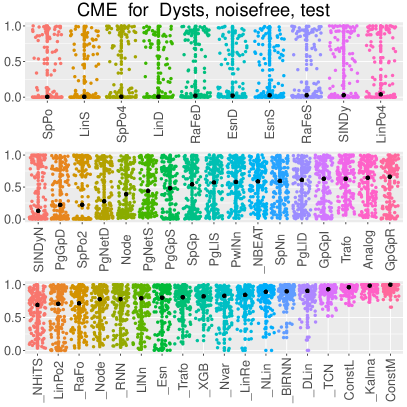
- 適切にチューニングされた軽量モデル(多項式フィッティングや線形回帰など)は、カオス的システムの予測において、最先端のディープラーニングモデルを頻繁に上回る。
- チューニングされていないベースラインモデルは、計算リソースが限られた状況でも、しばしば複雑なアーキテクチャを上回る性能を示す。
- 累積的最大誤差(CME)指標は、カオス的システムの特徴である分散を的確に捉え、従来の指標(sMAPE や RMSE など)よりも信頼性の高い評価を可能にする。
- 性能は実験設定によって顕著に異なることが判明。ノイズ、タイムステップスキーム、初期条件の選択が、モデルランクに強く影響を与える。
- ハイパーパrameterチューニングは、多くの可変パラメータを持つモデルでは性能向上をもたらすが、単純で安定性の高い手法には限界効果にとどまる。
- DeebLorenzデータセットにより、信頼性のある不確実性の定量化が可能となり、モデル性能がデータ特性と実験設計に極めて敏感であることが明らかになった。
この論文を読む
Nubintのビューアで原文を開き、読みながら気になる箇所をすぐに質問できます。
Nubintでこの論文を読むこのレビューはAIが論文の原文をもとに作成しました。引用する前に原文をご確認ください。