
[論文レビュー] Make-It-3D: High-Fidelity 3D Creation from A Single Image with Diffusion Prior
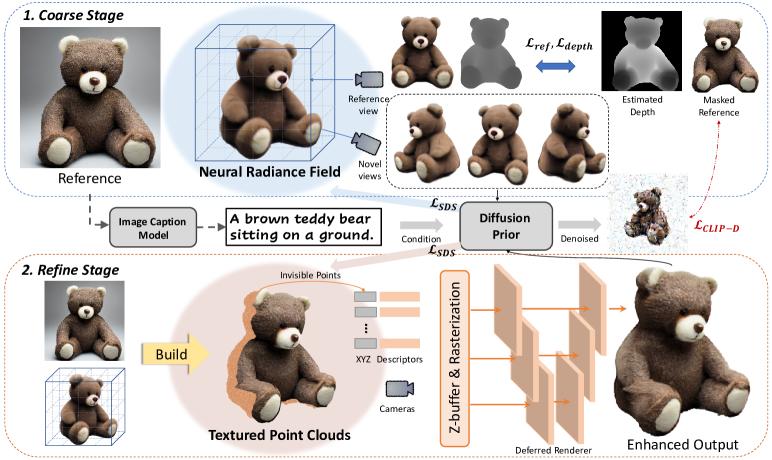
Make-It-3Dは、2D拡散モデルを3D対応プリオリとして活用することにより、単一画像から高忠実度の3Dコンテンツを作成する。2段階のNeRFとテクスチャ付き点群、拡散ベースのテクスチャ強化を採用。
In this work, we investigate the problem of creating high-fidelity 3D content from only a single image. This is inherently challenging: it essentially involves estimating the underlying 3D geometry while simultaneously hallucinating unseen textures. To address this challenge, we leverage prior knowledge from a well-trained 2D diffusion model to act as 3D-aware supervision for 3D creation. Our approach, Make-It-3D, employs a two-stage optimization pipeline: the first stage optimizes a neural radiance field by incorporating constraints from the reference image at the frontal view and diffusion prior at novel views; the second stage transforms the coarse model into textured point clouds and further elevates the realism with diffusion prior while leveraging the high-quality textures from the reference image. Extensive experiments demonstrate that our method outperforms prior works by a large margin, resulting in faithful reconstructions and impressive visual quality. Our method presents the first attempt to achieve high-quality 3D creation from a single image for general objects and enables various applications such as text-to-3D creation and texture editing.
研究の動機と目的
- 単一画像から一般オブジェクトの高品質な3D再構成を動機づけ、3Dコンテンツ作成のアクセス性を広げる。
提案手法
- 拡散プリオリを用いた3D対応の監視を行う2段階フレームワーク。
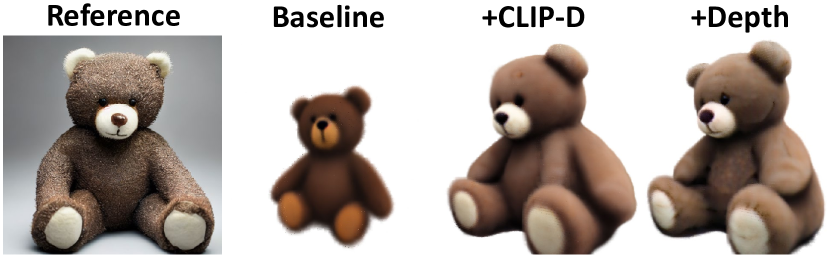
- Stage 1: 参照ビュー監視、SDS損失、CLIP-D損失、深度プリオリを用いた粗いNeRF最適化。
- Stage 2: テクスチャ付き点群へ変換し、参照テクスチャを投影し、学習可能な遅延レンダラーを介して拡散プリオリで不可視なテクスチャを洗練。
実験結果
リサーチクエスチョン
- RQ1拡散プリオリを用いることで、単一画像から任意オブジェクトの高忠実度3Dコンテンツを作成できるか。
- RQ2拡散プリオリをどのように統合して参照ビューの忠実度と新規視点の妥当性を保証するか。
- RQ32段階のNeRF-toテクスチャ付き点群パイプラインは、従来の単段Methodsより幾何とテクスチャ品質を向上させるか。
主な発見
- 幾何とテクスチャ品質の両方で従来手法を上回り、DTUと新規400画像ベンチマークで優れた評価を示す。
- 拡散プリオリを用いた粗いNeRFは、妥当な幾何と忠実な参照ビューレンダリングを生み出す。
- テクスチャ付き点群と拡散プリオリによるテクスチャの洗練は、非可視領域を著しく改善し高忠実なテクスチャを生成する。
- 単一画像からの360°再構成を可能とし、テキスト→3D作成やテクスチャ編集などの応用をサポートする。
- 本手法は、評価データセットでLPIPS、文脈距離、CLIPベースの類似度の最先端指標を達成する。
この論文を読む
Nubintのビューアで原文を開き、読みながら気になる箇所をすぐに質問できます。
Nubintでこの論文を読むこのレビューはAIが論文の原文をもとに作成しました。引用する前に原文をご確認ください。