
[論文レビュー] ManyDG: Many-domain Generalization for Healthcare Applications
本論文では、医療AIにおける患者固有の共変量を扱うために、各患者を個別のドメインとして扱う新しいドメイン一般化手法ManyDGを提案する。相互再構成と直交射影を用いて、ラベル不変の表現から患者固有の特徴を分離することで、低データおよび継続的学習設定下でも最先端の性能を達成し、MIMIC薬物推薦タスクにおいてJaccardスコアで3.7%の向上を達成した。
The vast amount of health data has been continuously collected for each patient, providing opportunities to support diverse healthcare predictive tasks such as seizure detection and hospitalization prediction. Existing models are mostly trained on other patients data and evaluated on new patients. Many of them might suffer from poor generalizability. One key reason can be overfitting due to the unique information related to patient identities and their data collection environments, referred to as patient covariates in the paper. These patient covariates usually do not contribute to predicting the targets but are often difficult to remove. As a result, they can bias the model training process and impede generalization. In healthcare applications, most existing domain generalization methods assume a small number of domains. In this paper, considering the diversity of patient covariates, we propose a new setting by treating each patient as a separate domain (leading to many domains). We develop a new domain generalization method ManyDG, that can scale to such many-domain problems. Our method identifies the patient domain covariates by mutual reconstruction and removes them via an orthogonal projection step. Extensive experiments show that ManyDG can boost the generalization performance on multiple real-world healthcare tasks (e.g., 3.7% Jaccard improvements on MIMIC drug recommendation) and support realistic but challenging settings such as insufficient data and continuous learning.
研究の動機と目的
- データ収集環境や個人識別子などの患者固有の共変量によって引き起こされるモデル一般化性能の低下を是正すること。
- 各患者を個別のドメインとして扱う新しい多ドメイン一般化設定を提案し、スケーラブルで現実的な一般化を可能にすること。
- ラベル不変の表現を保持しつつ、患者固有の特徴を明示的に除去する手法を開発し、一般化性能の向上を図ること。
- 限られたラベル付きデータや継続的学習が一般的な臨床設定において、手法の有効性を評価すること。
提案手法
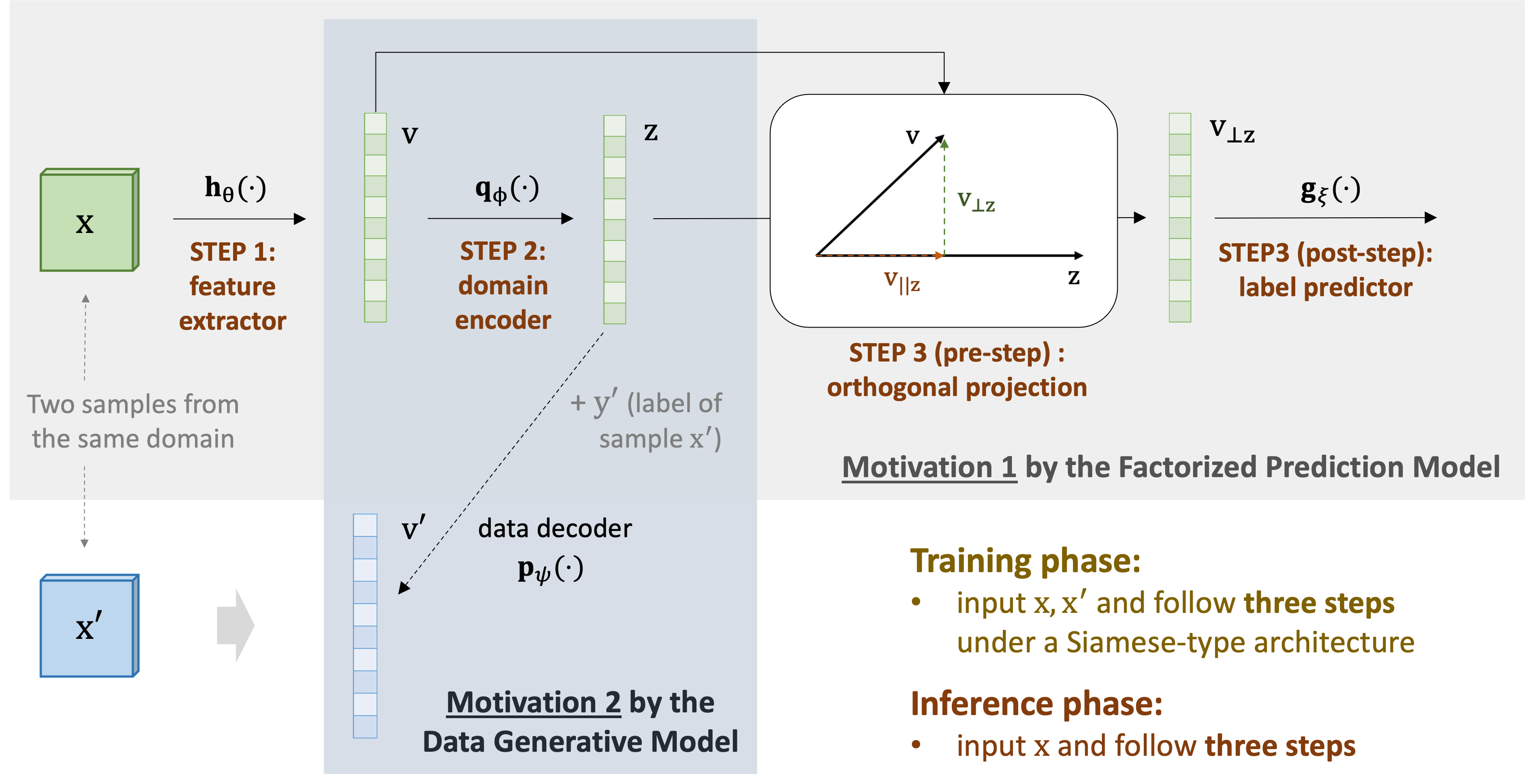
- 同じ患者からのペairedサンプルを用いて学習するシアン型アーキテクチャを採用し、患者固有のデータ上で統合最適化を可能にする。
- 相互再構成を用いて、別々のドメイン(z)およびラベル(u)表現から入力特徴ベクトルを再構成し、複数の視点間の一貫性を確保する。
- ドメイン(z)とラベル(u)表現の間の直交性を強制するため、直交射影を適用し、分離を促進する。
- 4つの損失項を用いてモデルを訓練する:ラベル予測のための教師あり損失、再構成損失、同一患者内でのz類似度最大化を目的とするドメイン類似度損失、直交性損失。
- ドメインとラベル情報のための分離エンコーダを備えた因子化予測モデルを用い、エンドツーエンドの学習を実現する。
- 本手法は、てんかん検出、睡眠ステージ分類、薬物推薦、再入院予測といった多様なタスクをカバーする4つの実世界医療データセットで評価された。
実験結果
リサーチクエスチョン
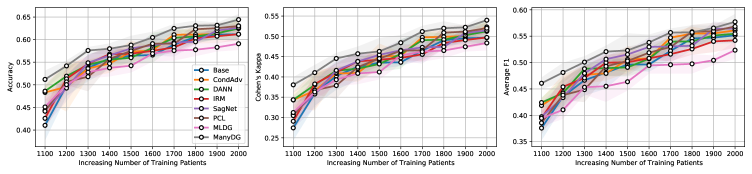
- RQ1各患者を個別のドメインとして扱うことで、医療応用におけるモデル一般化性能が向上するか?
- RQ2相互再構成と直交射影は、ラベル不変の表現から患者固有の共変量をどれほど効果的に分離できるか?
- RQ3限られたデータと継続的学習のシナリオにおいて、提案手法は良好な一般化性能を示すか?
- RQ4既存のドメイン一般化ベースラインと比較して、性能と頑健性の面で優れているか?
主な発見
- MIMIC薬物推薦ベンチマークにおいて、最も優れたベースラインと比較して、ManyDGはJaccardスコアで3.7%の向上を達成した。
- てんかん検出タスクでは、ManyDGは0.6754(±0.0079)の精度を達成し、SimD1(0.5954)とSimD2(0.6499)を上回った。
- 睡眠ステージ分類では、ManyDGは0.9055(±0.0054)の精度を達成し、SimD1(0.8862)とSimD2(0.9017)を上回った。
- オープンEHR薬物推薦タスクでは、ManyDGはJaccardスコア0.5175(±0.0130)を達成し、SimD1(0.4894)とSimD2(0.4901)を顕著に上回った。
- 本手法は、標準的および挑戦的な設定下でも、再入院予測や睡眠ステージ分類を含むすべての評価タスクで一貫した性能向上を示した。
- アブレーションスタディの結果、再構成とドメイン類似度に正規化されたコサイン類似度を用いたSimD2は、MSEを用いたSimD1よりも優れた性能を示した。これは、より適切にスケーリングされた損失目的によるものであった。
この論文を読む
Nubintのビューアで原文を開き、読みながら気になる箇所をすぐに質問できます。
Nubintでこの論文を読むこのレビューはAIが論文の原文をもとに作成しました。引用する前に原文をご確認ください。