
[論文レビュー] Markerless Motion Capture and Biomechanical Analysis Pipeline
本論文は、深層学習に基づく人体ポーズ推定と密な生物学的根拠を持つキーポイントセット、滑らかな軌道再構成のための暗黙的ニューラル表現、および逆運動学のための二段階最適化を組み合わせたマーカーレスモーションキャプチャとバイオメカニクス解析パイプラインを提示する。この手法は、立ち止まりのキャリブレーション試行を必要とせず、ゴールドスタンダードの歩行測定と比較して10 mm以内の高精度な関節運動学的推定を達成でき、臨床的リハビリテーション環境での迅速かつ信頼性の高いバイオメカニクス的評価を可能にする。
Markerless motion capture using computer vision and human pose estimation (HPE) has the potential to expand access to precise movement analysis. This could greatly benefit rehabilitation by enabling more accurate tracking of outcomes and providing more sensitive tools for research. There are numerous steps between obtaining videos to extracting accurate biomechanical results and limited research to guide many critical design decisions in these pipelines. In this work, we analyze several of these steps including the algorithm used to detect keypoints and the keypoint set, the approach to reconstructing trajectories for biomechanical inverse kinematics and optimizing the IK process. Several features we find important are: 1) using a recent algorithm trained on many datasets that produces a dense set of biomechanically-motivated keypoints, 2) using an implicit representation to reconstruct smooth, anatomically constrained marker trajectories for IK, 3) iteratively optimizing the biomechanical model to match the dense markers, 4) appropriate regularization of the IK process. Our pipeline makes it easy to obtain accurate biomechanical estimates of movement in a rehabilitation hospital.
研究の動機と目的
- マーカーレスモーションキャプチャとバイオメカニクス的分析のための、臨床現場に適した、堅牢で実用可能なパイプラインを開発すること。
- 複数データセットからのトレーニングで得られる密な生物学的整合性を持つキーポイントセットを用いることで、関節運動学の推定精度を向上させること。
- 逆運動学処理に二段階最適化を統合することで、立ち止まりのキャリブレーション試行を不要にする。
- 3次元キーポイント再構成のための暗黙的ニューラル表現を用いることで、滑らかで解剖学的に妥当な軌道を実現し、滑らかさと生物学的妥当性を向上させること。
- 多様な患者集団に対して、1回のセッションあたり10分未塔で迅速かつ繰り返し可能な歩行分析を可能にすること。
提案手法
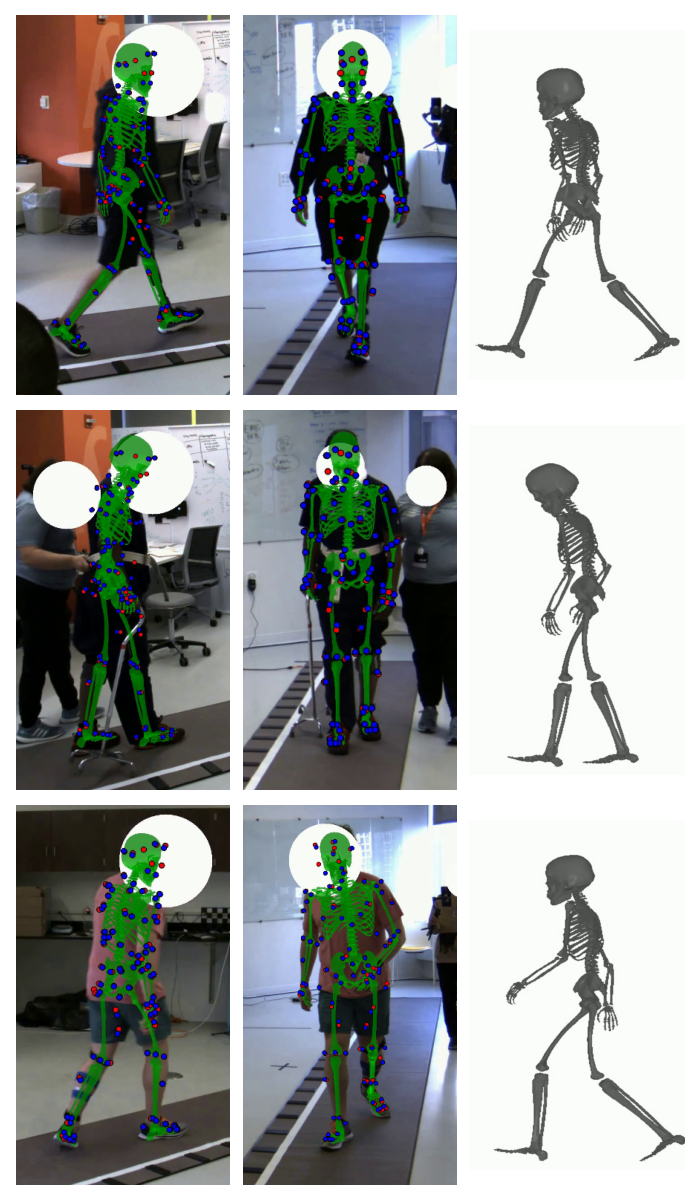
- MeTraBs-ACAE(複数データセット向けニューラルネットワーク)を用い、1枚の画像から生物学的整合性を持つ空間的関係を有する2次元および3次元キーポイント推定を生成する。
- 時間から3次元位置へのマッピングを行う暗黙的ニューラル表現(ニューラルネットワーク)を用いて、ノイズの多いHPE出力から滑らかで解剖学的に制約された3次元軌道を再構成する。
- 別個の立ち止まりキャリブレーション試行を必要とせず、生物学的モデルのスケーリングと逆運動学の解法を同時に実行する二段階最適化を適用する。
- 反復的精錬により、IK処理のハイパーパrameterと正則化項を最適化し、モデルの適合性と安定性を向上させる。
- HPEモデルからの信頼度推定値を用いて、軌道再構成およびIK適合の過程でキーポイントの寄与度を重み付けする。
- 複数のキャリブレーション済みで同期されたカメラからのデータ統合により、頑健な3次元再構成を実現し、遮蔽に起因する誤差を低減する。
実験結果
リサーチクエスチョン
- RQ1従来のトリアングレーション手法と比較して、3次元軌道再構成に暗黙的ニューラル表現を用いることで、マーカーレスモーションキャプチャの精度と滑らかさが向上するか?
- RQ2複数データセットからのトレーニングで得られる密な生物学的根拠を持つキーポイントセットを用いることで、標準の25キーポイントHPEモデルに比べて逆運動学の精度が向上するか?
- RQ3二段階最適化により、立ち止まりのキャリブレーション試行を不要にしつつも、生物学的モデルスケーリングの高精度を維持できるか?
- RQ4歩行障害や補助具を装着している患者を含む多様な患者集団において、臨床現場でのパイプラインの性能はいかがであるか?
- RQ5ゴールドスタンダードシステムと比較して、この手法は歩行パラメータ(歩幅、ステップ幅など)をどの程度正確に保持できるか?
主な発見
- パイプラインはGaitRite測定と比較して、10 mm以内の歩行パラメータ推定精度を達成し、高い空間的忠実性を示した。
- MeTraBs-ACAEから得られる密キーポイントセットを用いることで、標準の25キーポイントHPEモデルに比べて逆運動学の推定精度が顕著に向上した。
- 二段階最適化により、別個の立ち止まりキャリブレーション試行を必要とせず、正確な生物学的モデルスケーリングが可能になった。これは、臨床ワークフローの簡素化に寄与した。
- 暗黙的軌道再構成により、ノイズが低減され、解剖学的に妥当な滑らかな3次元マーカー軌道が得られ、IK収束性が向上した。
- 歩行障害や移動補助具を装着している患者に対しても、1回のセッションあたり10分未塔で信頼性の高い歩行分析が可能になった。
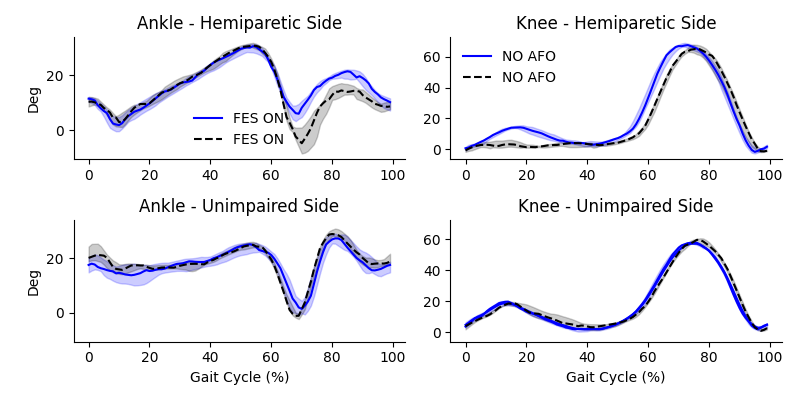
- 本手法は、補強具の装着や機能的電気刺激の効果といった臨床的関連変化を検出でき、動きの変化に高い感受性を示した。
この論文を読む
Nubintのビューアで原文を開き、読みながら気になる箇所をすぐに質問できます。
Nubintでこの論文を読むこのレビューはAIが論文の原文をもとに作成しました。引用する前に原文をご確認ください。