
[論文レビュー] Masked Particle Modeling on Sets: Towards Self-Supervised High Energy Physics Foundation Models
本稿では、高エネルギー物理学(HEP)における無順序な粒子集合から、置換不変な表現を学ぶための自己教師あり学習手法であるマスクドパーティクルモデリング(MPM)を紹介する。粒子特徴をマスクし、VQ-VAEで学習されたコードブックを介して離散トークンの識別を予測することで、ラベルなしのジェットデータに対する有効な事前学習が可能となり、下流の分類タスクにおいて強力なゼロショットおよびフェイントショットの転移性能を達成した。これは、未観測のクラスや新しいデータドメインに対しても有効である。
We propose masked particle modeling (MPM) as a self-supervised method for learning generic, transferable, and reusable representations on unordered sets of inputs for use in high energy physics (HEP) scientific data. This work provides a novel scheme to perform masked modeling based pre-training to learn permutation invariant functions on sets. More generally, this work provides a step towards building large foundation models for HEP that can be generically pre-trained with self-supervised learning and later fine-tuned for a variety of down-stream tasks. In MPM, particles in a set are masked and the training objective is to recover their identity, as defined by a discretized token representation of a pre-trained vector quantized variational autoencoder. We study the efficacy of the method in samples of high energy jets at collider physics experiments, including studies on the impact of discretization, permutation invariance, and ordering. We also study the fine-tuning capability of the model, showing that it can be adapted to tasks such as supervised and weakly supervised jet classification, and that the model can transfer efficiently with small fine-tuning data sets to new classes and new data domains.
研究の動機と目的
- 高エネルギー物理学(HEP)における基盤モデルの欠如に応じて、HEPデータに特化した自己教師あり学習(SSL)戦略の開発。
- コライダー物理学で一般的な無順序かつ連続的な粒子集合へのマスクモデリングの適用における課題を、NLPおよびCVの技術を適応することで克服。
- 最小限のラベル付きデータで、下流タスクへの転移学習を可能にし、フェイントショットおよびゼロショット一般化を実現。
- シミュレーションと実験データの分布ギャップを低減するため、実験データそのものに直接事前学習を行う可能性の検証。
- ノイズのあるラベルを用いた弱教師あり設定において、データ駆動型の異常検出や信号探索が可能となるように、MPMの有効性の検証。
提案手法
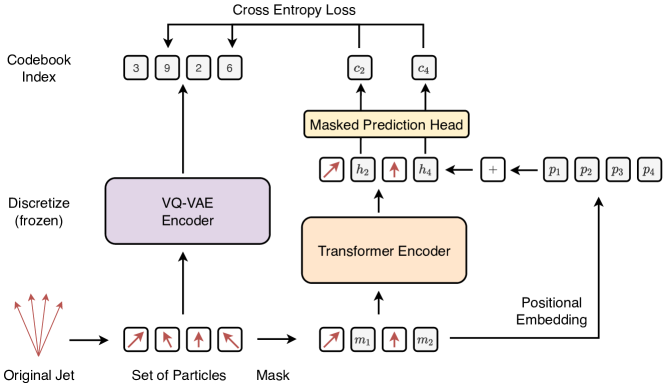
- 各ジェットを、連続的な特徴(例:運動量、エネルギー)を持つ粒子の無順序集合として表現し、事前に学習済みのベクトル量子化変分オートエンコーダー(VQ-VAE)を用いて粒子特徴を離散トークンに離散化する。
- 入力集合の一部の粒子をマスクし、トランスフォーマーに基づくエンコーダーを用いてマスクされた粒子の離散トークン識別を予測する。
- VQ-VAEから得た真値の離散コードと予測値との間の交差エントロピー損失を用いてモデルを訓練し、アーキテクチャおよびマスク戦略によって置換不変性を強制する。
- 事前学習済みのMPMバックボーンを特徴抽出器として用い、下流の分類タスクのための線形ヘッドのみを微調整する。
- 未観測のジェットタイプ(例:トップクォーク対QCDジェット)や異なるデータ分布における一般化性能を評価するため、微調整を実施する。
- ノイズのあるラベル(例:信号とバックグラウンドの混合サンプル)を用いたデータセットで学習し、純粋なテストセットでの重要度の向上を評価することで、弱教師あり設定における性能を評価する。
実験結果
リサーチクエスチョン
- RQ1NLPにおけるマスク言語モデリングに類似した形で、HEPにおける無順序かつ連続的な粒子集合にマスクモデリングを効果的に適応できるか?
- RQ2VQ-VAEによる離散化の選択とマスク戦略の選定が、素粒子物理学データにおける学習された表現の質にどのように影響するか?
- RQ3微調整に必要なデータが最小限でも、未観測のジェットタイプや新しいデータドメインにおいて、事前学習済みのMPMモデルがどの程度一般化できるか?
- RQ4混合データサンプルからのノイズのあるラベルといった弱教師あり信号を用いて、MPMベースのモデルを効果的に微調整できるか?
- RQ5実験データに直接事前学習を行うことは、シミュレーションから実データへのドメインシフト問題を軽減する上で現実的か?
主な発見
- MPMモデルは、わずかなラベル付きデータでの微調整でも、ジェット分類タスクにおいて顕著な性能向上を達成し、強力なフェイントショット転移性を示した。
- 未観測のジェットタイプに対する微調整においても、モデルは効果的に一般化され、強力なゼロショットおよびフェイントショット適応能力を示した。
- QCDとトップジェットの混合サンプルを用いた弱教師あり設定で微調整した場合、真値ラベルを訓練中に使用しなくても、学習から再スタートした場合と比較して重要度が2倍以上向上した。
- 新しいデータドメインへの転送においても、モデルは強固な性能を維持したことから、汎用的かつ転送可能な表現の学習に成功したことが示された。
- 実験データに事前学習を行い、微調整にはシミュレーションデータのみを用いた場合、ドメインシフトの問題が軽減される可能性があることが示され、より現実的で頑健な実用化への道筋が示唆された。
- VQ-VAEに基づく離散トークン化により、連続的な粒子特徴に対する効果的なマスクと予測が可能となり、NLP風のマスクモデリングとHEPデータの間のギャップを埋めることができた。
この論文を読む
Nubintのビューアで原文を開き、読みながら気になる箇所をすぐに質問できます。
Nubintでこの論文を読むこのレビューはAIが論文の原文をもとに作成しました。引用する前に原文をご確認ください。