
[論文レビュー] MathVista: Evaluating Mathematical Reasoning of Foundation Models in Visual Contexts
MathVista は、MathVista benchmarks mathematical reasoning in visual contexts across 6,141 examples from 28 existing multimodal datasets and 3 new datasets, evaluating 12 foundation models and revealing substantial gaps to human performance.
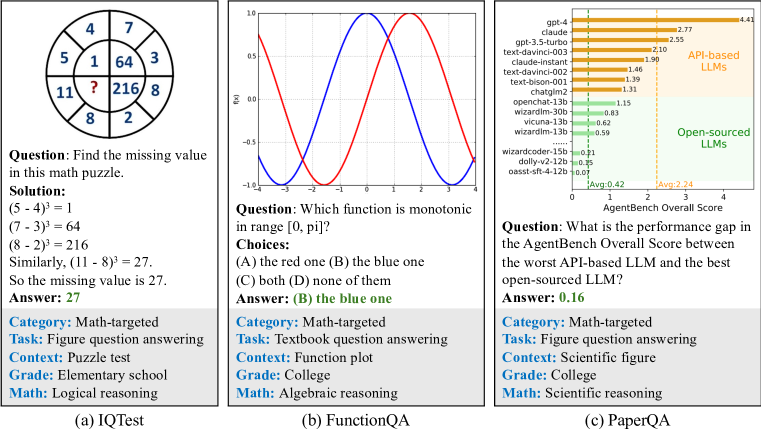
Large Language Models (LLMs) and Large Multimodal Models (LMMs) exhibit impressive problem-solving skills in many tasks and domains, but their ability in mathematical reasoning in visual contexts has not been systematically studied. To bridge this gap, we present MathVista, a benchmark designed to combine challenges from diverse mathematical and visual tasks. It consists of 6,141 examples, derived from 28 existing multimodal datasets involving mathematics and 3 newly created datasets (i.e., IQTest, FunctionQA, and PaperQA). Completing these tasks requires fine-grained, deep visual understanding and compositional reasoning, which all state-of-the-art foundation models find challenging. With MathVista, we have conducted a comprehensive, quantitative evaluation of 12 prominent foundation models. The best-performing GPT-4V model achieves an overall accuracy of 49.9%, substantially outperforming Bard, the second-best performer, by 15.1%. Our in-depth analysis reveals that the superiority of GPT-4V is mainly attributed to its enhanced visual perception and mathematical reasoning. However, GPT-4V still falls short of human performance by 10.4%, as it often struggles to understand complex figures and perform rigorous reasoning. This significant gap underscores the critical role that MathVista will play in the development of general-purpose AI agents capable of tackling mathematically intensive and visually rich real-world tasks. We further explore the new ability of self-verification, the application of self-consistency, and the interactive chatbot capabilities of GPT-4V, highlighting its promising potential for future research. The project is available at https://mathvista.github.io/.
研究の動機と目的
- Consolidate a benchmark for mathematical reasoning in visually rich contexts.
- Evaluate 12 prominent foundation models on diverse math and visual tasks.
- Create new datasets (IQTest, FunctionQA, PaperQA) to fill gaps in reasoning types.
- Provide fine-grained metadata and analyses to diagnose model strengths and failures.
提案手法
- 28 の既存のマルチモーダルデータセットに3つの新データセットを追加し、合計 6,141 の例として MathVista を組み立てる。
- 質問タイプ、回答タイプ、タスク、学年、視覚的文脈、推論スキルなどのメタデータを付与して例を注釈付けする。
- 応答生成、解答抽出、スコア計算の3段階パイプラインでモデルを評価する。
- 決定論的評価のために厳密解の正解率を用い、複数択一および自由回答の質問を評価する。
- テキストのみの LLM、視覚的ヒントを付与した A-LLM、オープンソース/独自 LMM に対して、ゼロショット・少数ショット・プロンプティング変種(CoT、PoT)を適用して比較する。
実験結果
リサーチクエスチョン
- RQ1視覚的文脈で問題が提示された場合、現代の LLM や LMM は数学的推論にどの程度対応できるか?
- RQ2MathVista のタスクにおけるテキストのみモデルとマルチモーダルモデルの相対的長所と欠点は何か?
- RQ3外部の視覚補助(キャプション、OCR)は数学推論におけるマルチモーダルモデルの性能をどの程度改善するか?
- RQ4新データセット(IQTest、FunctionQA、PaperQA)は、既存の数学または VQA ベンチマークではカバーされていないギャップを露呈させるか?
- RQ5このベンチマークにおけるモデルのパフォーマンスの上限は人間のパフォーマンスと比べてどの程度か?
主な発見
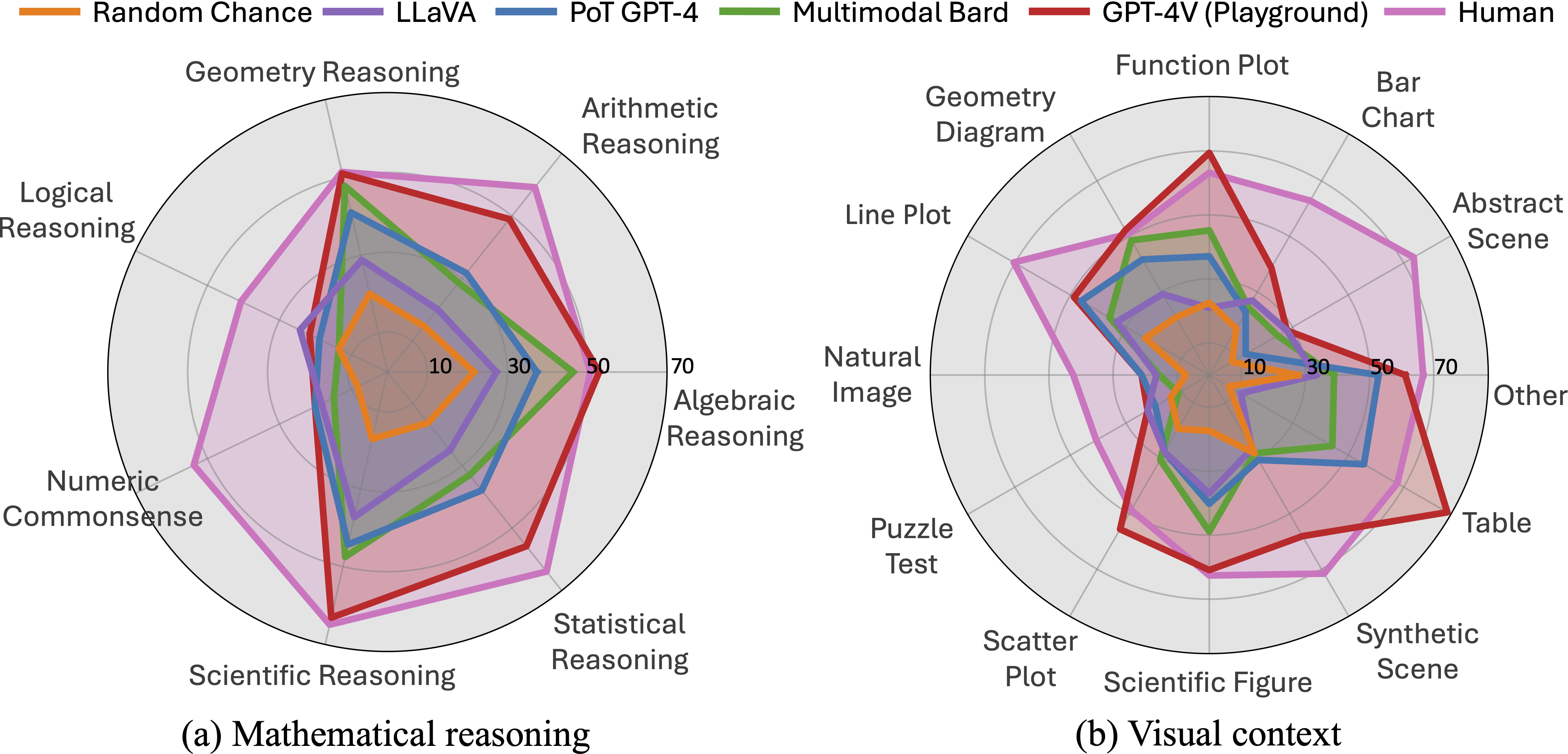
- GPT-4V は全体の正解率が最も高い 49.9% を達成するが、人間のパフォーマンスには 10.4% ポイント差で依然とどまる。
- キャプションと OCR を備えた augmented LLM は 33.9% に到達(GPT-4 with PoT)、テキストのみのベースラインに比べて限られた改善しか示さない。
- Multimodal Bard は 34.8% の正解率で、GPT-4V および人間には大きく劣る。主な幻覚と計算エラーが指摘される。
- オープンソース LMM はクローズドモデルに比べてパフォーマンスが劣り、数学的推論、OCR、チャート理解にギャップがある。
- GPT-4V は強力な視覚知覚と推論を示し、自己検証と自己整合性の能力が出現し、複数ターンの対話を可能にする。
- MathVista における人間の全体パフォーマンスは 60.3% であり、現行モデルが大学・科学レベルの視覚的数学タスクで大きなギャップを抱えることを示している。
この論文を読む
Nubintのビューアで原文を開き、読みながら気になる箇所をすぐに質問できます。
Nubintでこの論文を読むこのレビューはAIが論文の原文をもとに作成しました。引用する前に原文をご確認ください。