
[論文レビュー] Measurement-induced entanglement transitions in quantum circuits of non-interacting fermions: Born-rule versus forced measurements
論文は、非相互作用フェルミオン(Majoran鎖)のモニタリングされたガウシアン回路における Born-rule と強制測定が異なる普遍性クラスに属し、エンタングルメント遷移の臨界指数が異なることを示す。2次元の主成分チャリン非線形σモデルを用いた場の理論的理解を提供し、SO(n)×SO(n) の異なるレプリカ極限で説明される。
We address entanglement transitions in monitored random quantum circuits of non-interacting fermions, in particular, the question of whether Born-rule and forced measurements yield the same universality class. For a generic circuit with no symmetry other than fermion parity, acting on a one-dimensional Majorana chain, we numerically obtain several critical exponents, providing clear evidence that the two transitions with Born-rule and forced measurements are in different universality classes. We provide a theoretical understanding for our numerical results by identifying the underlying statistical mechanics model which follows from the general correspondence, established in Jian et al., Phys. Rev. B 106, 134206, between non-unitary circuits of non-interacting fermions and the ten-fold Altland-Zirnbauer (AZ) symmetry classes. The AZ class is the same for Born-rule and forced measurements of the circuits. For the circuit under consideration (in AZ class DIII), the statistical mechanics model describing the transition is the principal chiral non-linear sigma model whose field variable is an ${ m SO}(n)$ matrix in the replica limits $n o 0$ and $n o 1$ for forced and Born-rule measurements, respectively. The former is in an Anderson localization universality class while we show that the latter is in a novel universality class beyond Anderson localization. Both entanglement transitions are driven by proliferation of $\mathbb{Z}_2$ topological defects. The different replica limits account for the difference in the universality classes. Furthermore, we provide numerical and symmetry-based arguments that the entanglement transition in the previously-studied monitored circuit of Majorana fermions based on the loop model with crossings, a highly fine-tuned circuit, belongs to a universality class different from both transitions in the generic circuits discussed in this paper.
研究の動機と目的
- 最小対称性(フェルミオンパリティ)を持つ1Dマヨラナ鎖のモニタリングされたガウシアン回路におけるエンタングルメント遷移を調べる。
- Born-rule と forced 測定が同じ普遍性クラスを与えるかを判定する。
- AZ対称分類の下で、それぞれの遷移を記述する基礎的な統計力学モデルを同定する。
提案手法
- 最近傍二サイトゲートとS^2上の単位ベクトルでパラメータづけられたKraus演算子を用いてモニタリングされたガウシアン回路をモデル化する。
- Born-rule と forced 測定の統計を区別し、それをレプリカ極限(forced は n→0、Born-rule は n→1)と関連づける。
- フェルミオン表現を介して回路動力学をAltland–Zirnbauer DIIIクラスの静的ハミルトニアン問題へ写像する。
- エンタングルメント遷移をSO(n)×SO(n)対称性を持つ2次元の主成分チャリン非線形σモデルで記述する。
- 相関関数とマルチフラクタルスケーリングを解析して臨界指数を抽出し、普遍性クラスを区別する。
実験結果
リサーチクエスチョン
- RQ1モニタリングされた Gaussian 回路の非相互作用フェルミオンにおける Born-rule と forced 測定は、エンタングルメント遷移において同じ普遍性クラスに属するか。
- RQ2これらの遷移を記述する有効場の理論は AZ クラス DIII 内で何か。
- RQ3レプリカ極限(n→0 vs n→1)が遷移の臨界指数とマルチフラクタル特性にどう影響するか。
- RQ4Z2 トポロジー欠陥の増殖によって遷移が駆動されるのか、そしてそれがアンダーソン局在とどう比較されるか。
- RQ5Born-rule と forced 測定の遷移を、関連回路のループ模型( crossing のあるもの)と比較するとどうなるか。
主な発見
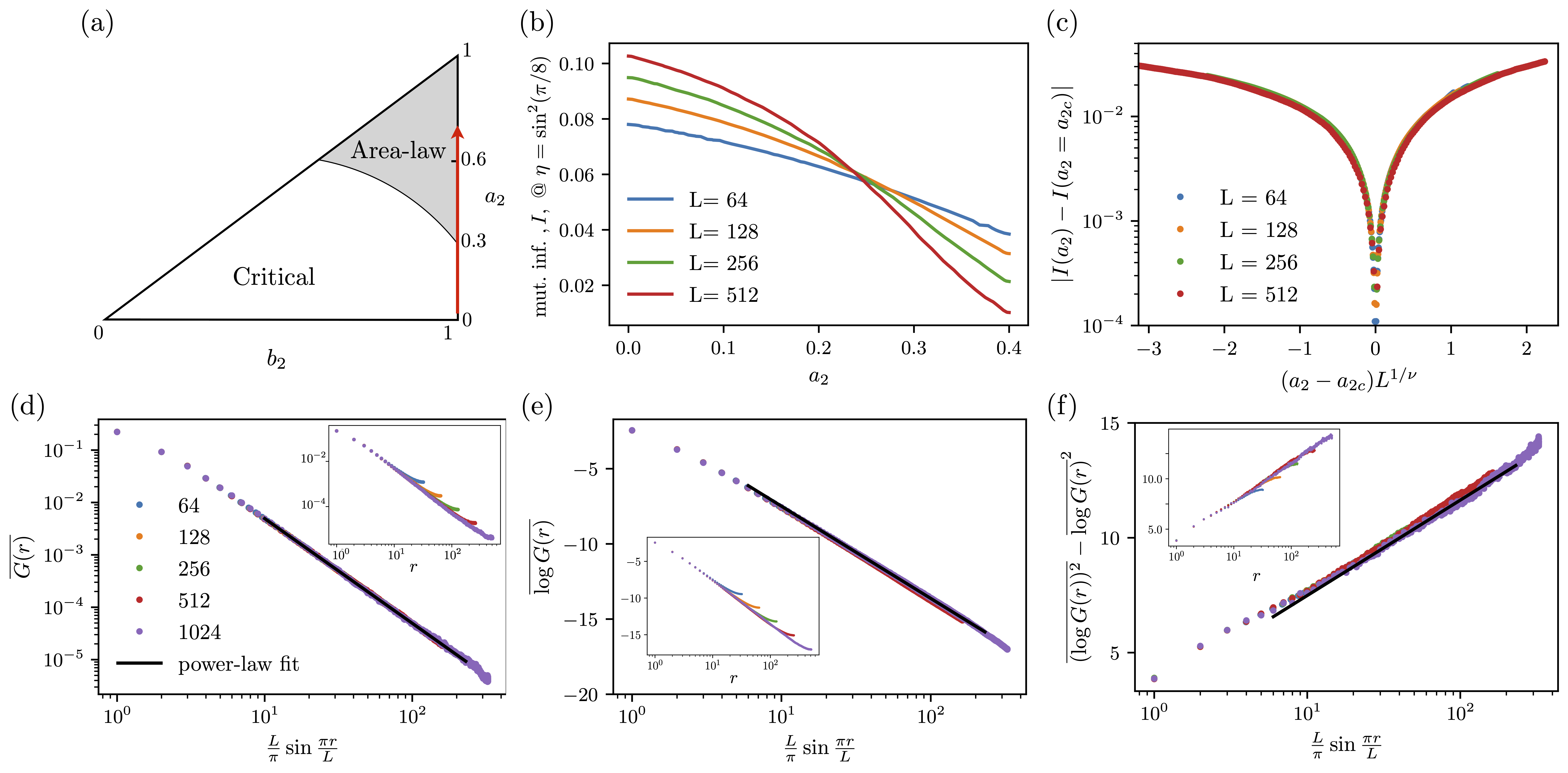
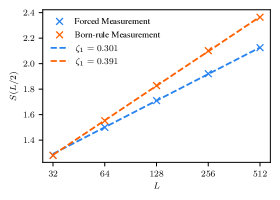
- Born-rule と forced 測定は、Majoran鎖回路におけるエンタングルメント遷移で異なる普遍性クラスを示す。
- 両遷移はSO(n)×SO(n)の主成分チャリン非線形σモデルで記述され、レプリカ極限は forced が n→0、Born-rule が n→1。
- Forced 測定は同じAZクラス内のアンダーソン局在普遍性クラスに対応する一方、Born-rule 測定はアンダーソン局在を超える新規普遍性クラスを生み出す。
- 両遷移はともにZ2 トポロジー欠陥の増殖により駆動されるが、異なるレプリカ極限のため臨界挙動が異なる。
- 数値的証拠は、両遷移の相関関数の減衰指数とマルチフラクタルスケーリングにおいて相違を示す。
この論文を読む
Nubintのビューアで原文を開き、読みながら気になる箇所をすぐに質問できます。
Nubintでこの論文を読むこのレビューはAIが論文の原文をもとに作成しました。引用する前に原文をご確認ください。