
[論文レビュー] MedAgents: Large Language Models as Collaborators for Zero-shot Medical Reasoning
本論文は、訓練を要さない多分野協働フレームワークを提案する。LLMベースの専門家が多回の議論を通じてゼロショット設定で医療の問いに取り組み、ゼロショットのベースラインを上回り、九つのデータセットで強力なfew-shot法に匹敵する。
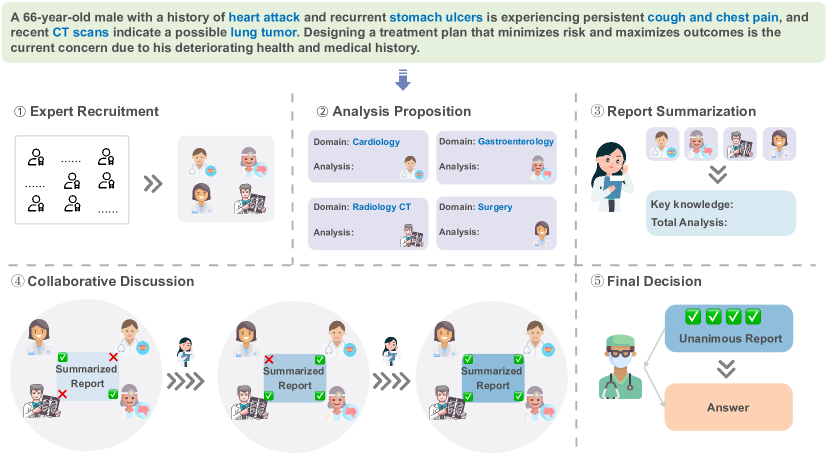
Large language models (LLMs), despite their remarkable progress across various general domains, encounter significant barriers in medicine and healthcare. This field faces unique challenges such as domain-specific terminologies and reasoning over specialized knowledge. To address these issues, we propose MedAgents, a novel multi-disciplinary collaboration framework for the medical domain. MedAgents leverages LLM-based agents in a role-playing setting that participate in a collaborative multi-round discussion, thereby enhancing LLM proficiency and reasoning capabilities. This training-free framework encompasses five critical steps: gathering domain experts, proposing individual analyses, summarising these analyses into a report, iterating over discussions until a consensus is reached, and ultimately making a decision. Our work focuses on the zero-shot setting, which is applicable in real-world scenarios. Experimental results on nine datasets (MedQA, MedMCQA, PubMedQA, and six subtasks from MMLU) establish that our proposed MedAgents framework excels at mining and harnessing the medical expertise within LLMs, as well as extending its reasoning abilities. Our code can be found at https://github.com/gersteinlab/MedAgents.
研究の動機と目的
- 医療分野の推論において、専門知識が限られており、プロンプトだけでは十分でないというギャップに対処する。
- 訓練不要で解釈可能な MC(framework) フレームワークを提案し、ロールプレイを通じてドメイン知識をLLMベースのエージェントとして具現化する。
- ゼロショット設定で九つのデータセット(MedQA、MedMCQA、PubMedQA、および六つのMMLU医療サブタスク)で有効性を示す。
- 人間による評価を通じて誤りを特徴づけ、パフォーマンスに影響する要因を理解するためのアブレーションを実施する。)
- method=[
- Five-stage Multi-disciplinary Collaboration framework: expert gathering, analysis proposition, report summarization, collaborative consultation, and decision making.
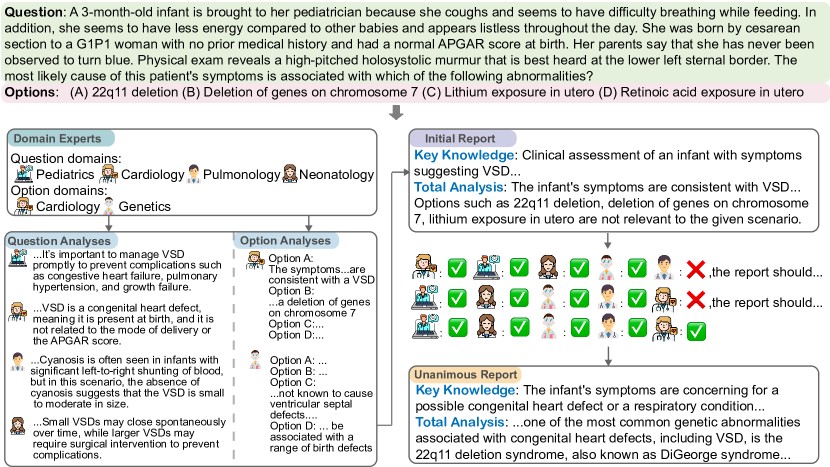
- Role-assignment prompts guide LLMs to act as domain experts for question and option analyses.
- Question analyses (qa_i) and option analyses (oa_i) are generated by LLMs acting as specialized domain experts.
- A synthesized report (Repo) is produced from analyses, followed by iterative collaborative consultations until all experts agree.
- Final decision (ans) is produced by an LLM medical decision maker based on the unanimous report.
提案手法
- Five-stage Multi-disciplinary Collaboration framework: expert gathering, analysis proposition, report summarization, collaborative consultation, and decision making.
- Role-assignment prompts guide LLMs to act as domain experts for question and option analyses.
- Question analyses (qa_i) and option analyses (oa_i) are generated by LLMs acting as specialized domain experts.
- A synthesized report (Repo) is produced from analyses, followed by iterative collaborative consultations until all experts agree.
- Final decision (ans) is produced by an LLM medical decision maker based on the unanimous report.
実験結果
リサーチクエスチョン
- RQ1多分野協働(MC)フレームワークは、多様な医療データセットにおけるゼロショットの医療推論を改善するか?
- RQ2MCは、チェーン・オブ・ソウトや自己整合性などを含む、ゼロショットおよびfew-shot promptingのベースラインとどう比較されるか?
- RQ3協業する質問ドメインエージェントの数がパフォーマンスに与える影響は何か?
- RQ4MCフレームワークにおける共通の誤りの種類は何か、そしてそれらをどう緩和できるか?
主な発見
- MCフレームワークは、九つのデータセットで全てのゼロショットベースラインを大幅に上回る。
- ゼロショット条件下で、MCは強力なfew-shot coT/self-consistencyベースラインに匹敵または上回る。
- 質問ドメインエージェントの最適数はデータセットごとに異なる(例:MedQA/MedMCQAは5、PubMedQAは4)。
- 人間の評価により、4つの誤りカテゴリが特定される:ドメイン知識の不足、誤った検索・取得、整合性エラー、CoTエラー。
- アブレーション研究は、フレームワークの有効性を明らかにし、特定された誤りタイプを緩和する方向性を示す。
この論文を読む
Nubintのビューアで原文を開き、読みながら気になる箇所をすぐに質問できます。
Nubintでこの論文を読むこのレビューはAIが論文の原文をもとに作成しました。引用する前に原文をご確認ください。