
[論文レビュー] Membership Inference Attacks on DNNs using Adversarial Perturbations
本稿では、MNIST や Fashion-MNIST といった単純なデータセットにおいて、先行研究の攻撃(LiRA や EMIA)が失敗する状況でも高い真正陽性率(TPR)を達成できる、効率的なメンバーシップ推定攻撃である AMIA および E-AMIA を提案する。1% FPR において、AMIA は両データセットで 6% の TPR を達成し、E-AMIA は Fashion-MNIST で 8%、MNIST で 4% の TPR を達成する。これは、低偽陽性率領域における既存手法を著しく上回る性能である。
Several membership inference (MI) attacks have been proposed to audit a target DNN. Given a set of subjects, MI attacks tell which subjects the target DNN has seen during training. This work focuses on the post-training MI attacks emphasizing high confidence membership detection -- True Positive Rates (TPR) at low False Positive Rates (FPR). Current works in this category -- likelihood ratio attack (LiRA) and enhanced MI attack (EMIA) -- only perform well on complex datasets (e.g., CIFAR-10 and Imagenet) where the target DNN overfits its train set, but perform poorly on simpler datasets (0% TPR by both attacks on Fashion-MNIST, 2% and 0% TPR respectively by LiRA and EMIA on MNIST at 1% FPR). To address this, firstly, we unify current MI attacks by presenting a framework divided into three stages -- preparation, indication and decision. Secondly, we utilize the framework to propose two novel attacks: (1) Adversarial Membership Inference Attack (AMIA) efficiently utilizes the membership and the non-membership information of the subjects while adversarially minimizing a novel loss function, achieving 6% TPR on both Fashion-MNIST and MNIST datasets; and (2) Enhanced AMIA (E-AMIA) combines EMIA and AMIA to achieve 8% and 4% TPRs on Fashion-MNIST and MNIST datasets respectively, at 1% FPR. Thirdly, we introduce two novel augmented indicators that positively leverage the loss information in the Gaussian neighborhood of a subject. This improves TPR of all four attacks on average by 2.5% and 0.25% respectively on Fashion-MNIST and MNIST datasets at 1% FPR. Finally, we propose simple, yet novel, evaluation metric, the running TPR average (RTA) at a given FPR, that better distinguishes different MI attacks in the low FPR region. We also show that AMIA and E-AMIA are more transferable to the unknown DNNs (other than the target DNN) and are more robust to DP-SGD training as compared to LiRA and EMIA.
研究の動機と目的
- MNIST や Fashion-MNIST といった単純なデータセットにおいて、モデルが過学習しない状況でも、先行研究のメンバーシップ推定攻撃(LiRA や EMIA)が著しく性能を発揮しない問題を解決すること。
- 訓練対象の被験者に関するメンバーシップ情報と非メンバーシップ情報を効果的に活用できる、計算的に効率的な攻撃を構築すること。
- 高信頼性のメンバーシップ推定が求められる低偽陽性率(FPR)領域における検出精度を向上させること。
- DP-SGD などのプライバシー保護型学習手法に対して、攻撃の転送性と耐性を強化すること。
- 準備、指標、意思決定の各段階を統合したフレームワークを通じて、メンバーシップ推定攻撃の分析と改善を統一的に実現すること。
提案手法
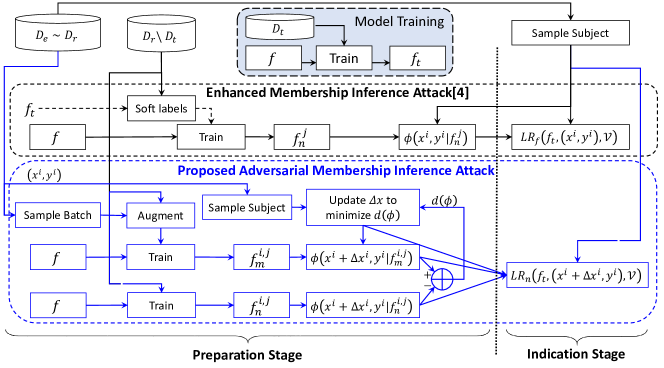
- 準備(シャドウモデルの訓練)、指標(損失に基づく特徴抽出)、意思決定(メンバーシップ分類)の3段階からなる統一的なフレームワークを提案。
- 被験者バッチ上でシャドウ DNN を訓練し、被験者周辺の局所的な損失関数の形状を活用する、新たなアドバルス損失関数を最小化することで、アドバルス攻撃を実現する。
- メンバーシップを持つ被験者における損失を最小化すると同時に、非メンバーシップを持つ被験者における損失を最大化する新たな損失関数を設計し、メンバーシップの識別能を向上させる。
- EMIA のソフトラベル利用法と AMIA のアドバルス損失最適化を統合することで、攻撃性能を向上させた、拡張版の AMIA(E-AMIA)を構築。
- ガウス近傍損失情報を統合した2つの拡張指標を導入し、1% FPR における TPR を Fashion-MNIST で 2.5%、MNIST で 0.25% 向上させる。
- 特に高信頼性の推定に適した低 FPR 領域での性能評価を可能にする新しい評価指標「Running TPR Average(RTA)」を提案。
実験結果
リサーチクエスチョン
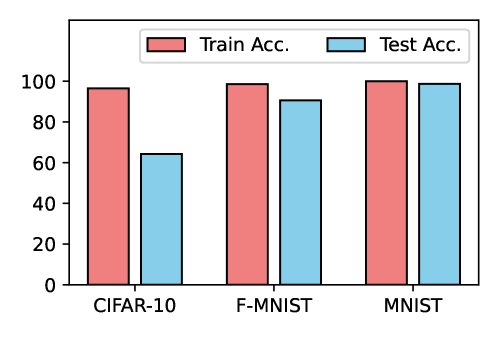
- RQ1CIFAR-10 や ImageNet といった複雑なデータセットでは有効であるものの、MNIST や Fashion-MNIST といった単純なデータセットでは、LiRA や EMIA といった既存のメンバーシップ推定攻撃がなぜ失敗するのか。
- RQ2メンバーシップと非メンバーシップ両方の情報を有効に活用することで、過学習を示さない well-trained な DNN に対しても、メンバーシップ推定攻撃をより効果的にできるか。
- RQ3アドバルス摂動と局所的な損失関数の形状情報を組み込むことで、低 FPR 領域におけるメンバーシップ推定性能がどのように向上するか。
- RQ4AMIA や E-AMIA は、LiRA や EMIA よりも未知の DNN に対してどれほど高い転送性を示すか。
- RQ5DP-SGD というプライバシー保護型学習手法で訓練された DNN に対して、AMIA や E-AMIA は標準的な L2 正則化モデルと比較して、どの程度優れた性能を発揮するか。
主な発見
- 1% FPR において、AMIA は Fashion-MNIST および MNIST の両方で 6% の TPR を達成し、これらのデータセットでは LiRA(0% TPR)と EMIA(それぞれ 0% および 2% TPR)を著しく上回る性能を示す。
- E-AMIA は 1% FPR において Fashion-MNIST で 8%、MNIST で 4% の TPR を達成し、LiRA や EMIA と比較して低 FPR 領域での性能が顕著に優れている。
- 提案された拡張指標により、1% FPR における TPR が Fashion-MNIST で 2.5%、MNIST で 0.25% 向上し、近傍損失情報の統合による利点が明確に示された。
- AMIA と E-AMIA は LiRA や EMIA よりも未知の DNN に対して高い転送性を示し、特に AMIA は異なるアーキテクチャ間で最も高い転送性を示した。
- AMIA と E-AMIA は、DP-SGD で訓練された DNN に対して、LiRA や EMIA よりも著しく効果的に機能し、微分プライバシー防御に対して強い耐性を示した。
- 提案された Running TPR Average(RTA)指標は、低 FPR 領域における攻撃性能の差をより的確に区別でき、標準的な TPR-FPR 曲線に比べてより洗練された評価を可能にした。
この論文を読む
Nubintのビューアで原文を開き、読みながら気になる箇所をすぐに質問できます。
Nubintでこの論文を読むこのレビューはAIが論文の原文をもとに作成しました。引用する前に原文をご確認ください。