
[論文レビュー] MGMAE: Motion Guided Masking for Video Masked Autoencoding
MGMAEは、時間的に一貫性のあるマスキングボリュームを作成するために光学フローを活用するモーションガイドドマスキング戦略を、動画マスキング自己符号化に導入する。これにより情報漏洩が軽減され、再構築の難易度が向上する。その結果、自己教師付き動画表現学習が向上し、Something-Something V2(72.3%の正確度)で最先端の性能を達成するとともに、Kinetics-400でも長時間の事前学習において一貫した向上を示す。
Masked autoencoding has shown excellent performance on self-supervised video representation learning. Temporal redundancy has led to a high masking ratio and customized masking strategy in VideoMAE. In this paper, we aim to further improve the performance of video masked autoencoding by introducing a motion guided masking strategy. Our key insight is that motion is a general and unique prior in video, which should be taken into account during masked pre-training. Our motion guided masking explicitly incorporates motion information to build temporal consistent masking volume. Based on this masking volume, we can track the unmasked tokens in time and sample a set of temporal consistent cubes from videos. These temporal aligned unmasked tokens will further relieve the information leakage issue in time and encourage the MGMAE to learn more useful structure information. We implement our MGMAE with an online efficient optical flow estimator and backward masking map warping strategy. We perform experiments on the datasets of Something-Something V2 and Kinetics-400, demonstrating the superior performance of our MGMAE to the original VideoMAE. In addition, we provide the visualization analysis to illustrate that our MGMAE can sample temporal consistent cubes in a motion-adaptive manner for more effective video pre-training.
研究の動機と目的
- フレーム間で一貫性のないマスキングが原因で生じる動画マスキング自己符号化における情報漏洩を是正すること。
- マスキングの過程で運動情報を事前知識として組み込むことで、自己教師付き動画表現学習を向上させること。
- 再構築の難易度を高め、動画の構造的特徴を学習するのを促進する、動的な運動適応型マスキング戦略を設計すること。
- より良いマスキング設計により過学習のリスクを低減することで、より長期間かつ効果的な事前学習を可能にすること。
提案手法
- 隣接フレーム間の運動を捉えるオンラインで軽量な光学フロー推定器(RAFT)を導入し、マスキングをガイドする。
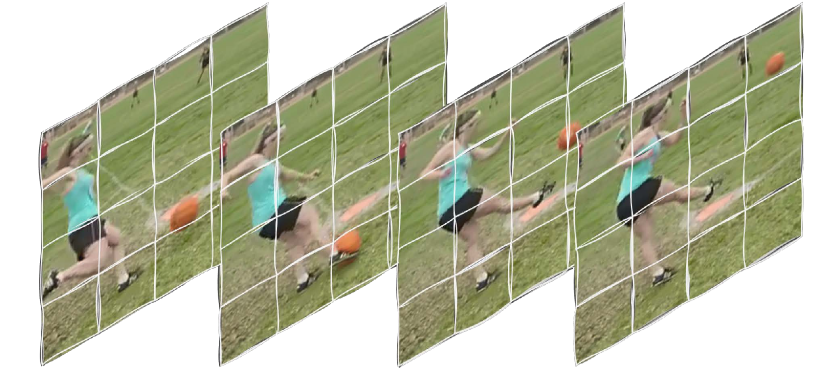
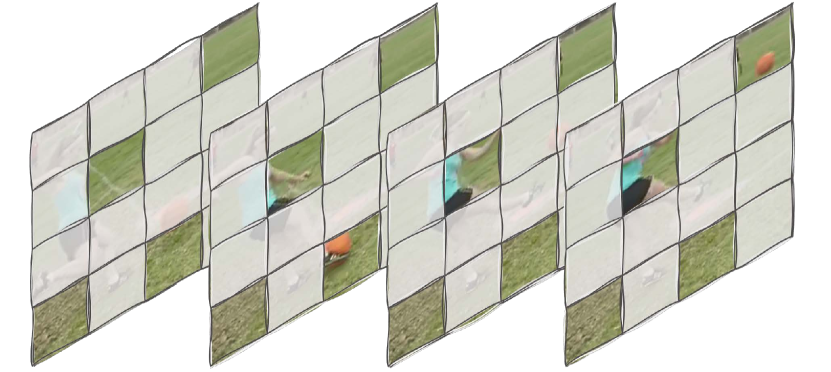
- 基本フレームで初期のランダムマスキングマップを生成し、推定された光学フローを用いて前向きおよび後向きにワープすることで、時間的に一貫性のあるマスキングボリュームを構築する。
- 各フレームごとに、運動ワープによる一貫性のあるマスキングボリュームに基づき、トップ-kトークン選択を実行し、自己符号化に使用する可視トークンをサンプリングする。
- 時間的・空間的整合性を保持するため、バックワーディングを用いて動画MAEフレームワークにモーションガイドドマスキングを統合する。
- 得られたマスキングトークンを用いて、ビジョンTransformerバックボーンを搭載した標準的なマスキング自己符号化訓練を実行する。
- 再構築の難易度を高めることで、モデルがより強固で一般化可能な動画表現を学習するよう促進する。
実験結果
リサーチクエスチョン
- RQ1運動情報は、動画マスキング自己符号化における時間的整合性の向上に効果的に活用できるか?
- RQ2ランダムマスキングやチューブマスキングと比較して、モーションガイドドマスキングはフレーム間の情報漏洩を低減するか?
- RQ3運動適応型マスキング戦略は、より優れた自己教師付き動画表現学習を実現できるか?
- RQ4モーションガイドドマスキングは、事前学習の安定性および長時間のトレーニングスケジュールの実現可能性にどのように影響するか?
- RQ5MGMAEの性能向上は、動き中心とシーン中心の動画ベンチマークの両方で一貫しているか?
主な発見
- MGMAEは2400エポックでSomething-Something V2で72.3%のトップ-1正確度を達成し、VideoMAEを1.5%上回った。
- Kinetics-400では1600エポックで81.8%の正確度を達成し、VideoMAEの81.5%をわずかに上回った。
- MGMAEの事前学習損失は、常にVideoMAEより0.05高いことから、再構築タスクがより困難であることが示された。
- SSV2では800エポックで1.4%、2400エポックで1.5%の性能ギャップを維持し、持続的な向上が確認された。
- 可視化結果から、MGMAEのマスクマップが物体の動きに適応しており、より複雑でダイナミックな再構築の課題を生み出していることがわかった。
- モーションガイドド戦略により過学習のリスクが低減され、より長期間の事前学習が可能となり、下流タスクの性能が向上した。
より良い研究を、今すぐ始めましょう
論文の読解から最終レビューまで、研究時間を劇的に削減しましょう。
クレジットカード登録不要
このレビューはAIが作成し、人間の編集者が確認しました。